Every treatment method has the same blind spot. Boiling, filtering and chemical tablets all deal with living organisms and none of them deal with dissolved chemicals. Some sources are therefore untreatable with field equipment, and recognising them is the more important skill.
Why can chemicals not be treated out?
Because they are dissolved rather than suspended. A filter traps particles larger than its pores, and a dissolved metal ion or pesticide molecule is orders of magnitude smaller. Chemical disinfectants attack biological structures and leave inorganic contaminants untouched. Boiling actively makes matters worse, since water evaporates while the contaminant does not, concentrating whatever remains. Only distillation or reverse osmosis address dissolved chemistry, and neither is realistically portable in an emergency.
What are the visual warning signs?
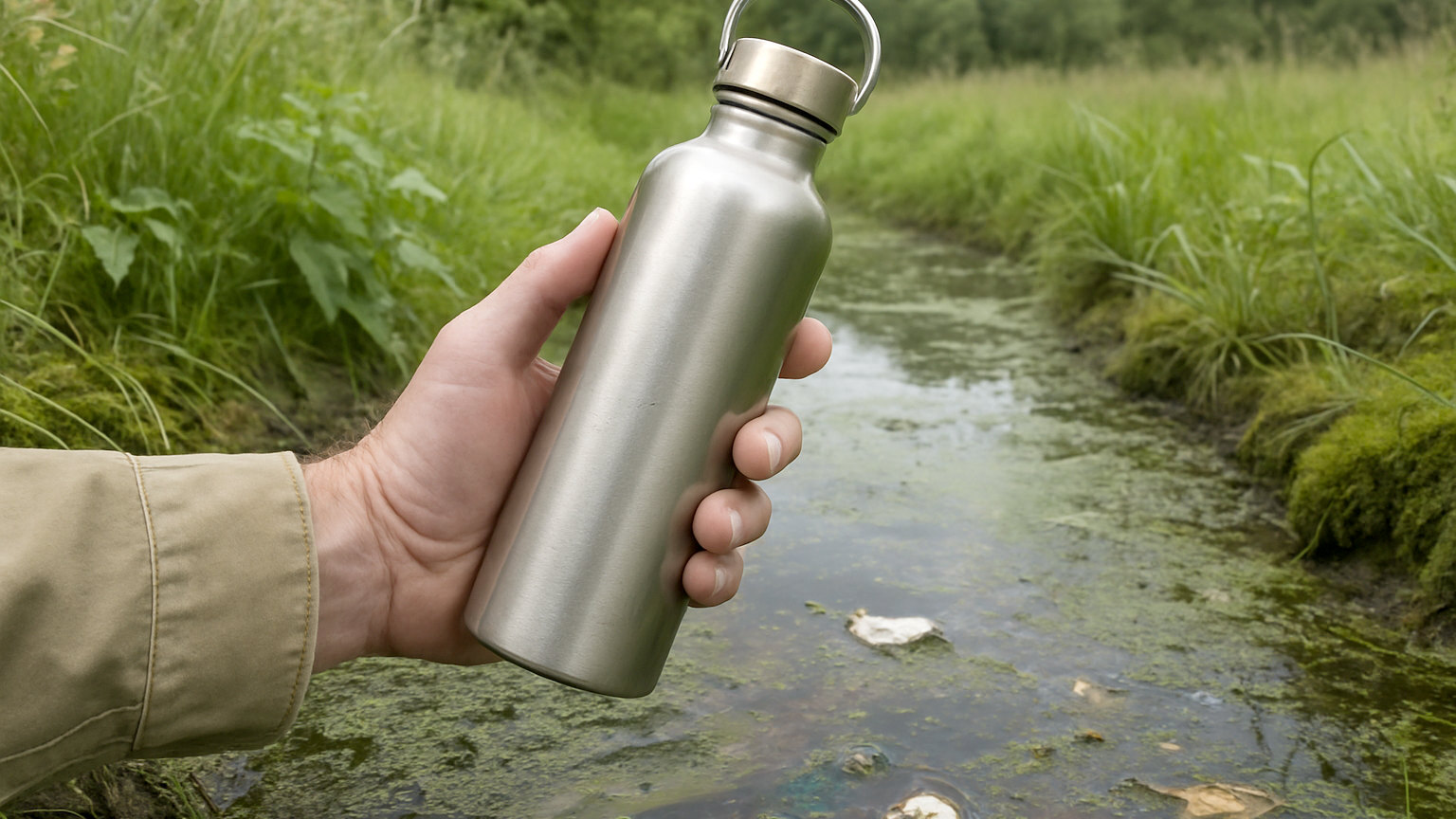
An oily or rainbow sheen on the surface suggests hydrocarbons. Unusual colouration, particularly orange, rust red or milky blue, often indicates metal contamination or mine drainage. Persistent foam that is not simply agitation from a waterfall can indicate detergents or industrial discharge. A strong chemical, sulphurous or sewage smell is self explanatory. Most telling of all is an absence of life: healthy fresh water contains visible invertebrates, algae and plants, and water that is conspicuously sterile is usually sterile for a reason.
- Oily sheen, unusual colour, foam or strong chemical smell
- Orange or rust staining on the bed, typical of mine drainage
- No visible plant, insect or invertebrate life at all
- Standing water in industrial, landfill or intensive agricultural areas
- Blue green algal blooms, which produce toxins boiling does not destroy
- Flood water, which mixes sewage, fuel and chemicals unpredictably
Why is mine drainage such a problem in Britain?
Because the legacy is extensive and largely unmarked. Former metal mining districts in mid Wales, the Pennines, the Lake District, Cornwall and parts of Scotland have watercourses carrying elevated lead, zinc, cadmium and arsenic leaching from spoil heaps and drainage adits. The characteristic sign is ochre staining on the stream bed and stunted or absent bankside vegetation. These metals accumulate in the body and no field treatment removes them, so the only correct response is to find another source.
What is the risk from algal blooms?
Blue green algae, properly cyanobacteria, form dense blooms in warm nutrient rich still water, appearing as green or blue green scum, paint like streaks or pea soup discolouration. They produce toxins affecting the liver and nervous system, and those toxins are not destroyed by boiling and are not removed by ordinary filters. Blooms are increasingly common in British lakes and slow rivers during warm spells, and they are frequently fatal to dogs that drink from affected water. Avoid entirely, including for washing.
Why is flood water uniquely dangerous?
Because it is a mixture and you cannot know the proportions. Floods overwhelm sewers, flush agricultural slurry and pesticides off fields, wash out fuel tanks and garages, and mobilise whatever was stored at ground level across a wide area. It routinely contains sewage, hydrocarbons, farm chemicals and leptospira from rodent urine simultaneously. Treat flood water as undrinkable regardless of what equipment you have, and wash thoroughly after any contact with it.
What should you do when every nearby source is suspect?
Widen the search rather than compromise. Look uphill and upstream of the contamination, seek springs emerging from rock, collect rain directly, or collect dew from vegetation with a cloth at dawn. In genuine extremity, distillation over a fire is the only method that separates water from dissolved contaminants, and it is worth the fuel when the alternative is drinking something toxic.
How do you assess a suspect source?
Work outward from the water itself. Look upstream for the obvious first: outfall pipes, spoil heaps, farm buildings, silage clamps, landfill and roads. Check the bank vegetation, since a healthy margin of reeds, grasses and mosses suggests water that supports life, while bare or blackened banks suggest otherwise. Turn over a stone in the shallows and look for freshwater shrimp, caddis larvae and mayfly nymphs, all of which are intolerant of pollution and are used by the Environment Agency as biological indicators. Abundant invertebrate life is a genuinely useful sign.
Treatment answers biology. Source selection answers chemistry, and it is the decision that treatment cannot rescue you from.