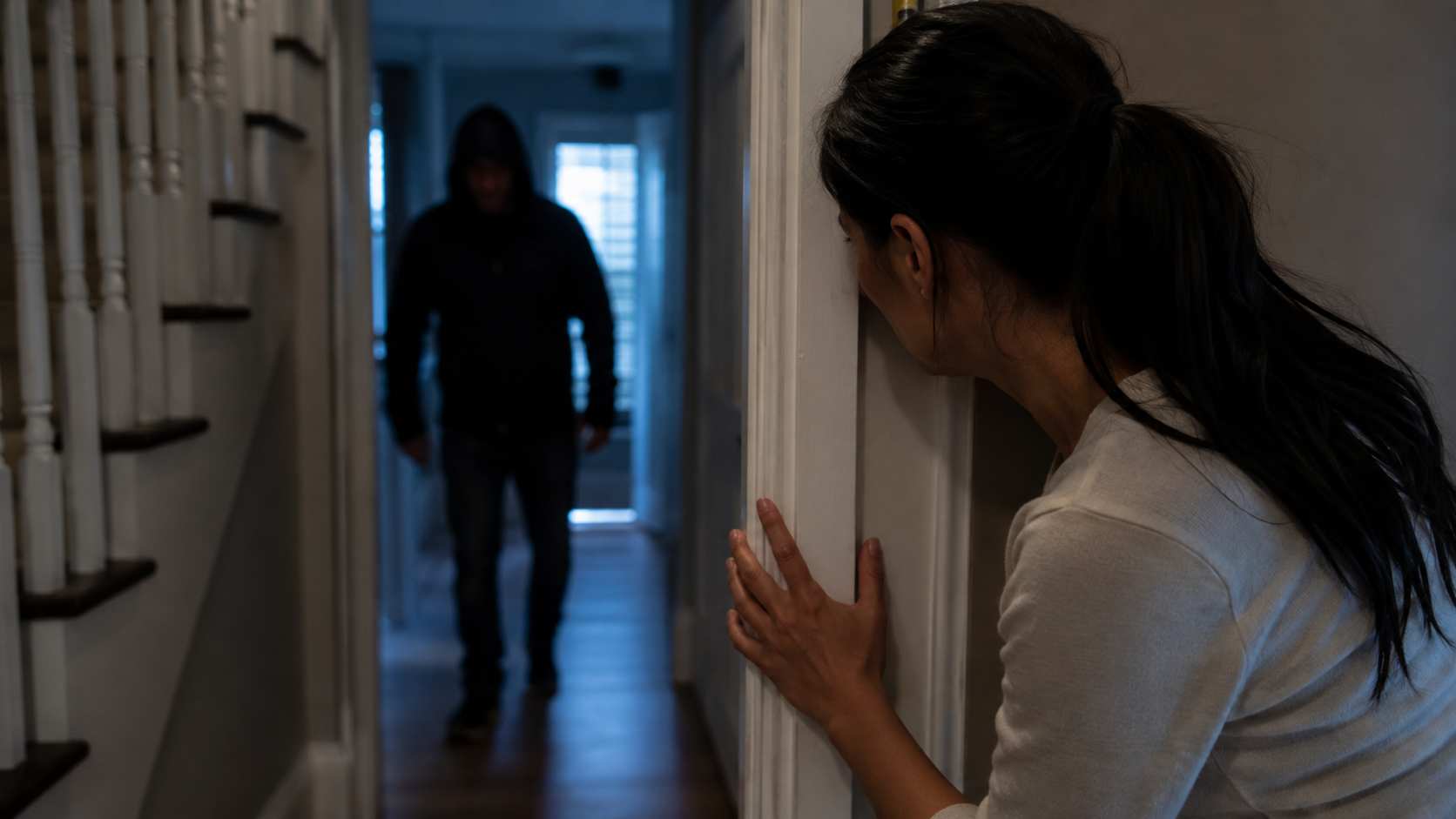
The overwhelming majority of burglars want an empty house and will leave immediately if they realise someone is in. That fact shapes the sensible response, which is to make your presence known from a position of safety rather than to investigate.
What should you do first?
Get yourself and anyone else to a safe part of the house, ideally a room with a door you can secure and a phone. Then call 999. Do not go downstairs to look, do not go outside, and do not attempt to detain anyone. The priority is people rather than property, and property is insured while people are not.
Should you make noise?
Yes, once you are somewhere safe. Turning on lights, talking loudly or setting off an alarm signals occupancy and almost always causes an intruder to leave. This is preferable to remaining silent and hoping, because a silent house may be searched room by room. Make the noise from a position you would not have to defend rather than from the top of the stairs.
- Move to a safe room with a door and a phone
- Call 999 and say an intruder is in the house
- Turn on lights and make noise from a position of safety
- Do not confront, chase or attempt to detain anyone
- If you cannot speak, use the Silent Solution system
- Stay on the line and follow the operator instructions
What if you cannot speak safely?
Call 999 anyway and use Silent Solution. Listen to the operator, and when prompted by an automated message, press 55. This signals a genuine emergency where speaking is not possible and passes the call to police. Coughing or tapping the handset also indicates a live line. This does not work from landlines, so a mobile is preferable if you have a choice.
Should you leave the house?
Only if you can do so safely and without passing the intruder. If you are on the ground floor near an exit and the intruder is elsewhere, leaving and calling from a neighbour is a good option. If leaving would mean moving toward them, stay put and secure the room instead. Never leave a child or a vulnerable person behind to get out yourself.
What if you disturb someone face to face?
Back away, create distance and get to safety. Do not block their exit, since an offender who feels cornered is far more likely to become violent. Most want to leave and will do so if given a clear route. Try to note height, build, clothing and any vehicle, which is useful later, and do not pursue them out of the house.
What about the following morning?
Do not tidy up. Touching surfaces, closing windows or clearing broken glass destroys forensic evidence and complicates the investigation. Call 999 if the offender may still be nearby or anyone is hurt, and 101 otherwise. Take photographs before anything is moved, and wait for advice on what can be cleaned.
How do you reduce the chance of a night intrusion?
By locking internal routes as well as external ones. Lock the door between an integral garage and the house. Lock upstairs doors at night if you have a reason to. Keep car keys away from the front door and out of sight, since many night burglaries are specifically for vehicles and involve fishing keys through a letterbox. A key safe or a drawer well away from the door removes that entirely.
What support exists afterwards?
More than people realise. The police will issue a crime reference number, and Victim Support offers free confidential help regardless of whether the crime was reported. Being burgled affects people more than they expect, including those who describe it as only property, and taking up that support is entirely reasonable.
Should you agree a plan in advance?
Briefly, yes, in the same way as a fire escape plan. Agree which room the household would gather in, that everyone stays there, that one person calls 999 while another keeps children calm, and that nobody goes downstairs to investigate. Children should know to come to that room rather than hide or go looking for a parent. Five minutes of discussion removes the paralysis and the improvisation that otherwise happen at two in the morning.
Get to safety, call 999, make noise from where you are, and let them leave rather than meeting them.