A person in the water becomes almost impossible to see within a very short distance, which is why every man overboard procedure begins with the same three actions in the same order.
What are the immediate actions?
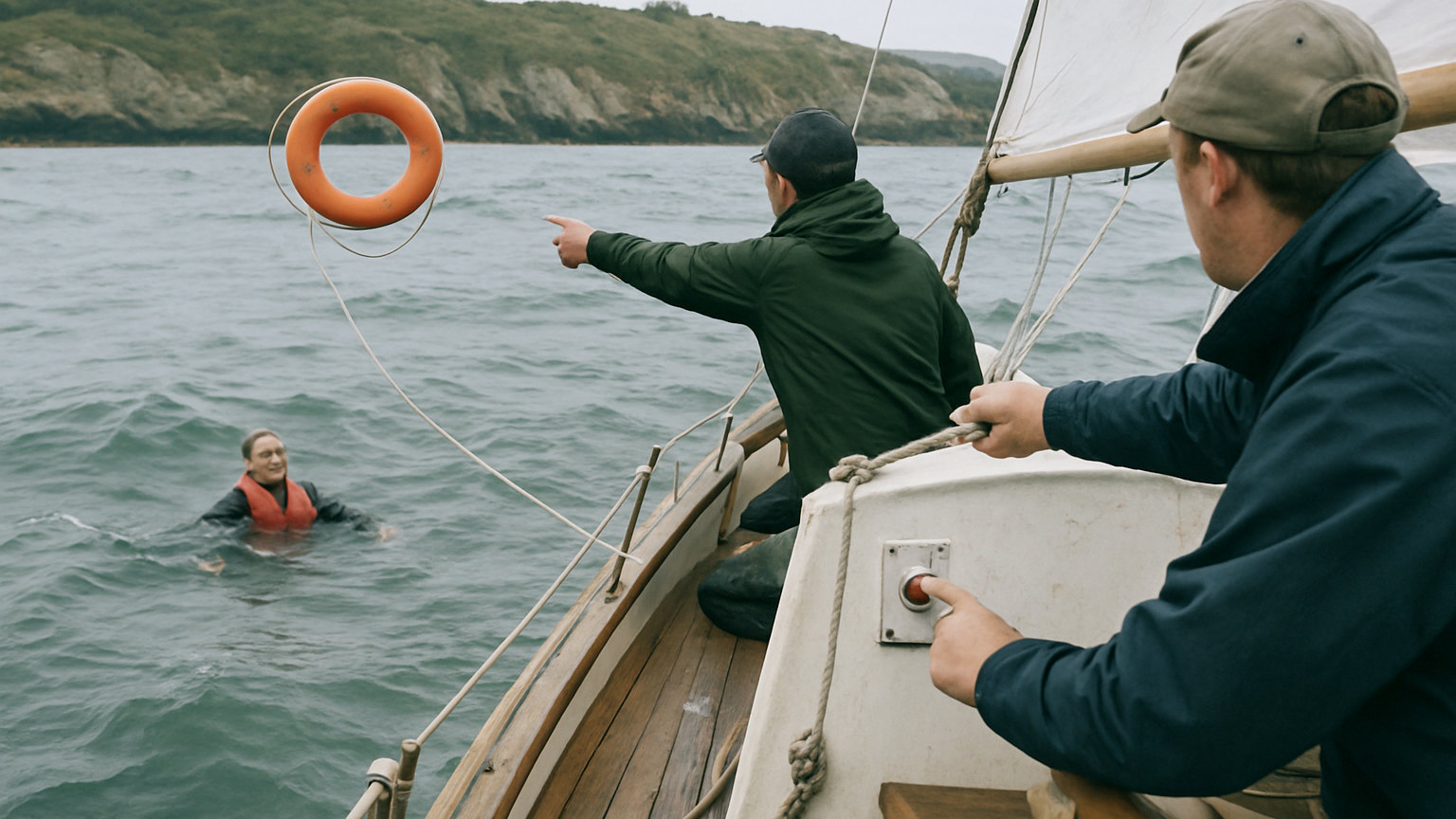
Shout, so everyone on board knows. Point, and keep pointing, which means one person does nothing except watch the casualty. Throw something buoyant immediately, both to help them and to mark the position. And press the man overboard button on the chart plotter or GPS, which records the position.
Why does one person just point?
Because a head in even a modest sea disappears within seconds and is extremely difficult to relocate. Assigning one person to maintain continuous visual contact, doing nothing else at all, is the single most important part of the procedure. That person points and calls the bearing and does not help with anything else.
- Shout so the whole crew knows immediately
- Assign one person to point and watch, doing nothing else
- Throw a lifebuoy or danbuoy at once, even if it is not close
- Press the man overboard button to record the position
- Make a mayday or DSC alert without delay
- Practise the whole drill before you need it
Why throw something even if it will not reach?
Because it marks the position and gives searchers a reference. A danbuoy with a flag is visible far further than a person, and a lifebuoy floating on the surface gives the helm something to steer back to. It also gives the person in the water something to aim for and something visible to hold.
Should you call for help immediately?
Yes, straight away rather than after attempting recovery. A DSC distress alert and a mayday take seconds and can be cancelled if you recover the person quickly. Waiting to see whether you can manage alone wastes the time that other vessels and the coastguard would use to reach you, and recovery frequently proves harder than expected.
How do you get back to them?
By a practised manoeuvre appropriate to the boat, whether that is an immediate crash stop and turn under power, or a recognised sailing manoeuvre to return along a reciprocal course. What matters is that the crew has practised it and that it is executed without discussion. Approaching from downwind and stopping alongside is the usual aim.
Why is recovery so difficult?
Because a cold person in the water is heavy, cannot help themselves, and a boat has high topsides. Even fit crew struggle to lift someone aboard by hand, particularly in a sea. Recovery equipment such as a lifting sling, a ladder, a boarding platform or a halyard and winch should be identified and practised, not improvised.
What about lifting them horizontally?
It matters, and it is not always achievable. Someone who has been in cold water can deteriorate on being lifted vertically, because of the sudden change in circulation after prolonged immersion. Where possible, lift them horizontally and keep them lying down afterwards. Where it is not possible, getting them out quickly still takes priority.
How do you prevent it entirely?
Clip on. A harness and a tether attached to jackstays keeps you on the boat, which is far better than any recovery procedure. Wear it at night, in rough weather and when alone on deck. Most man overboard incidents involve someone who was not attached and did not expect to need to be.
What if you are single handed?
The situation is close to unrecoverable, which is why prevention matters so much for solo sailors. Nobody can point, nobody can steer back and nobody can lift you aboard. A harness and tether attached at all times, a trailing line, an engine kill cord and a personal AIS beacon are what single handed sailors rely on, and none of them substitute for staying attached.
Shout, point, throw and press, send a distress alert at once, practise the recovery manoeuvre, and clip on so it does not happen at all.