
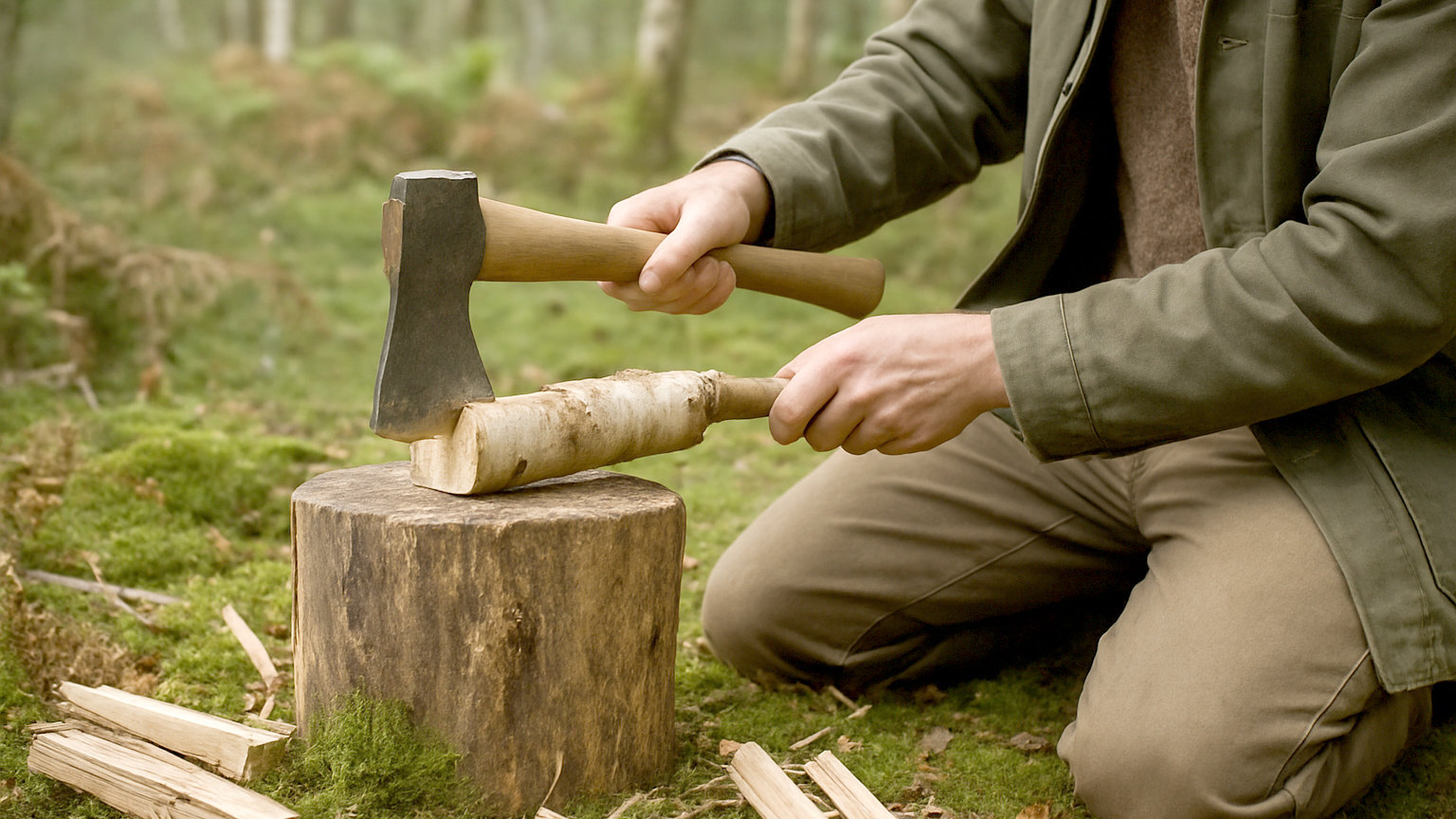
An axe is the most dangerous tool in bushcraft and the one most people are least trained on. The injuries are infrequent, severe and almost entirely preventable by position.
What is the central rule?
Nothing of yours should be where the axe goes if you miss. A missed or glancing strike continues on its arc, and a standing person swinging downward has their shin, foot and knee directly on that line. Kneeling or using a block that puts the work well away from your body removes it. This single change prevents the majority of serious axe injuries.
Why kneel?
Because it shortens the arc and puts your legs out of the path. Kneeling to work means a missed strike hits the ground rather than your leg, and it lowers your centre of gravity, improving control. It feels awkward at first and is standard practice among people who use axes regularly. Where kneeling is impractical, use a block that keeps the work at a safe distance.
- Kneel or use a block so a miss cannot reach your legs
- Check overhead for branches before swinging
- Keep everyone well outside your working area
- Split on a solid block, never on the ground or a rock
- Check the head is tight before every session
- Sheathe it and carry it at your side, head down
What should you check before use?
The head, the handle and the surroundings. A loose head can fly off, so check for movement and listen for a dull sound when tapped. Inspect the handle for cracks, particularly behind the head where overstrikes damage it. Look overhead for dead branches, and clear the area around you of anything that could deflect the axe or trip you.
How do you split safely?
On a solid block, with the piece stood upright, striking through the centre. Never split on the ground, on a rock or on soft earth, all of which deflect the edge or damage it. For awkward pieces, the technique of holding the axe and the piece together and bringing both down onto the block keeps your hands clear of the strike entirely.
What about limbing and felling?
Felling standing trees is a different discipline requiring training, and you almost certainly do not have permission to do it anyway. For limbing fallen wood, always work with the trunk between you and the axe, cutting on the far side, so a glance goes away from you. Watch for branches under tension, which spring violently when cut.
How should you carry it?
Sheathed, in one hand, at your side, with the head down and the edge facing away from your leg. Never carry it over a shoulder, on the outside of a pack where it can catch, or in your hand while scrambling. If you fall while carrying an axe, throw it clear rather than trying to keep hold of it.
Do you actually need one?
Frequently not. A folding saw does most camp wood processing faster, more safely and with far less effort, and a knife with a baton splits what a saw has cut. An axe earns its place for larger volumes of wood, for hewing and for longer stays, and for a day out or a weekend it is often weight you do not need.
How do you learn properly?
From an instructor, watching you. Axe technique is difficult to self correct because the errors are in body position rather than in the swing, and reading about kneeling is not the same as being told your left knee is in the arc. This is the tool where a day of proper instruction has the highest return of anything in bushcraft.
What size axe should you have?
Smaller than most people buy. A small forest axe with a handle of around sixty centimetres handles the great majority of camp work and is manageable one handed or two. Hatchets with very short handles are more dangerous, since a miss has a much shorter distance to travel before reaching your leg. Large felling axes are for felling, which you are unlikely to be doing.
Kneel or use a block, check the head and overhead, split on solid wood, carry it sheathed and head down, and get taught rather than working it out.


