Manufacturers use both words loosely, but there is a real technical distinction with practical consequences. Buying the wrong one for where you are going is a common and avoidable mistake.
What does a filter actually do?
A filter is a physical barrier with pores of a defined size. Anything larger than the pores is trapped. Most backpacking filters use hollow fibre membranes with a pore size around zero point one to zero point two microns, which is small enough to block protozoa such as giardia and cryptosporidium, and bacteria such as E. coli and campylobacter. It is not small enough to block viruses, which are typically zero point zero two to zero point three microns and pass straight through.
So what makes something a purifier?
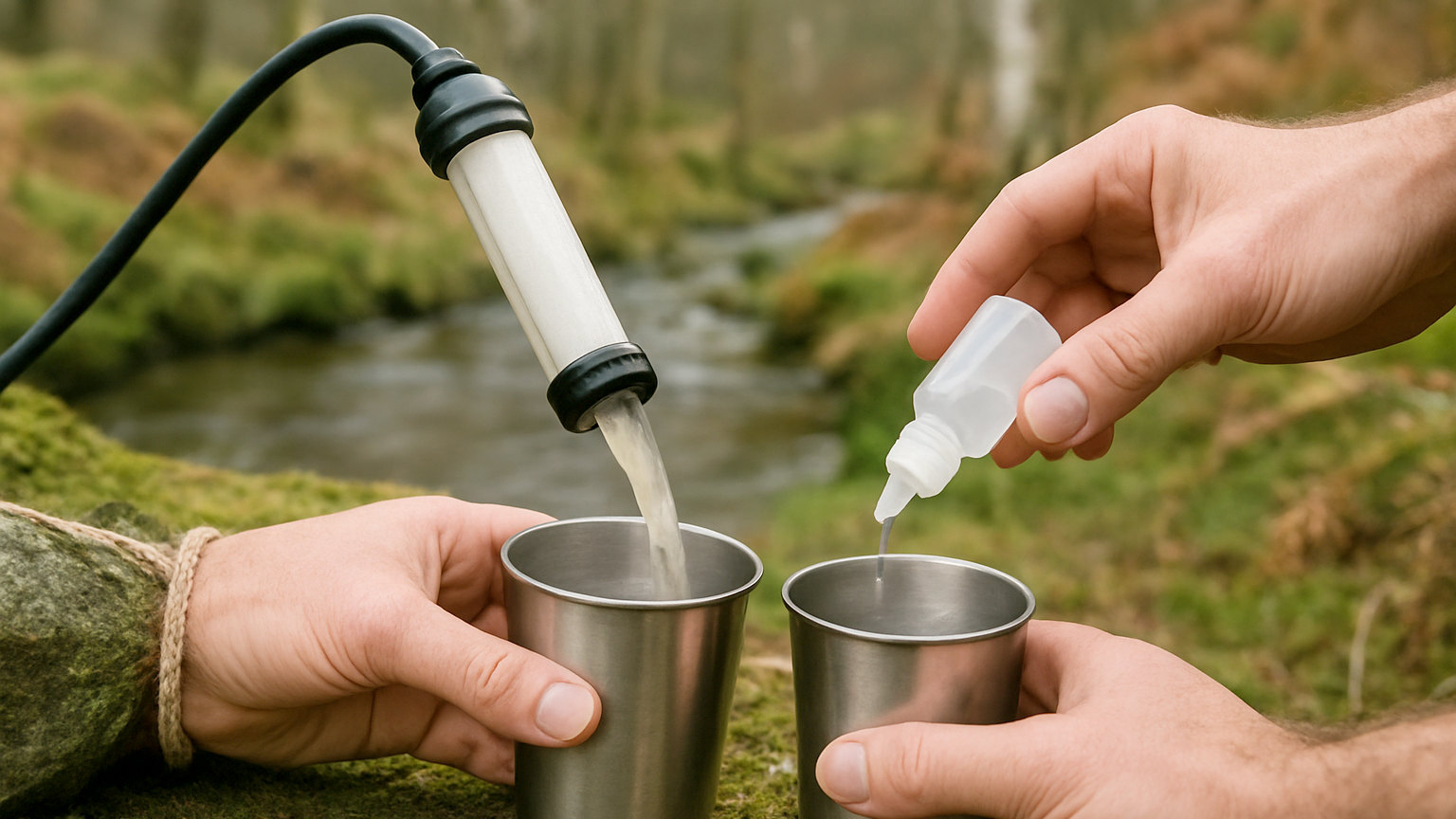
A purifier addresses viruses as well. It does this either with a much finer barrier, such as an ultrafiltration or reverse osmosis membrane, or by adding a chemical stage, commonly an iodine resin or a chlorine dioxide element, that inactivates what the filter cannot physically stop. Some devices use ultraviolet light for the same purpose. The defining question is simply whether viruses are dealt with, not what technology is used to do it.
- Filter, blocks protozoa and bacteria, not viruses
- Purifier, deals with protozoa, bacteria and viruses
- Activated carbon, improves taste and removes some chemicals, kills nothing
- Ultraviolet, inactivates all pathogens but needs clear water and power
- Reverse osmosis, removes salt and most chemicals, slow and expensive
Which do you need in Britain?
A filter is generally sufficient. The realistic risks in British upland and rural water are protozoa and bacteria, largely from livestock, wildlife and agricultural runoff, and a good hollow fibre filter handles those. Waterborne viral illness from UK fresh water is uncommon because human sewage contamination of the sources people typically drink from is rare. Downstream of settlements or after flooding, that assumption weakens and chemical treatment alongside filtering becomes sensible.
When is a purifier genuinely necessary?
Anywhere human sewage may reach the water supply, which in practice means much of Asia, Africa, Central and South America and parts of Eastern Europe. Hepatitis A, rotavirus and norovirus are all waterborne and all pass through an ordinary filter. If you are travelling somewhere with poor sanitation infrastructure, a purifier or a filter combined with chemical tablets is the correct choice, and the weight difference is negligible.
What does activated carbon add?
Taste and chemistry, not safety. Carbon adsorbs chlorine, pesticides, some heavy metals and many organic compounds that cause bad taste and odour. It does not kill or remove pathogens, so a carbon element alone is not water treatment. Many filters include a carbon stage, which is useful, but it should never be mistaken for the part doing the microbiological work.
How do you choose between the formats?
Match it to how you travel. Squeeze and straw filters are light and fast for individuals but tedious for filling large volumes. Pump filters work from shallow or awkward sources and give control over flow. Gravity systems are the best answer for groups and base camps, treating several litres unattended while you do something else. Bottle integrated filters are convenient for day trips. Whichever you choose, check whether it can be backflushed, because a filter that cannot be cleaned in the field will clog and become useless.
How long does a filter actually last?
Manufacturers quote figures from a thousand litres to several thousand, and those numbers assume reasonably clear water. Silty or organic rich sources clog a membrane far faster, sometimes reducing effective life by more than half. Most hollow fibre filters can be backflushed to restore flow, and doing this regularly rather than waiting for the flow to stop makes a substantial difference to working life. Watch for two failure signs: flow that stays slow after backflushing, and any suggestion the element has frozen, since ice ruptures the fibres invisibly and a frozen filter must be replaced rather than trusted.
For UK use, a hollow fibre filter and a strip of chlorine dioxide tablets covers everything realistically likely, at low cost and negligible weight.