The solar still appears in almost every survival manual, usually illustrated with a neat cross section and no mention of yield. It is a genuinely clever piece of physics and, in most real situations, a poor use of your remaining energy.
What is the principle behind it?
Distillation driven by sunlight. Moisture evaporates from a wet surface inside a sealed enclosure, condenses on a cooler transparent cover above, and runs down to a collection point. Because only water evaporates, the condensate is genuinely pure, leaving salts, heavy metals, chemicals and every pathogen behind. That is the appeal: it is the only field method that handles salt water and chemical contamination, which no filter or tablet can do.
How do you build a below ground still?
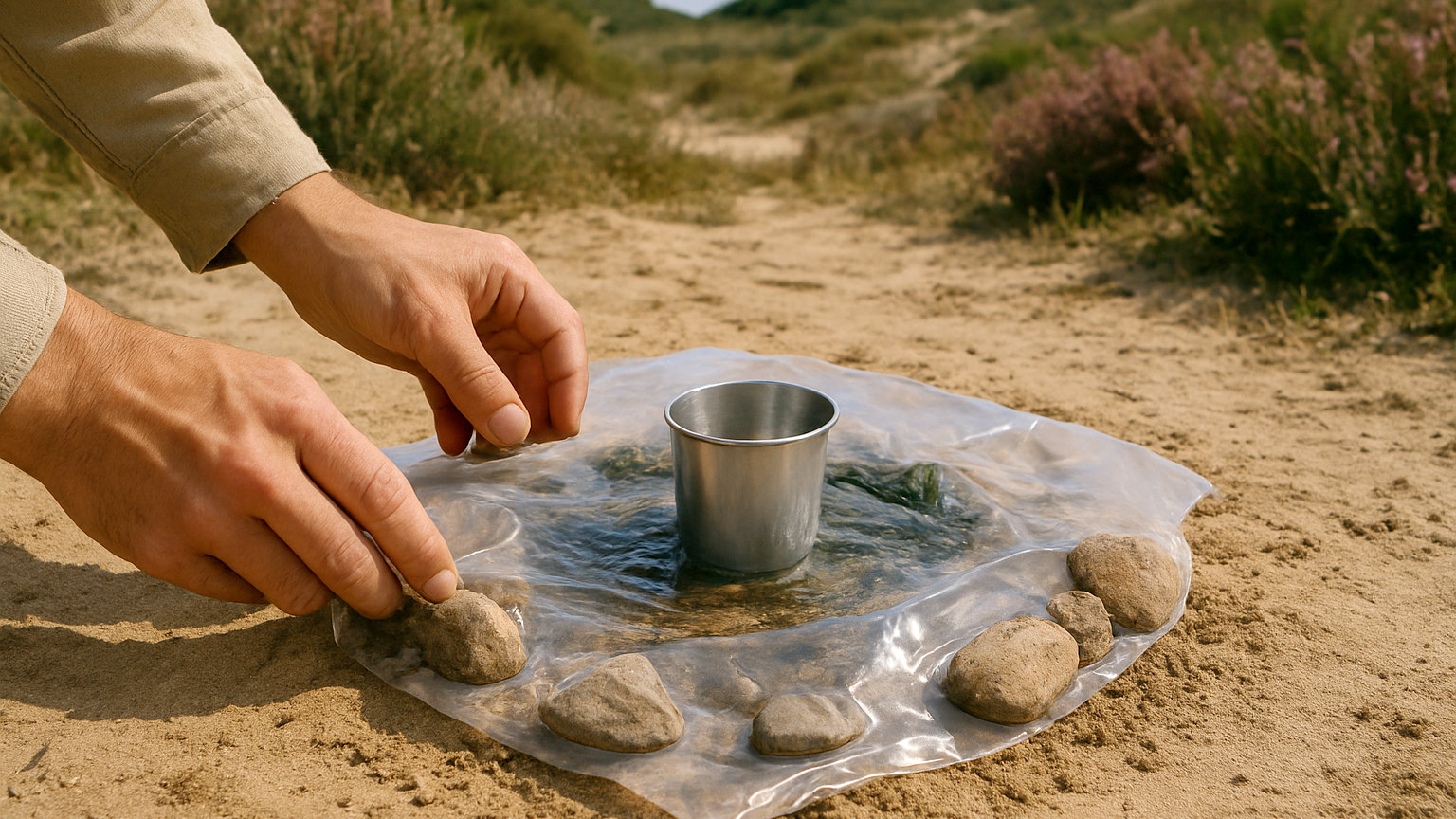
Dig a pit roughly a metre across and half a metre deep in the sunniest spot available. Place a clean container in the centre. Line the pit walls with any moist vegetation you have. Stretch a clear plastic sheet over the pit, seal the edges with soil, and place a small stone in the centre so the sheet forms a cone directing condensate into the container. A tube running from the container to the surface lets you drink without dismantling the still.
- Choose the sunniest available ground, ideally a damp hollow or dry stream bed
- Add green vegetation, urine or contaminated water to the pit to raise output
- Seal the sheet edges completely, since any leak destroys the yield
- Weight the centre so condensate runs to a single point
- Run a drinking tube out to avoid opening the still
How much water does one actually produce?
Far less than the diagrams suggest. Field trials consistently show a single well built still in good conditions yielding somewhere between a quarter litre and one litre in twenty four hours, and often far less on ground that is not genuinely damp. Set against a daily requirement of two to three litres, and against the litre or more of sweat that digging a pit in desert heat can cost, the arithmetic frequently comes out negative. This is the reason experienced instructors are lukewarm about it.
Is a transpiration bag better?
Usually, yes, and by a considerable margin. Tie a clear plastic bag over a leafy branch of a non poisonous tree, with a corner hanging low to collect, and the plant transpires moisture that condenses inside. It requires almost no effort, no digging and no fluid expenditure, and a good branch in sunlight can produce a similar or greater yield than a pit still. Several bags on several branches scale the output linearly. Avoid poisonous or irritant species, since some compounds carry over.
When is a solar still genuinely the right choice?
When the only water available is salt, chemically contaminated or otherwise untreatable, and when you have time, materials and shade in which to work. On a coast with plenty of seawater and driftwood, a still or an improvised distillation setup over a fire is a legitimate answer. In a desert with no water source at all, digging one is usually a mistake. Improving shade, reducing exertion and waiting for darkness to move will preserve more fluid than a still will produce.
What should you build instead if you can?
A fire driven still, if fuel exists. Boiling water in a covered container and condensing the steam on a cool surface, or running it through a tube into a cool vessel, produces far more distilled water per hour than sunlight ever will. It costs fuel rather than sweat, which is often the better trade.
What do you need to build one?
The essential item is a clear or lightly translucent plastic sheet, and without one no version of this works. A survival blanket will not do, since it reflects rather than transmits light. Beyond that you need a digging implement, a container that fits in the pit, and ideally a length of tubing. This is the practical argument for carrying a large clear plastic bag or a lightweight sheet in a desert or coastal kit, because it enables both the pit still and the far more efficient transpiration bag at almost no weight cost.
Understand the still because the principle matters, but reach for a transpiration bag first and treat pit digging as a last resort rather than a first move.