Both appear regularly in survival folklore, usually presented as desperate but viable last resorts. Both are physiologically counterproductive, and understanding why prevents a decision that makes a bad situation considerably worse.
Why does seawater dehydrate you?
Seawater contains roughly thirty five grams of salt per litre, around four times the concentration your kidneys can produce in urine. To excrete the salt load from a litre of seawater, your body must produce well over a litre of urine, and the additional fluid has to come from your existing reserves. The net result is a fluid deficit larger than if you had drunk nothing. Salt also draws water osmotically from the gut wall into the intestine, commonly causing diarrhoea, which accelerates the loss further.
What happens if you keep drinking it?
Progressive hypernatraemia, meaning dangerously elevated blood sodium. Water shifts out of cells, including brain cells, producing confusion, irritability, muscle twitching, seizures and eventually coma. The characteristic pattern in maritime survival records is a person who drank seawater becoming irrational and agitated before those who abstained, which is precisely why every maritime survival authority is unequivocal on the point.
Is urine any better?
No, and it degrades with each cycle. Urine is your body actively removing surplus salts, urea and metabolic waste dissolved in water it could otherwise have kept. Drinking it returns that waste load for the kidneys to process again, requiring further water to excrete. Because a dehydrated person produces increasingly concentrated urine, the version available when you most want it is the version least worth drinking. Each round through the body concentrates it further.
- Seawater requires more water to excrete than it provides
- Urine returns concentrated waste for the kidneys to process again
- Both commonly cause diarrhoea, accelerating fluid loss
- Both can be distilled to yield genuinely safe water
- Neither should be drunk directly under any circumstances
Can either be made drinkable?
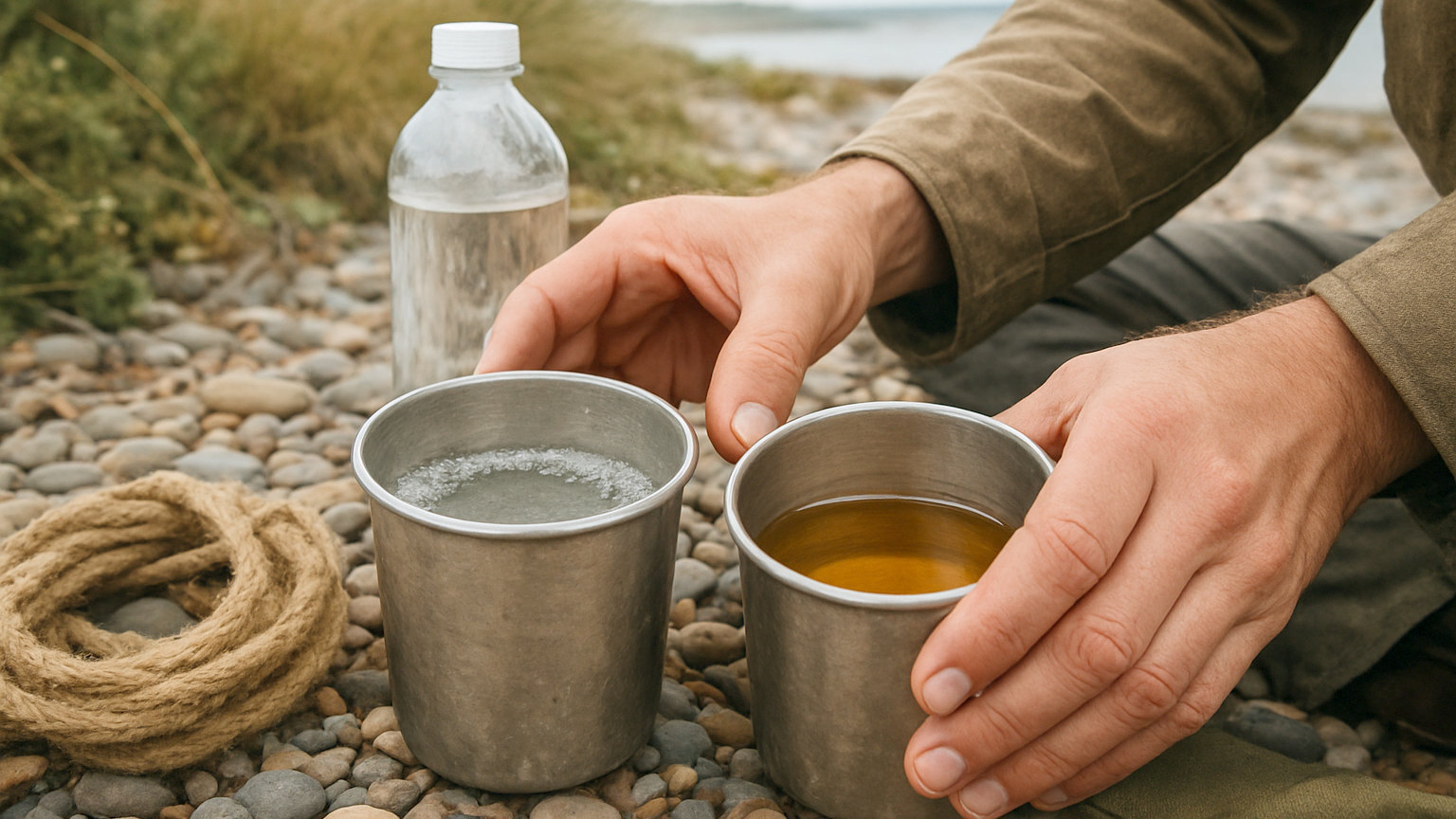
Yes, by distillation, which is the one method that separates water from dissolved substances. Boiling either liquid and condensing the steam on a cool surface produces pure water, leaving salt and waste behind. A solar still does the same using sunlight, and adding urine or seawater to the pit is standard practice precisely because the still separates the water out. This is why both are worth collecting even though neither is worth drinking.
What should you do instead when water runs out?
Reduce loss before seeking replacement. Get out of the sun and into shade, stop exerting yourself during heat and move at night instead, keep clothing on to reduce evaporative loss, breathe through your nose, and avoid eating if water is very short, since digestion consumes fluid. These measures extend your endurance substantially and cost nothing. Meanwhile collect dew at dawn with a cloth, look for vegetation indicating groundwater, set transpiration bags on leafy branches, and collect any rain that falls.
How long can you realistically last?
The common rule of three days without water is a rough guide rather than a limit, and it varies enormously with temperature, exertion and starting condition. In cool conditions at rest, considerably longer is possible. In desert heat with exertion, substantially less. Since the variable you control is loss rather than intake, shade and rest are the levers that matter, and both are more valuable than any desperate measure involving seawater.
What about other tempting options?
Alcohol is a diuretic and worsens fluid balance while impairing the judgement you need most. Blood is high in protein and salt and burdens the kidneys in much the same way as seawater. Sea ice more than a year old has largely shed its salt and is genuinely drinkable, identifiable by rounded edges and a blue tint, whereas fresh grey sea ice is not. Fish contain drinkable fluid in their flesh and eyes, which is a legitimate maritime survival technique, though the protein load means it is a supplement rather than a solution.
Collect both if you have the means to distil them. Drink neither, because the physiology does not bend to how desperate the situation feels.