Fractures are common outdoor injuries and rarely immediately life threatening, with important exceptions. The aim of field treatment is to stop things getting worse rather than to correct anything, and expectations should be set accordingly.
How do you recognise a fracture?
Pain that is severe and localised, swelling, deformity, an inability to use or bear weight on the limb, and sometimes a grating sensation. The casualty may report having heard or felt a snap. Bruising develops over time. It is frequently impossible to distinguish a fracture from a bad sprain without an X ray, which is why the sensible approach is to treat anything that might be broken as though it is.
What should you do first?
Support the limb in the position you found it, using your hands initially, and keep it still. Movement causes pain, further tissue damage and bleeding. Reassure the casualty and encourage them to keep the limb still themselves, since they will guard it more sensitively than you can. Do not attempt to straighten an angled limb or push a bone back into place.
- Support the limb in the position found and keep it still
- Immobilise the joints above and below the injury
- Check circulation beyond the injury before and after splinting
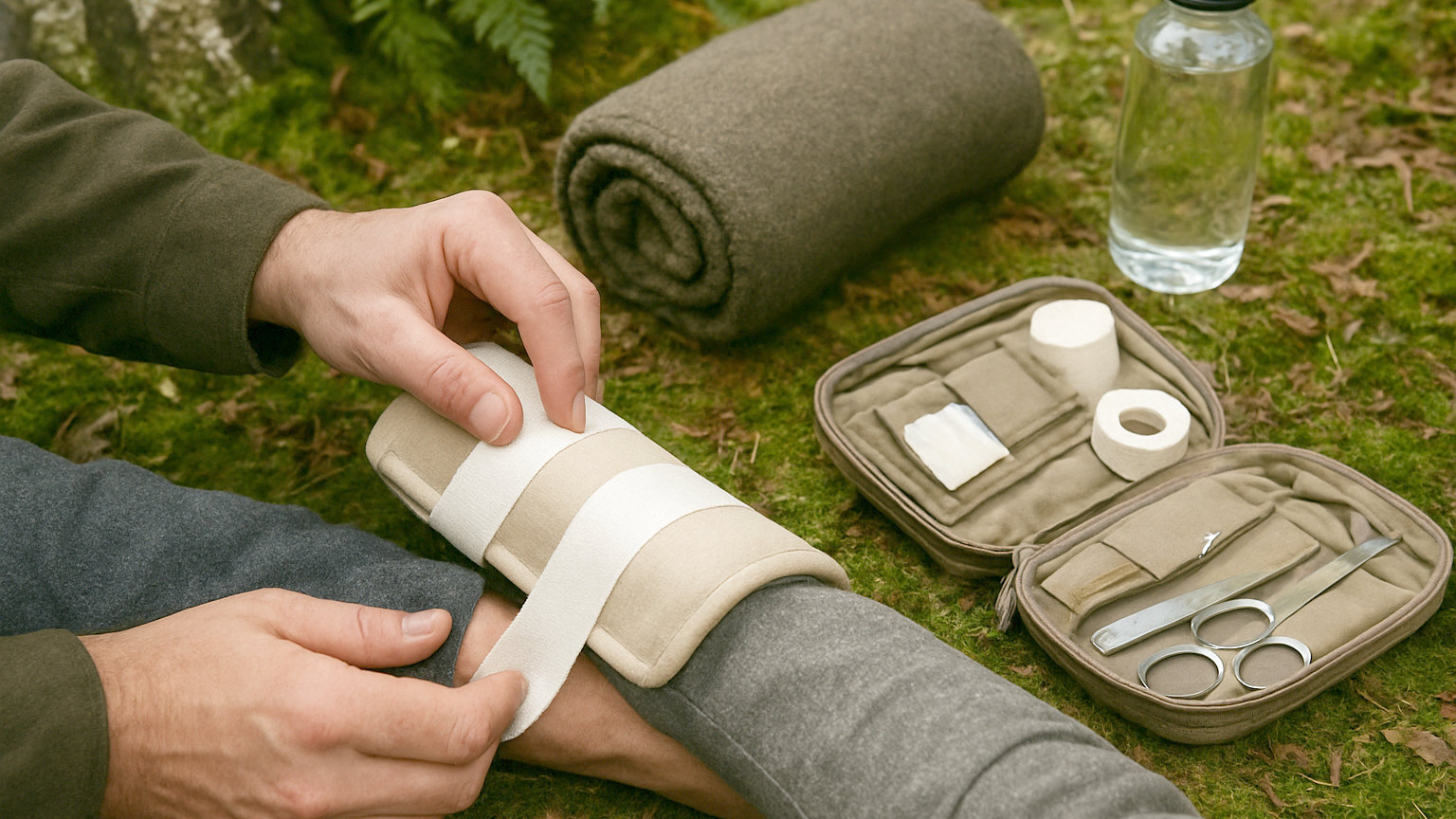
- Pad any splint generously, particularly at bony points
- Cover an open fracture with a clean dressing before immobilising
- Keep the casualty warm and monitor for shock
How do you improvise a splint?
With anything rigid and plenty of padding. Walking poles, tent poles, a rolled sleeping mat, a folded map case or a straight branch all work. A closed cell foam mat rolled around a lower leg is particularly effective and comfortable. Secure it with tape, bandages, cord or torn clothing, tied firmly enough to stop movement and loosely enough not to restrict blood flow, and never directly over the fracture site.
Why check circulation beyond the injury?
Because swelling and a tight splint can both cut off blood supply, which threatens the limb far more than the fracture does. Check the fingers or toes beyond the injury for warmth, colour, sensation and movement before and after applying anything, and recheck every fifteen minutes. Pale, cold, blue or numb extremities mean the binding is too tight and must be loosened immediately.
What makes a fracture an emergency?
Open fractures, where bone has broken the skin, because of infection risk and blood loss. Fractures of the femur, pelvis or multiple long bones, which can bleed enough internally to cause life threatening shock. Any fracture with absent circulation beyond it. Spinal or skull fractures. Each of these needs 999 and rapid evacuation rather than field management. For an open fracture, cover the wound with a clean dressing, control bleeding with pressure around rather than on protruding bone, and immobilise.
Can you use the body as a splint?
Yes, and it is often the best available option. An injured arm can be supported in a sling made from a triangular bandage or a jacket, then bound to the chest. An injured leg can be padded and bandaged to the uninjured leg, which is quick and remarkably effective. These techniques need no equipment and are worth knowing precisely because they always work.
What about painkillers?
Simple painkillers the casualty normally takes, such as paracetamol, are reasonable if they are fully conscious and have no reason to avoid them. Avoid giving anything if surgery seems likely or if they are drowsy, and never give anything to an unresponsive person. Warmth, reassurance, good immobilisation and a comfortable position often do more for pain than tablets, particularly in the cold.
Should you ever straighten a limb?
Only in one narrow circumstance: when a limb is severely angled and there is no circulation beyond the injury, and evacuation will take hours. Applying gentle traction along the line of the limb can restore blood flow and may save it. This is taught on remote and wilderness medicine courses for good reason, since done wrongly it causes serious harm. Where help is reachable within a reasonable time, splint as found and let hospital staff handle it.
Immobilise, insulate, check circulation, and call for help. Straightening and setting are hospital jobs, not field ones.