Major bleeding kills quickly and is one of the few conditions a bystander can reliably reverse. The techniques are simple, they work, and the main obstacle is usually reluctance to press hard enough. This is a topic that genuinely warrants a practical course rather than reading alone.
What should you do first?
Apply firm direct pressure straight onto the wound, with whatever is to hand. Use a dressing if you have one, clothing if you do not, and your gloved hand if that is all there is. Press hard, press directly on the bleeding point rather than around it, and keep pressing. Most bleeding, including from surprisingly large wounds, stops with sustained direct pressure alone.
How long should you press for?
At least ten minutes without lifting to check, and longer if bleeding continues. Repeatedly peeking disrupts the clot that is forming and restarts the process, which is the most common reason pressure appears not to be working. If blood soaks through the dressing, add another on top and keep pressing rather than removing the first. Elevating an injured limb above the level of the heart helps and should not replace pressure.
- Firm direct pressure onto the bleeding point
- Add dressings on top rather than replacing them
- Elevate a limb if you can do so without causing harm
- Tourniquet high and tight on a limb if pressure fails
- Pack deep wounds firmly with gauze or clean cloth
- Note and record the time a tourniquet was applied
When should you use a tourniquet?
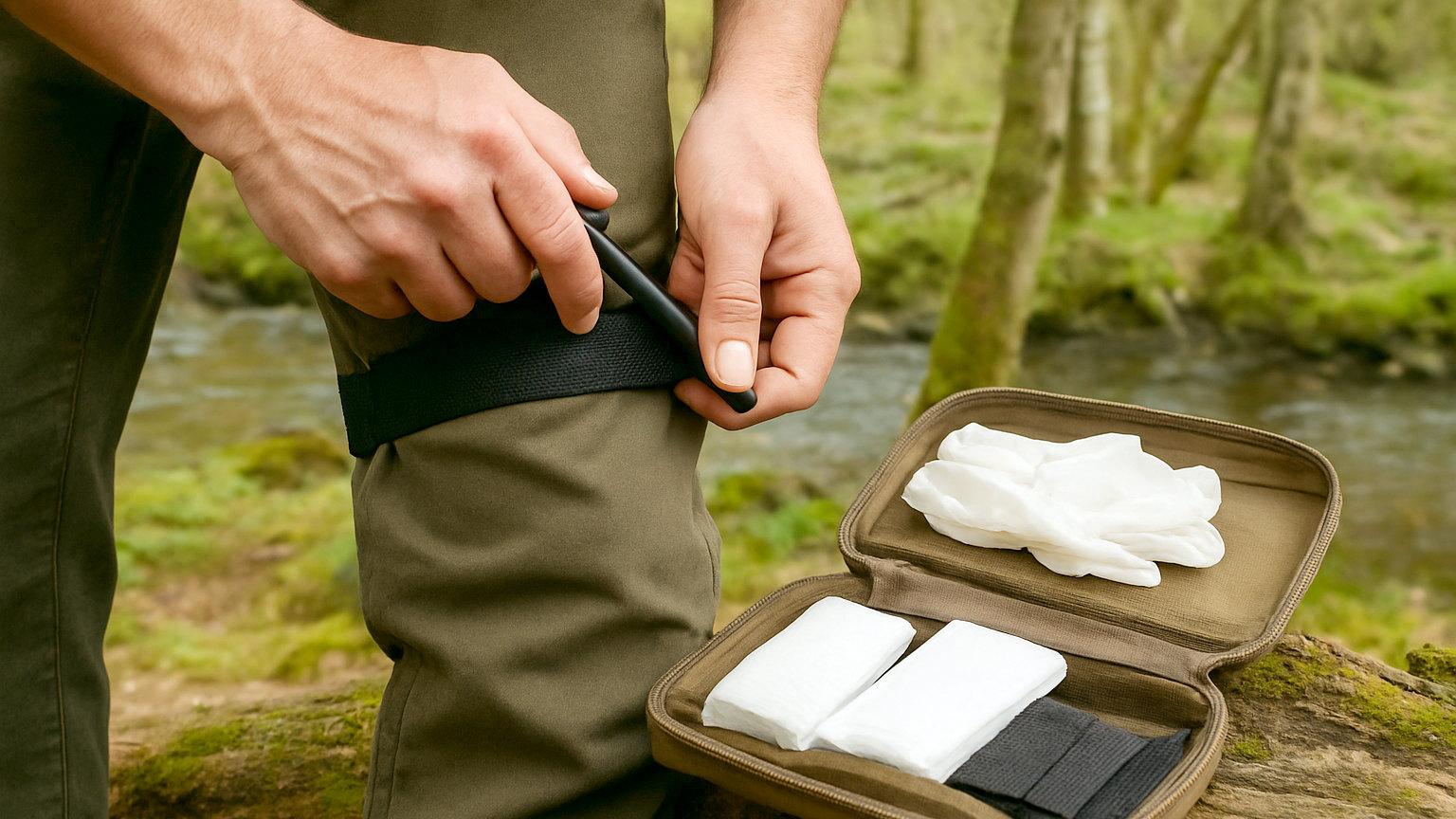
When bleeding from an arm or leg is life threatening and direct pressure has not controlled it, or when there are multiple casualties and you cannot maintain pressure. Military and civilian trauma experience over the last two decades has shifted opinion sharply in favour of early tourniquet use, and the historical fear of losing a limb has proved largely unfounded. A tourniquet left in place for a couple of hours is generally well tolerated, and bleeding to death is not.
How do you apply one correctly?
Place it around the limb between the wound and the body, roughly five to seven centimetres above the wound and never over a joint. Tighten it until the bleeding stops, which will hurt considerably and is the point at which it is working. Secure the windlass, write the time on the casualty or the tourniquet, and tell the ambulance crew. Do not loosen or remove it, because releasing a tourniquet can restart catastrophic bleeding and cause further problems.
What if the wound is not on a limb?
Wounds at the neck, armpit and groin cannot be tourniqueted and are treated with hard direct pressure and, if available, wound packing. Pack gauze or clean cloth firmly into the wound cavity, pushing it right down to the bleeding vessel and filling the space completely, then apply pressure on top. This is uncomfortable to do and to receive, and it is the correct treatment. Haemostatic dressings, which contain agents promoting clotting, are designed for exactly this and are worth carrying.
How do you protect yourself?
Wear gloves if you have them, and use a barrier such as a plastic bag if you do not. Avoid blood contact with your eyes, mouth or any break in your own skin, and wash thoroughly afterwards. This should never delay treatment of life threatening bleeding, and the risk from a single incident is low, but the habit is worth building.
What else should you watch for?
Shock, which follows significant blood loss. Pale, cold, clammy skin, a fast weak pulse, rapid shallow breathing, thirst, restlessness and confusion all suggest the circulation is failing. Lie the casualty down, raise their legs if injuries allow, keep them warm and do not give anything to eat or drink. Call 999 early, because a person bleeding significantly needs hospital rather than field treatment.
Press hard, press long, and reach for a tourniquet without hesitating if a limb is bleeding uncontrollably.