The recovery position is one of the few first aid techniques almost everyone has heard of and comparatively few can perform confidently under pressure. It exists to solve one problem: keeping the airway of an unresponsive person clear. This describes the technique and does not replace practising it on a course.
When should you use it?
When someone is unresponsive but breathing normally. That combination is the trigger. If they are responsive, they do not need it. If they are not breathing normally, they need chest compressions and calling 999 immediately, not repositioning. Checking breathing properly before deciding is therefore essential, and takes up to ten seconds with the airway open.
Why does it work?
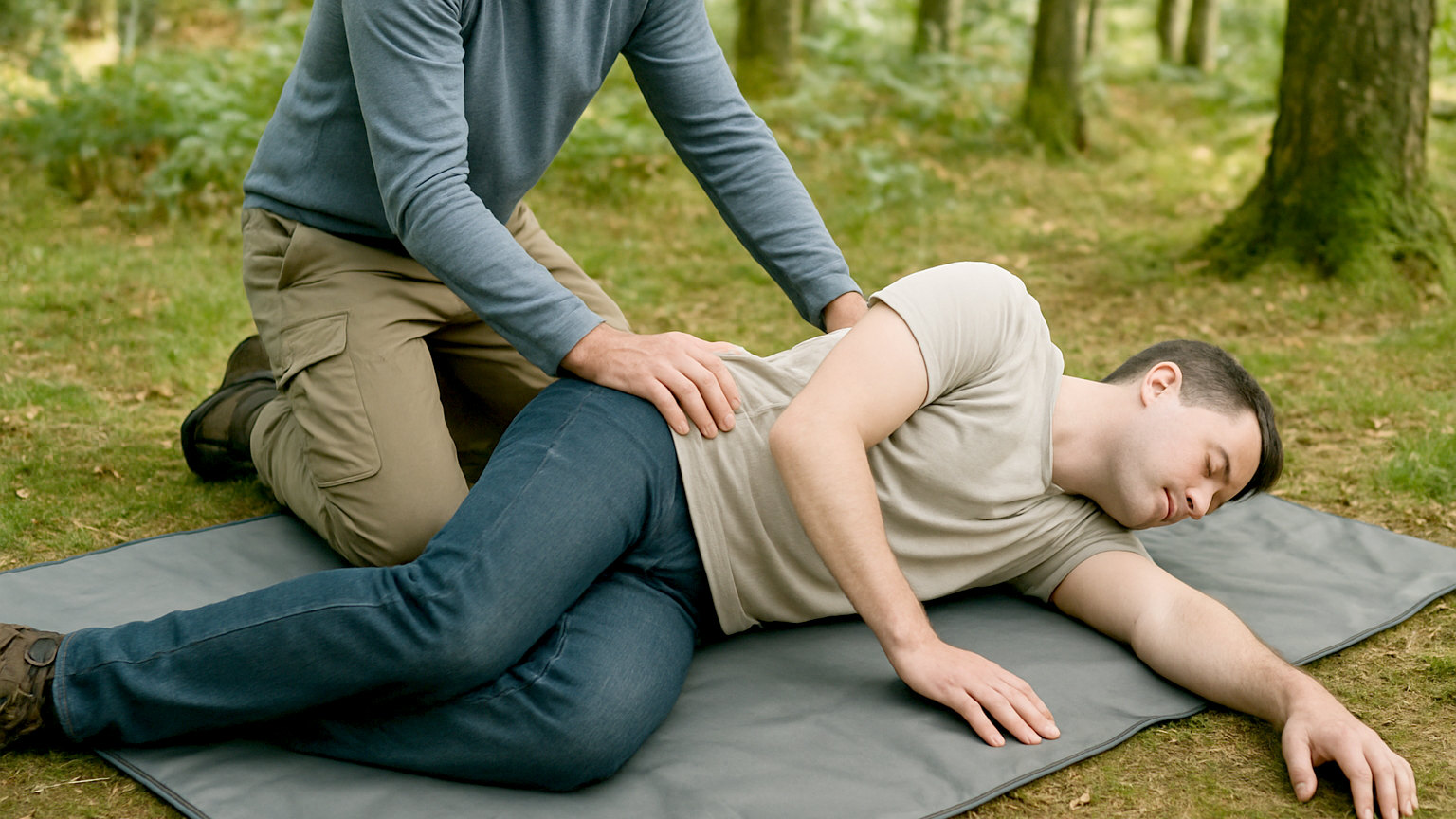
Because an unresponsive person on their back is at risk from two things. The tongue falls back and obstructs the throat, and anything vomited has nowhere to go except the lungs. Rolling them onto their side with the head tilted slightly back and the mouth angled downward keeps the tongue forward and lets fluid drain out rather than in. It is a simple mechanical solution to both problems at once.
- Kneel beside them and straighten both legs
- Place the near arm at right angles, elbow bent, palm upward
- Bring the far arm across the chest, back of hand to their cheek
- Pull the far knee up so the foot is flat on the ground
- Pull on that knee to roll them toward you onto their side
- Adjust the upper leg so hip and knee are bent at right angles
- Tilt the head back gently to keep the airway open
What should you do once they are positioned?
Call 999 if you have not already, then monitor breathing continuously. An unresponsive casualty can stop breathing at any point, so check regularly rather than assuming stability. Keep them warm, since unresponsive people lose heat quickly, and insulate them from the ground. Stay with them and be ready to start chest compressions if breathing becomes absent or abnormal.
Should you turn them if you suspect a spinal injury?
Yes, if that is what it takes to keep the airway open. This is the difficult judgement people worry about most, and the guidance is clear: an obstructed airway will kill someone within minutes, whereas a spinal injury handled imperfectly may not. Keep the head, neck and spine aligned as you roll, use extra helpers if available so one person can support the head, and move as smoothly as possible. Airway always wins.
Which side should they be on?
Either is acceptable in general. If there is an injury, position them with the uninjured side downward where practical. If they are pregnant, roll them onto the left side, because lying on the right allows the weight of the uterus to compress a major vein and reduce blood return to the heart. If they must remain in position for longer than half an hour, turn them onto the other side to relieve pressure.
Is the technique different for a child or baby?
The principle is identical and the handling differs. Children are placed in the same position with more care and support. A baby under one year should be cradled in your arms, head tilted slightly downward, so that fluid can drain and the airway stays clear. In both cases, call 999 and monitor breathing continuously, and be aware that breathing problems are a far more common cause of collapse in children than in adults.
What is the most common mistake?
Failing to tilt the head back after rolling. The roll alone does not open the airway, and a casualty positioned neatly on their side with the chin on the chest is still obstructed. The head tilt is the part that does the work, and it should be checked and rechecked.
Practise it on a willing friend until it takes fifteen seconds, because the position is easy and doing it under pressure is what takes rehearsal.