Shouting is the instinctive response to needing help and it is a poor one. A whistle solves every problem the voice has, at a cost of a few grams and a few pounds.
How much further does a whistle carry?
Several times further, depending on conditions and terrain. A loud whistle produces a sound pressure level well above what a person can shout, and it concentrates that energy into a narrow band of high frequency that cuts through ambient noise. Where a shout might be heard a couple of hundred metres away in still conditions, a whistle can carry over a kilometre, and considerably further downwind or across water.
Why does the voice fail?
Because it tires quickly and then stops working. Sustained shouting produces hoarseness within minutes and can leave someone effectively voiceless within half an hour, precisely when a search may be starting. It also consumes energy and moisture, both of which matter when cold and short of water. A whistle can be sounded intermittently for many hours with almost no physical cost.
- Carries far further than the voice, particularly in wind
- Costs almost no energy or moisture to use
- Works when the voice has gone entirely
- Unmistakably artificial rather than ambiguous
- Usable by children, casualties and exhausted people
- Weighs a few grams and needs no battery
Which type should you buy?
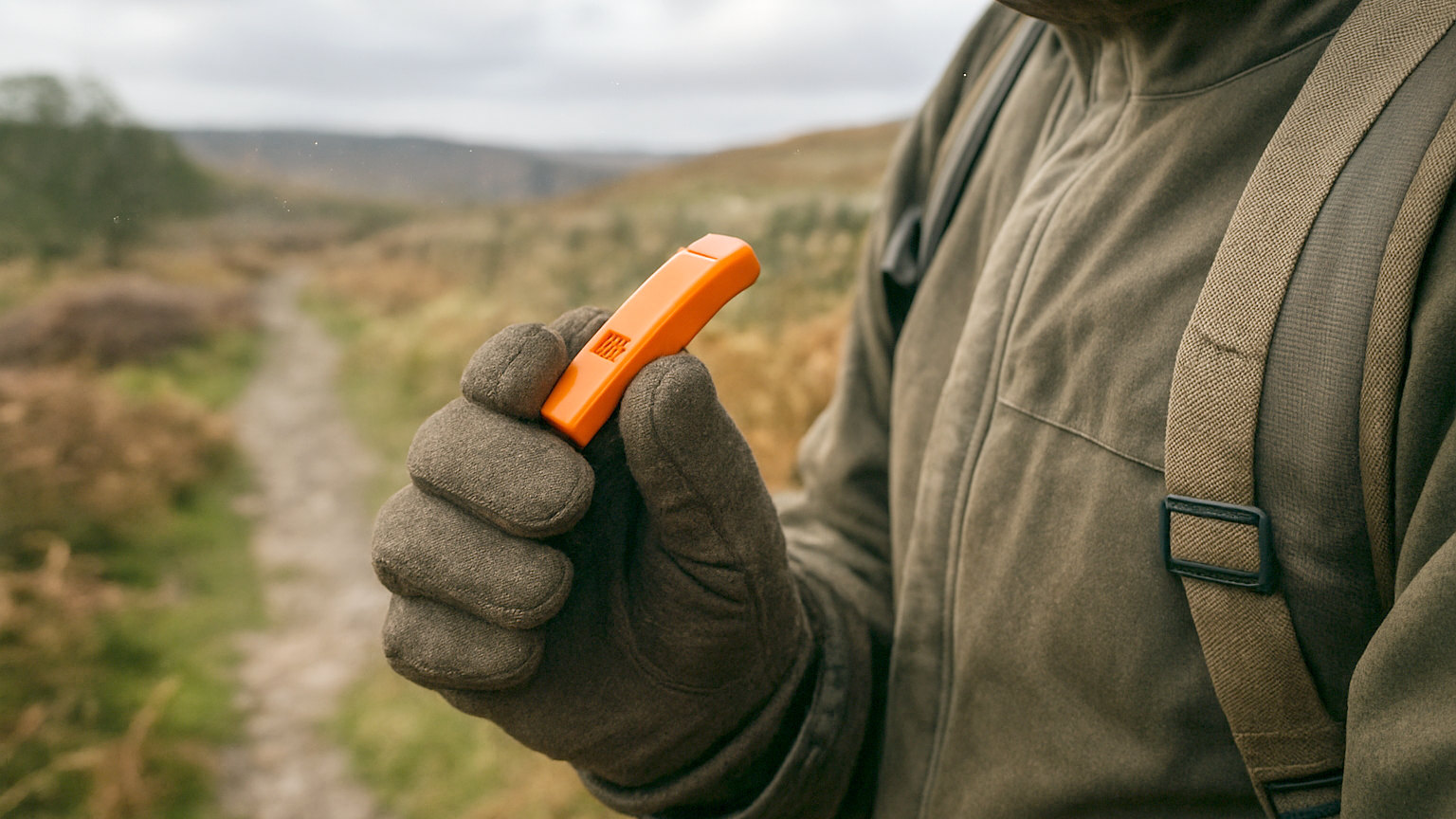
A pealess whistle, meaning one with no cork or plastic ball inside. Traditional pea whistles fail when wet or frozen, which is exactly when you need them, and the pea can jam or fall out. Pealess designs work reliably when soaked and in freezing conditions. Choose a loud one, made of plastic rather than metal since metal sticks to lips in cold weather, and check the sound before relying on it.
Where should you carry it?
Attached to a rucksack shoulder strap or a jacket zip, where you can reach it without taking anything off. A whistle inside a pack is a whistle you cannot use if you are pinned, injured or in the water. Many rucksacks now include one in the chest strap buckle, which is convenient though usually quieter than a dedicated whistle. Every member of a group should have one, particularly children.
What pattern should you sound?
Six blasts spread across a minute, then a minute of silence, repeated. That is the international distress convention and it distinguishes a deliberate signal from an accidental one. Three blasts in reply means help is coming. Keep sounding six after hearing a reply, because the responding team still needs to locate you and can only do so by following the sound.
Does it work in wind and woodland?
Better than the voice does, though both are affected. Wind carries sound downwind and suppresses it upwind, so sound toward likely searchers or from a position where the wind favours you. Dense woodland and deep snow absorb high frequencies and reduce range considerably. In poor conditions, combine sound with visual signals rather than relying on one alone.
What other uses does it have?
Group management, which is why leaders carry them routinely. An agreed whistle code lets a group communicate across distance without shouting, whether to stop, gather or indicate a problem. It is also invaluable for attracting attention in water, where shouting is close to useless, which is why lifejackets have whistles attached as standard.
Should you use it for group communication?
Yes, and agreeing a simple code beforehand is worthwhile. One blast to mean stop or attention, two to mean come to me, three to mean I need help, and six for a genuine emergency is a common arrangement. Agree it before setting off and make sure everyone including children knows it. The advantage is that a whistle carries across a spread out group in wind where voices do not, and it avoids the exhausting shouting that a long day of route finding otherwise produces.
Buy a loud pealess whistle, attach it where you can reach it one handed, and give one to everyone in the group.