A signal mirror is the most effective daytime signalling device relative to its weight and cost, capable of being seen from many miles away and from aircraft. The catch is that it is useless unless aimed, and aiming is not intuitive.
Why is it so effective?
Because it reflects sunlight at an intensity far beyond anything else you can produce. A flash from a small mirror can be visible to an aircraft at considerable range and has been reported at distances of tens of miles in clear conditions. It also produces a signal that is unmistakably artificial, since nothing in nature flashes in a controlled repeating pattern. It requires no battery, no fuel and no maintenance.
How do you aim it?
With the two finger method, which solves the fundamental problem that you cannot see where the beam is going. Hold your free hand out at arms length and make a V with two fingers, positioning your target within the V. Catch the sun on the mirror and bring the reflected bright spot onto your own fingers. Once the spot is on your fingers, the beam is travelling toward whatever sits between them. Then keep it there while flashing.
- Face roughly toward the sun and your target
- Make a V with two fingers of the free hand at arms length
- Place the target inside the V
- Reflect the sun onto your own fingers
- Hold the spot on your fingers and tilt slightly to flash
- Sweep the horizon slowly when you have no specific target
What if the mirror has a sighting hole?
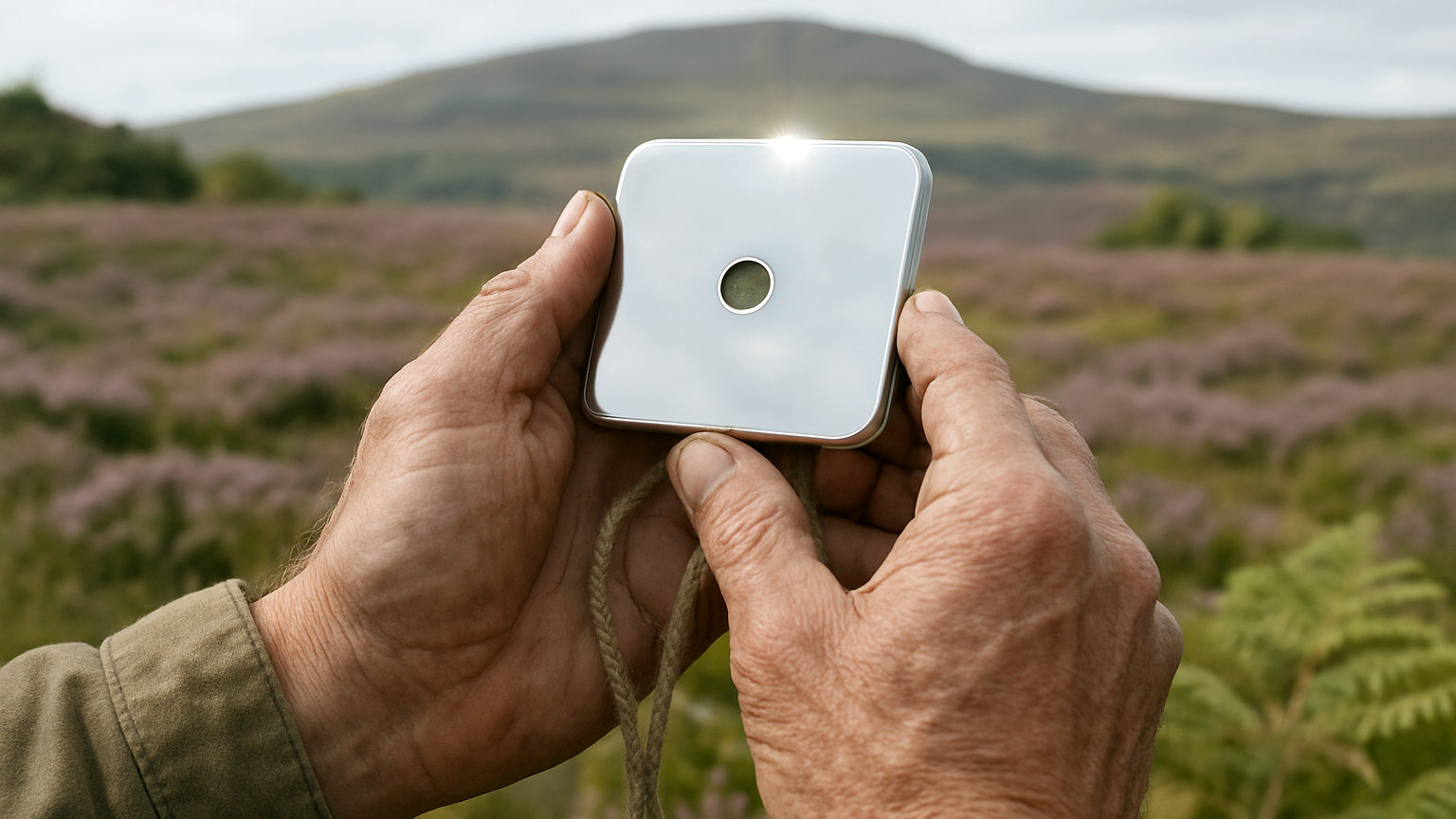
Purpose made signal mirrors have a mesh or hole in the centre that makes this considerably easier. Hold it close to your eye, look through the hole at your target, and you will see a bright spot on the mesh. Tilt the mirror until that spot sits directly on your target as seen through the hole, and the beam is aligned. This is faster and more accurate than the finger method and is worth the small extra cost.
What can you use if you have no mirror?
Anything reflective and reasonably flat. A phone screen, a watch face, the polished back of a compass, a foil survival blanket, a knife blade, a CD, a metal mug or a piece of glass all work. Foil blankets are particularly useful because they are large, though they are hard to aim and are better laid out flat as a static reflective panel. Improvised reflectors are less efficient than a proper mirror and are far better than nothing.
When should you flash?
Sweep the horizon periodically even when you can see nothing, particularly along likely search lines such as valleys, ridges and coastlines. If you see or hear an aircraft, vehicle or vessel, aim directly at it and flash repeatedly. Aircraft crews specifically look for mirror flashes and often spot them before anything else. Continue after the aircraft appears to have seen you, since confirming the position takes several passes.
What are the limitations?
It needs direct sunshine, which in Britain means it may be unusable for days. It requires you to see your target or guess its direction. It does not work at night or in cloud, fog or heavy rain. This is why a mirror belongs alongside a whistle and a torch rather than instead of them, and why beacons and phones remain the primary means of raising the alarm.
Is it worth practising?
Yes, and it takes ten minutes. Aim at a friend a few hundred metres away, or at a window across a valley, and learn how small a movement swings the beam a long way. Doing this once removes the fumbling that would otherwise waste the brief moments when an aircraft is within range.
Can you signal without seeing the sun directly?
Only if the sun is genuinely shining, though it need not be behind you. A mirror works over a wide range of angles, roughly anywhere the sun can reach the reflective surface, so you can signal to targets well off to the side and even partly toward the sun. What defeats it is cloud, since the technique depends on a strong directional beam that overcast sky does not provide. Bright hazy conditions produce a weaker flash that may still be worth attempting.
Carry a small mirror, learn the finger method, and practise once, because in sunlight it outperforms everything else you can carry.