Search crews report that individual people are remarkably difficult to see from an aircraft, even in open country and good visibility. Understanding why changes what you should do while waiting.
Why are people so hard to spot?
Because a person occupies a tiny area from above, moves slowly, and in typical outdoor clothing blends into moorland, rock and vegetation. A crew scanning at a hundred knots has seconds over any given patch of ground and is covering a large area. Muted greens, browns, blues and greys, which dominate outdoor clothing, are precisely the colours that disappear against a British hillside.
What should you make yourself look like?
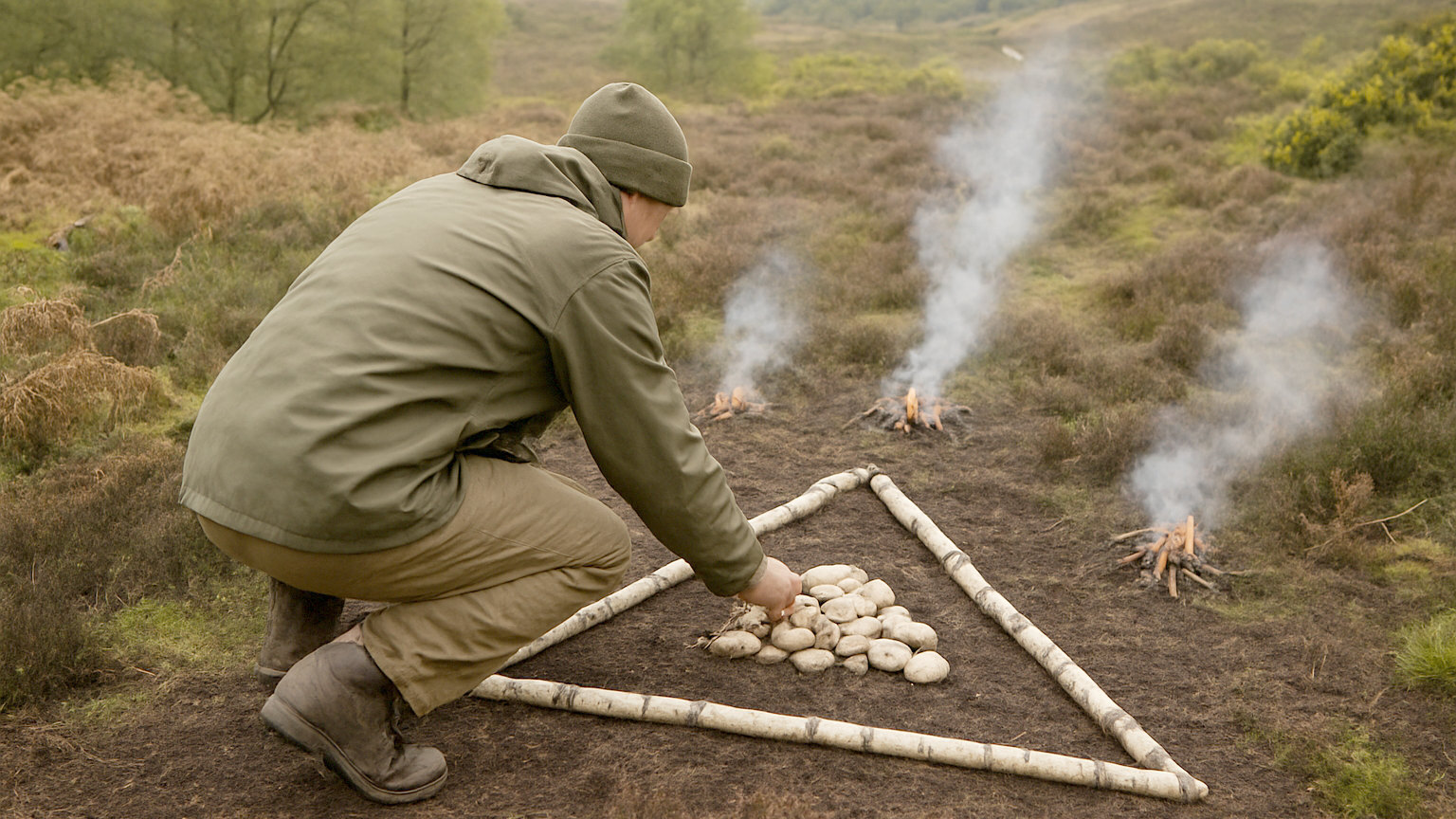
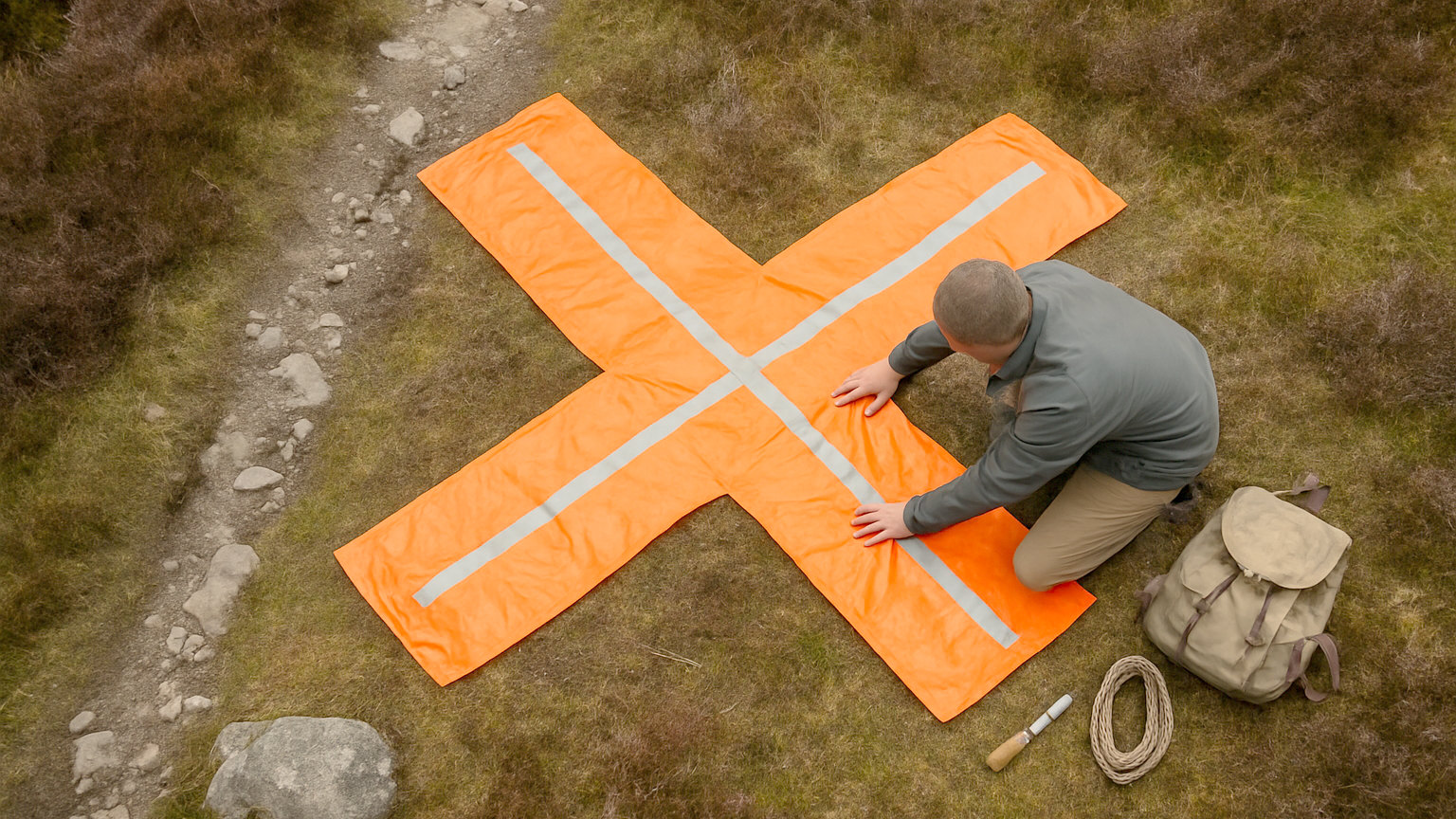
Something that does not belong. Straight lines, sharp angles, geometric shapes and symmetry are almost absent from natural landscapes, so a large triangle or a straight line of bright material reads immediately as human. Size matters enormously: a marking needs to be several metres across to register from altitude, and anything smaller than about three metres is likely to be missed entirely.
- Choose open ground, never under tree cover
- Make shapes at least three metres across, larger if possible
- Use straight lines and geometric forms, not scattered items
- Maximise colour contrast against the specific background
- Add movement by waving something large when aircraft appear
- Use shadow by building up material rather than laying it flat
What materials work?
Anything bright and large. Orange survival bags are ideal, as are bivvy bags, waterproofs, tent flysheets, rucksack covers and foil blankets laid shiny side up. Weight them down with stones, because downdraught and wind will remove anything loose at the worst moment. In snow, dark material provides far better contrast than bright material, so packs, jackets and even branches laid out will show more clearly than anything light coloured.
Does waving help?
Movement helps and waving an arm does not. A single arm is too small to register. Wave something large and bright, such as a jacket, a survival bag or a rucksack, using slow broad arcs above your head. Slow deliberate movement is more visible than fast frantic movement, which tends to blur. Keep waving until you are certain the crew has seen you, which usually means they alter course or circle.
How does shadow help?
Considerably, particularly early and late in the day when the sun is low. A shape built up from stones, turf or snow blocks casts a shadow that effectively doubles its apparent size and gives it definition. Digging a trench works on the same principle in snow or sand. Flat markings laid on the ground are far less visible in flat light than raised or excavated ones.
What about fire and smoke?
Both are highly effective and need preparation. Three fires in a triangle is a recognised distress arrangement. By day, adding green vegetation, damp moss or grass produces thick white smoke that shows well against dark ground and woodland. Against snow or a pale background, oily or rubbery material gives black smoke that contrasts better. Keep the fire ready to light rather than burning constantly, so you can produce smoke on demand when an aircraft is heard.
Where should you position yourself?
In the open, on a ridge, clearing, shoreline or open hillside, provided that is safe and you can still shelter. Being under a canopy or in a gully makes you effectively invisible from above. If your shelter is in cover, lay your markings in the nearest open ground and be ready to move there quickly when you hear an aircraft.
What about drones?
Search teams increasingly use them, and they change what works. Drones fly lower and slower than crewed aircraft and frequently carry thermal cameras, which detect body heat against cold ground rather than colour. That means a person sitting in the open is far more visible to a thermal camera at night than during the day, and that being wrapped in a foil blanket, which reflects heat inward, can actually reduce your thermal signature. If you hear a drone, move into the open and expose yourself rather than staying wrapped up.
Get into the open, make something large and geometric, weight it down, and wave something big rather than a hand.