People build a roof first because rain is visible and cold ground is not. It is the single most common shelter mistake, and it produces the frustrating outcome of a finished shelter in which someone spends a miserable, dangerous night.
How does heat actually leave your body?
By four routes. Conduction, through direct contact with a colder surface. Convection, as moving air carries warmth away. Radiation, as infrared energy emitted to cooler surroundings. And evaporation, as sweat and moisture change state. Lying on the ground puts a large area of your body in direct contact with a vast cold mass, which makes conduction dominant, and ground has a far higher thermal conductivity and heat capacity than air.
Why is the ground so much worse than cold air?
Because it never warms up. Air trapped in clothing or a sleeping bag is heated by you and then insulates you. Soil, rock and especially wet ground conduct that heat away into an effectively infinite reservoir, so the surface beneath you stays cold no matter how long you lie there. Damp ground is worse again, because water conducts heat roughly twenty five times better than air, which is why a wet groundsheet is close to useless.
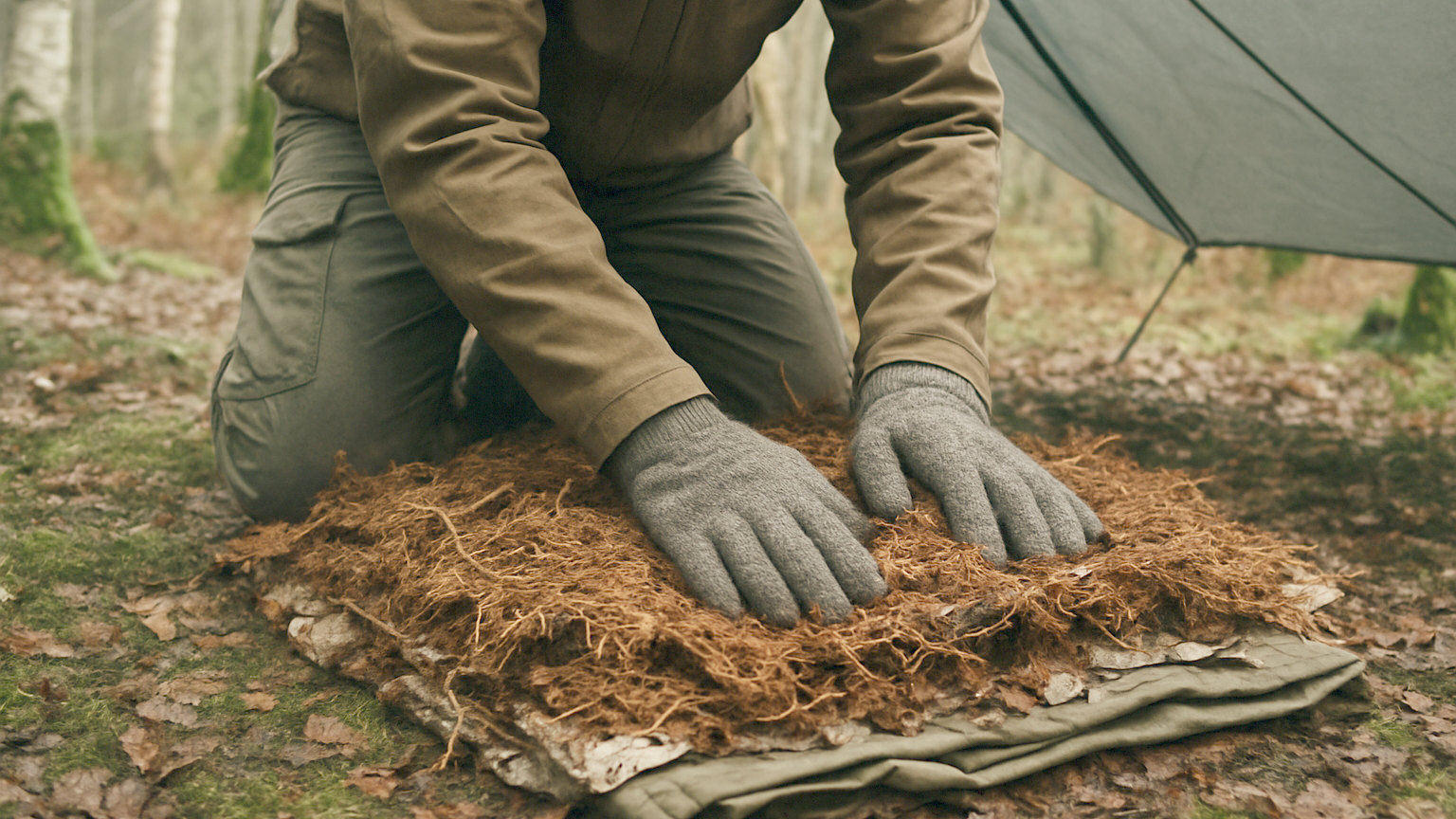
- Gather bedding material before roofing material
- Aim for at least twenty centimetres of compressed insulation
- Prefer dry, springy, bulky material that traps air
- Bracken, dry grass, conifer boughs, leaf litter and moss all work
- Add a vapour barrier such as a survival bag beneath if the ground is wet
How much material do you need?
Compressed depth is what counts, and compression is severe. Loose leaf litter piled to a metre settles to perhaps twenty centimetres once you lie on it, which happens to be about the working minimum. That means gathering roughly four times the depth you want to end up with. Test it by lying down: if you can feel the ground through the bedding, or feel any cold spot at hip or shoulder, add more before doing anything else.
What materials work best?
Anything dry, bulky and springy. Dry bracken is excellent and abundant across much of Britain. Conifer boughs laid in overlapping layers with the curve upward create a springy platform that resists compression well. Dry grass, leaf litter, moss, heather and even a pile of small dead branches topped with finer material all serve. Avoid anything wet, and avoid material scraped from directly under the surface, which is nearly always damp even when the top layer is dry.
What does a sleeping mat actually do?
The same job, measured. Mats are rated by R value, a measure of thermal resistance, with figures around one to two suitable for summer and four or above needed for winter or snow. An inflatable mat without insulation inside performs poorly in cold conditions despite the thickness, because air circulates within it and carries heat away by convection. Closed cell foam is heavier and bulkier but is entirely reliable, cannot puncture, and doubles as a splint or a windbreak.
Does this apply when sitting rather than lying?
Very much so, and it is frequently forgotten during a rest stop. Sitting on cold rock or wet ground during a break drains heat quickly at exactly the point when you have stopped generating much. A small foam sit mat weighs almost nothing and makes a genuine difference on a long cold day, which is why mountain leaders carry them and why they are standard in group shelters.
How do you insulate on rock or frozen ground?
By building a platform rather than looking for softer ground. Rock and frozen soil conduct heat away efficiently and cannot be improved by scraping, so the answer is to raise yourself above them. Lay a lattice of dead branches, then a thick bed of bracken, conifer boughs or heather on top, aiming to get several centimetres of air and material between you and the surface. On snow, the same approach applies with the additional benefit that snow itself insulates reasonably well once you are clear of direct contact with it.
Build the bed before the roof. It is counterintuitive, it feels like the wrong order, and it is the decision that determines whether the night is survivable or merely unpleasant.