The debris hut is the standard answer to shelter in temperate woodland with nothing but your hands. It requires no cordage, no tools and no manufactured materials, and a well built one will keep a person alive through a night that would otherwise be dangerous.
What is the underlying principle?
Trapped air. Leaf litter is a poor insulator by itself, but piled deeply it holds an enormous quantity of still air within its structure, and still air is what insulation actually is. The same principle makes a sleeping bag work, and a bird nest, and the loft of a house. The debris hut is essentially a wearable pile of insulation with a frame inside it to stop it collapsing on you.
How do you build the frame?
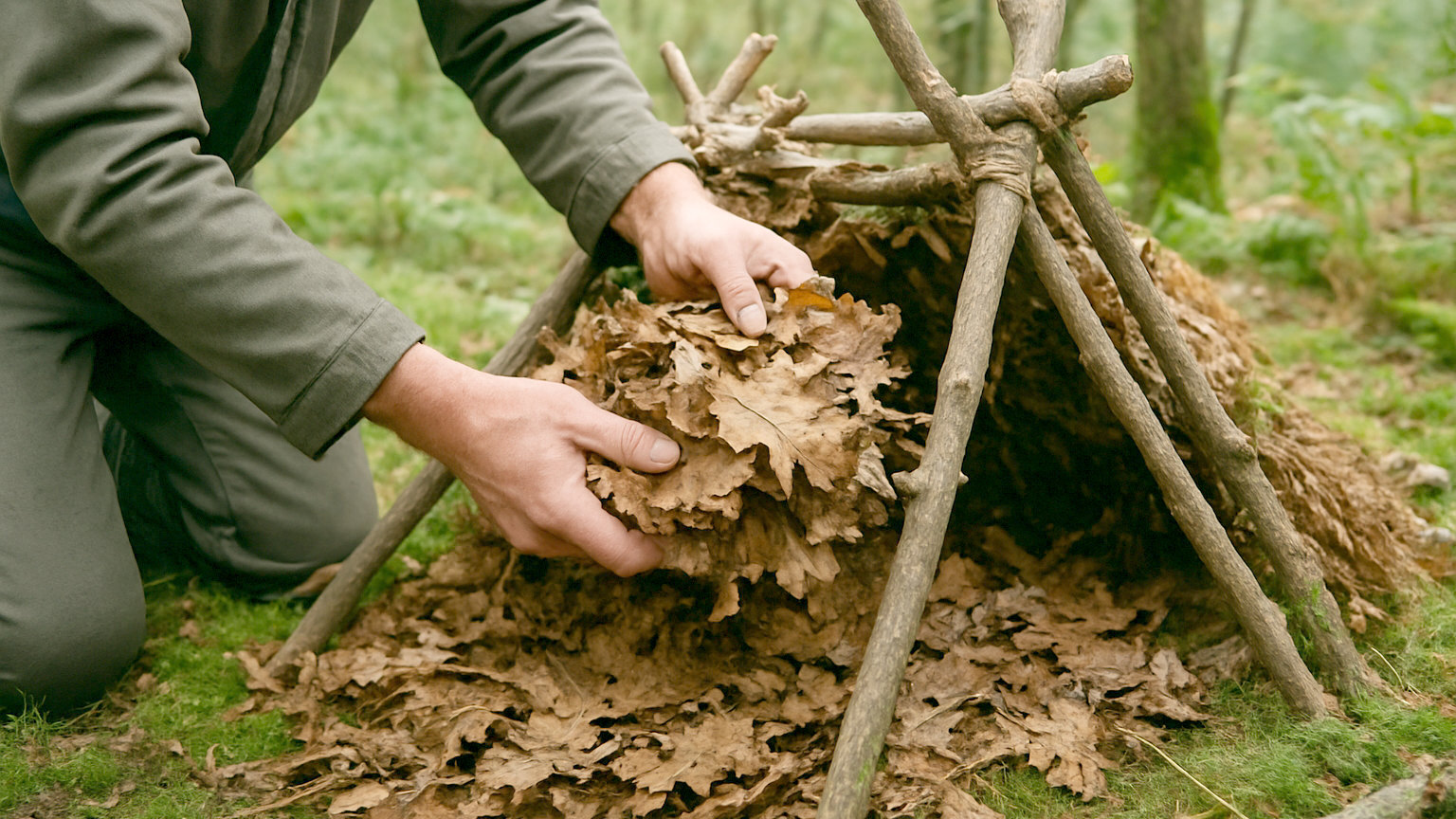
Find a ridge pole roughly a metre longer than your height and strong enough to take the weight of wet debris. Prop one end on a stump, a forked branch, a rock or a fallen trunk at about hip height, with the other end resting on the ground. Then lean shorter ribs along both sides at a steep angle, close enough together that debris will not fall through, forming a long triangular tunnel. Add a lattice of finer brush over the ribs to hold the smallest material in place.
- Ridge pole about a metre longer than you are tall
- Raised end at hip height, no higher
- Ribs leaned steeply on both sides to shed water
- Fine brush lattice over the ribs to retain small debris
- Debris piled at least sixty centimetres deep all over
- Interior stuffed full of the driest material available
How much debris do you actually need?
Far more than instinct suggests. Sixty centimetres of settled depth is the working minimum, and a metre is better in cold conditions. A useful test is to lie inside and look upward: if you can see daylight through the roof, it is not thick enough. Gathering this quantity is the bulk of the work, often two hours or more, and using a jacket or a large piece of bark as a drag sheet roughly doubles the rate at which you can move material.
Why does the interior need stuffing too?
Because the bedding matters more than the roof. Fill the inside with dry leaves, bracken, moss or grass until it is packed, then crawl in and compress it. You want at least twenty centimetres of compressed material beneath you, which means starting with a great deal more. The correct feeling on entering a finished debris hut is that there is barely room, because you are effectively burrowing into insulation rather than entering a room.
What about the entrance?
It is the largest heat leak in the structure and needs closing. Build a plug from a bundle of brush and debris, roughly the size of the opening, and pull it in behind you. Face the entrance away from prevailing wind, and downhill if the site slopes, so cold air draining down the slope does not run straight in. Some builders narrow the entrance deliberately so the plug seats tightly.
What conditions does it suit?
Temperate woodland with abundant leaf litter, which describes most of lowland Britain in autumn and winter. It works poorly on open moor, on grazed land where there is nothing to gather, and in summer when litter has broken down. In those places a tarp, a bothy bag or a different structure is the better answer, and recognising when the debris hut is the wrong tool saves hours of wasted effort.
How do you speed up the gathering?
Use a drag sheet, which roughly doubles the rate at which material moves. A waterproof jacket laid flat, a large slab of bark, or a groundsheet can be heaped with litter and dragged rather than carried in armfuls. Rake with a forked branch rather than your hands, which is faster and keeps you out of nettles and brambles. Work in a spiral outward from the shelter so you are never carrying further than necessary, and take the driest material from beneath dense cover first while you have the energy for the walk.
Build the frame in twenty minutes, spend two hours gathering, and the resulting heap will hold body heat through a night that a bare hillside would not.