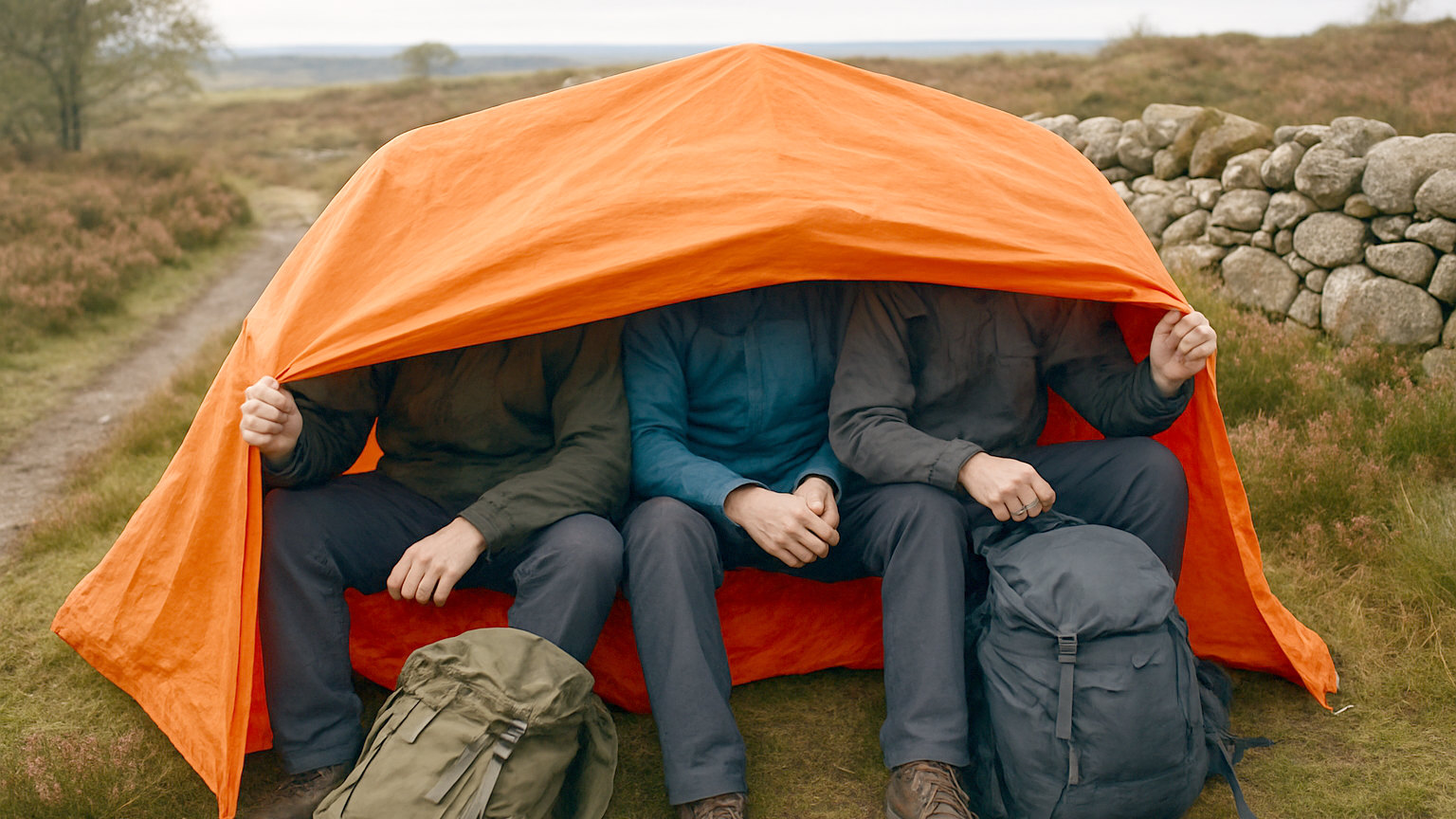
A bothy bag, also called a group shelter, is a coated fabric bag with no floor that a group sits inside on the ground, holding the edges down with their own weight. It is among the highest value items available for its weight in British hill walking, and it is routinely absent from packs.
How does it actually work?
By eliminating wind chill and trapping body heat. The fabric stops moving air entirely, which removes convective heat loss, and several bodies in an enclosed volume raise the internal temperature very quickly. Measured rises of ten to fifteen degrees within a few minutes are typical with a full complement of people. Small mesh vents near the top allow enough air exchange to prevent carbon dioxide build up while keeping the wind out.
When should you deploy one?
Far earlier than most people do. The common pattern is a group pressing on in worsening conditions until someone is genuinely hypothermic, when the shelter should have come out half an hour earlier. Legitimate reasons to deploy include waiting out a squall, taking a break in driving rain or wind, warming someone who is getting cold, managing an injured person while waiting for help, navigating and eating in comfort, and reassuring anyone who has become frightened or exhausted.
- Deploy early rather than as a last resort
- Sit on rucksacks or mats to insulate from the ground
- Keep the vents clear and the edges under everyone
- Buy for the group size you actually walk with
- Practise deployment in wind before you need it
Why does group size matter so much?
Because heating depends on bodies per unit volume. A four person shelter with four people inside is warm within minutes. The same shelter with one person is barely better than a survival bag, since one hundred watts cannot heat that volume. Manufacturers size them from two up to twelve or more, and the correct choice is the size matching your usual party. Two people carrying a two person shelter each is better than one person carrying an eight person shelter.
How does it compare to a survival bag?
They solve different problems. A survival bag is an individual sealed sack, usually orange polythene or a heavier duty version, which stops wind and rain for one person lying down. It is cheaper, lighter and better for an immobile casualty who needs to be wrapped. A bothy bag serves a group, keeps people upright and able to communicate, and lets you manage a casualty while sheltered alongside them. Many hill walkers carry both, since together they weigh under half a kilogram.
What is the correct way to get into one?
With the wind in mind, because a bothy bag in a gale behaves like a sail. Turn your back to the wind, have everyone gather close, lift it over the group from the upwind side and pull it down together, then sit down promptly on the hem. Sit on your rucksack or a foam mat, since the shelter has no floor and cold ground will undo much of the benefit. Once settled, locate the vents and keep them unobstructed.
What are the limitations?
Condensation builds quickly with several people breathing inside, so it becomes damp within half an hour or so. It provides no ground insulation whatsoever. And it is a stopping shelter rather than a sleeping one: viable for a night in an emergency, but uncomfortable enough that it should not be the plan. None of these outweigh the fact that it takes under a minute to deploy and can reverse a deteriorating situation.
How should you look after one?
Repack it dry and repack it loosely. Condensation leaves the inside damp after every use, and stuffing a wet shelter back into its bag encourages the coating to degrade and, in storage, to mildew. Air it fully at home before putting it away. Store it packed but not compressed for long periods, and keep it somewhere accessible in the pack rather than at the bottom, because a shelter you have to unpack everything to reach is one you will talk yourself out of deploying at exactly the moment it would help.
For under three hundred grams, a group shelter buys time, warmth and calm, which is why every mountain rescue team and outdoor instructor carries one.