Building from nothing is exhausting and slow. The faster answer, almost always, is finding a place that already provides part of a shelter and improving it, which converts a three hour build into a thirty minute one.
What natural features are worth looking for?
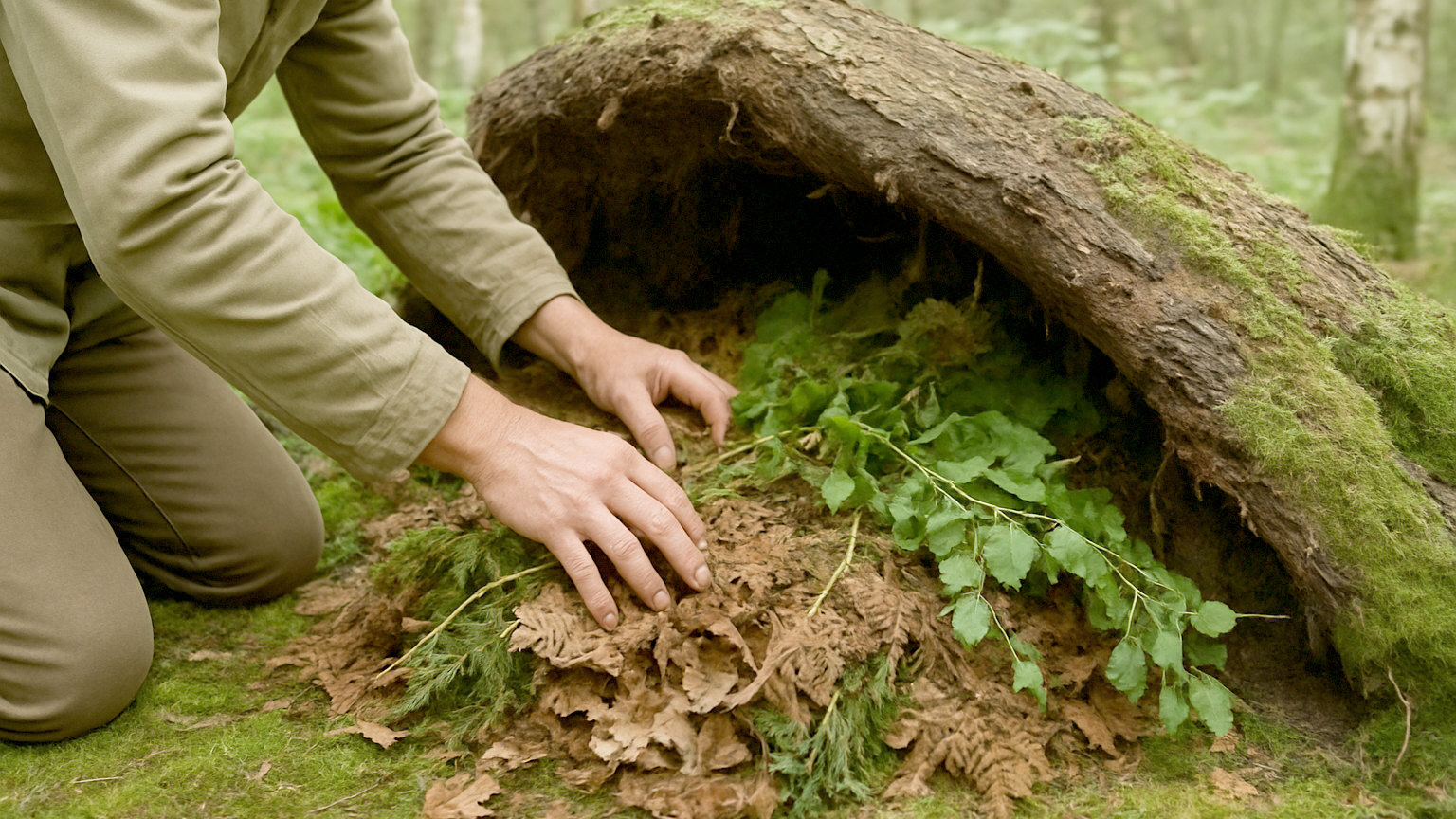
Anything that already blocks wind or rain from at least one direction. Rock overhangs and shallow caves are the obvious prize. Fallen trees resting at an angle provide a ready made ridge. The upturned root plate of a wind thrown tree gives a substantial vertical wall and often a dry hollow beneath. Dense evergreen stands, particularly mature spruce and yew, shelter dry ground and dry lower branches even in prolonged rain. A steep bank or a hollow behind a boulder blocks wind for no effort at all.
How do you use a fallen tree?
As a ready made ridge pole, which saves the heaviest and most awkward part of a debris hut. Lean ribs against one side, add a brush lattice, pile debris over it, and stuff the interior. Check first that the trunk is stable and not resting on something that could shift, and check what is above it. A large fallen trunk also serves as a windbreak, a fire reflector and a bench, and the space beneath a substantial one is often already dry.
- Rock overhangs and shallow caves, checked for water flow and animals
- Fallen trunks as ready made ridge poles
- Upturned root plates as instant walls
- Dense conifer stands with dry ground and dead lower limbs
- Hollows behind boulders and banks for wind shelter
- Thick bracken, gorse or heather stands for insulating material
What can your clothing and kit contribute?
More than people assume. A waterproof jacket becomes a roof panel across a small frame or a drag sheet for gathering debris. A rucksack keeps your legs off the ground and blocks an entrance. A survival bag, which weighs under a hundred grams and belongs in every daypack, provides a windproof and waterproof outer layer that transforms a marginal night. Even a bin liner with a head hole is a genuine improvement over nothing, and two of them with debris stuffed between is warmer still.
What should you avoid?
Caves that show signs of animal use, water flow marks on the walls, or loose material on the ceiling. Anything beneath dead branches or unstable trees. Hollows in valley floors that will fill with cold air and, in heavy rain, with water. Gorse and bramble that seems sheltering but makes movement and gathering painfully slow. And spending so long searching for the ideal feature that darkness arrives before anything is built.
How do you improve a natural feature quickly?
Close the gaps and insulate the floor, in that order. Lean brush against the open side to block wind. Pile debris against any wall that leaks air. Then gather bedding, because a rock overhang keeps rain off while conducting heat out of you enthusiastically. Twenty centimetres of compressed dry bracken beneath you will do more for the night than another hour spent on the walls.
When should you stop improving and settle?
When you are still generating heat and light is going. The most common serious mistake is continuing to work until soaked in sweat and then cooling rapidly in the dark. Set a point, perhaps an hour before dark, at which you stop building, put on dry layers, eat something and get into the shelter. What you have at that point is what you have, and being in it warm beats improving it cold.
What natural materials insulate best?
Dry bracken is the standout across most of Britain, being bulky, springy and abundant, and it resists compression better than leaf litter. Dry grass and heather work well. Conifer boughs laid in overlapping courses with the curve upward form a springy platform that stays off the ground. Moss is excellent for filling gaps but holds water readily, so use it as a packing material rather than as bedding. Avoid anything green and sappy underneath you, since living vegetation carries a great deal of moisture and will chill you steadily through the night.
Search first, build second, and let the landscape do as much of the work as it is willing to.