Where you build matters more than what you build. A crude shelter on a good site outperforms a well made one in a bad place, and most of the serious incidents involving overnight shelter come down to site choice rather than construction.
What should you look up at first?
Dead branches. Standing dead wood in the canopy, broken limbs hung up in the branches below, leaning or partially uprooted trees, and any tree with an obviously damaged root plate. These are known as widowmakers and they fall without warning, most often in wind or after heavy rain loosens things. Walk around any prospective site and look upward through the canopy before considering anything else, and move if you are uncertain, because the consequence is not a cold night but a serious injury.
What does the ground tell you?
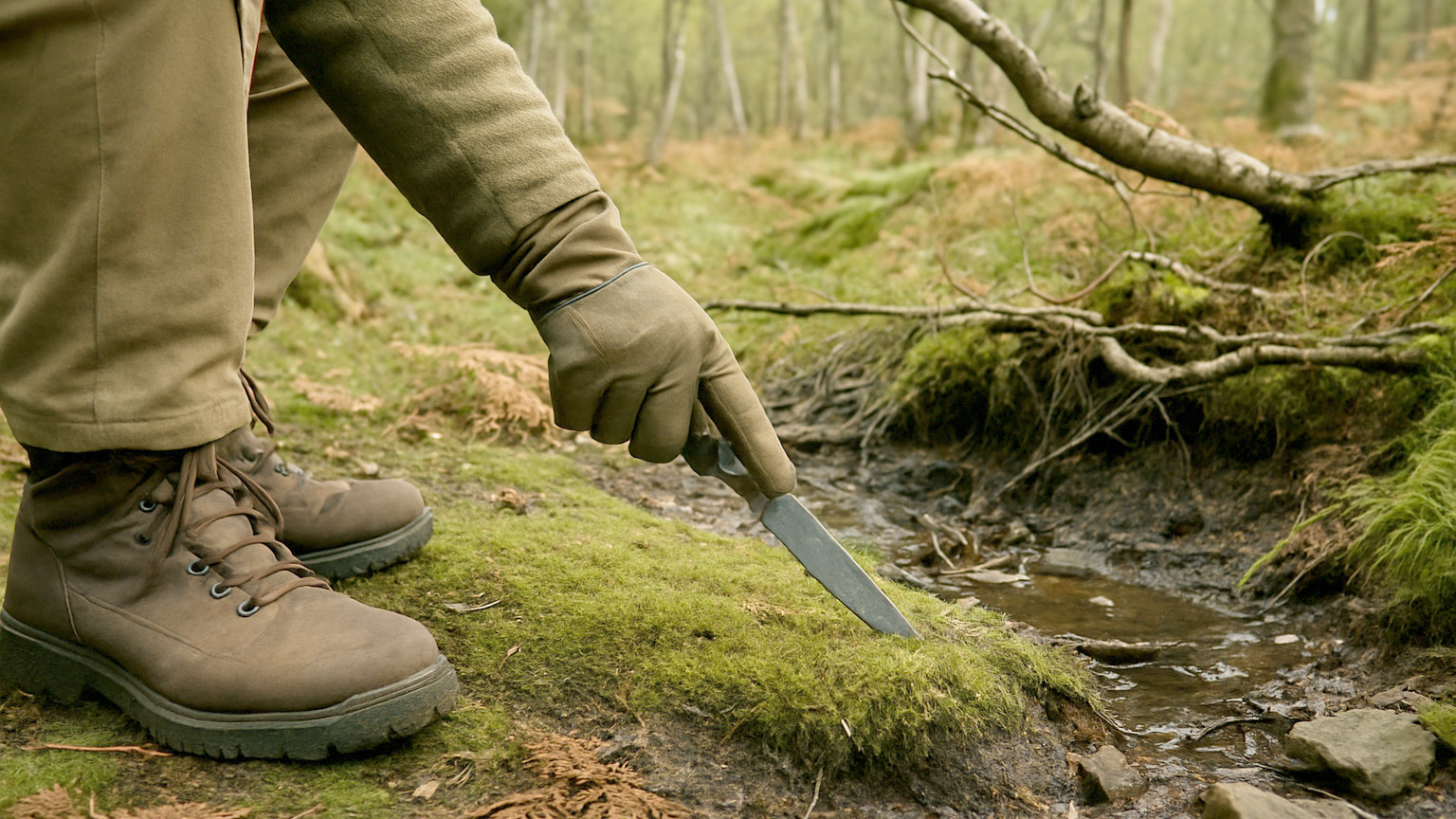
A great deal, if you read it. Flattened vegetation, debris caught in low branches and a scoured channel all indicate water has moved through recently. Bare gravel and rounded stones suggest a stream bed that is dry only temporarily. Moss and lush growth on one side indicates persistent damp. Look for slightly raised, well drained ground with established vegetation, which is the surest sign that water does not sit there.
- Check overhead for dead branches and unstable trees
- Avoid dry stream beds, gullies and anything that channels water
- Avoid valley floors and hollows where cold air collects
- Avoid ridge lines and cols where wind accelerates
- Avoid animal trails, nests and obvious insect activity
- Stay near water, fuel and building material without being on top of them
Why do hollows get so cold?
Because cold air is denser than warm air and drains downhill overnight, pooling in valley bottoms, hollows and behind obstructions. The temperature difference between a valley floor and a slope thirty metres above it can exceed five degrees on a clear still night, which is a meaningful margin when you are marginal. The best position is usually part way up a slope, high enough to be out of the cold sink and low enough to be out of the wind.
How close to water should you be?
Close enough to walk to, not close enough to be beside. Water attracts insects, sits in a cold hollow, produces damp air and mist, carries the risk of rising levels after rain upstream, and draws animals at night. Fifty to a hundred metres away and slightly above is the conventional compromise. It also protects the watercourse from your presence, which matters where others will drink from it.
What natural features can you use?
Look for anything that does part of the work. A fallen trunk becomes a ridge pole or a wall. A rock face reflects fire heat and blocks wind from one direction. Dense evergreen cover shelters dry ground and dry lower branches. A slight bank provides a windbreak. The best sites reduce construction from hours to minutes, and spending fifteen minutes searching for one usually saves more time than it costs.
What about wind direction?
Identify it before committing, because reorienting a finished shelter is not practical. Watch smoke, grass or cloud movement, and remember that valley winds commonly reverse between day and night as slopes heat and cool. Build with the closed side or the low edge facing prevailing wind, position any fire downwind of the shelter opening, and prefer partial shelter from terrain over full exposure, while avoiding the perfectly still hollow that will be the coldest place available.
What does a good site look like in practice?
Slightly raised, well drained ground on a gentle slope, part way up rather than at the bottom, with established vegetation showing that water does not stand there. Partial tree cover overhead but nothing dead within falling distance. A natural windbreak on the prevailing side, whether a bank, a boulder or dense scrub. Deep leaf litter or bracken within easy reach for bedding, dead standing wood nearby for fire, and water a few minutes walk away rather than immediately beside you. Sites meeting all of these are uncommon, and meeting most of them is usually enough.
Spend fifteen minutes choosing and two hours building, rather than the reverse, and most of the night takes care of itself.