The most common shelter failure is not poor construction. It is starting too late, running out of light, and finishing something inadequate in the dark while cold and tired. Knowing roughly how long each option takes turns that into a planning decision.
What are the realistic timings?
A tarp pitched as a lean to or plough point takes five to ten minutes once practised. A bothy bag takes under a minute. A snow trench takes twenty to thirty minutes. A basic lean to with natural thatch takes one to two hours. A properly built debris hut takes two to three hours for one fit person in good conditions. A quinzhee takes three to four hours including the ninety minute sintering wait. Every one of these figures roughly doubles in darkness, heavy rain or when you are already cold.
Where does the time actually go?
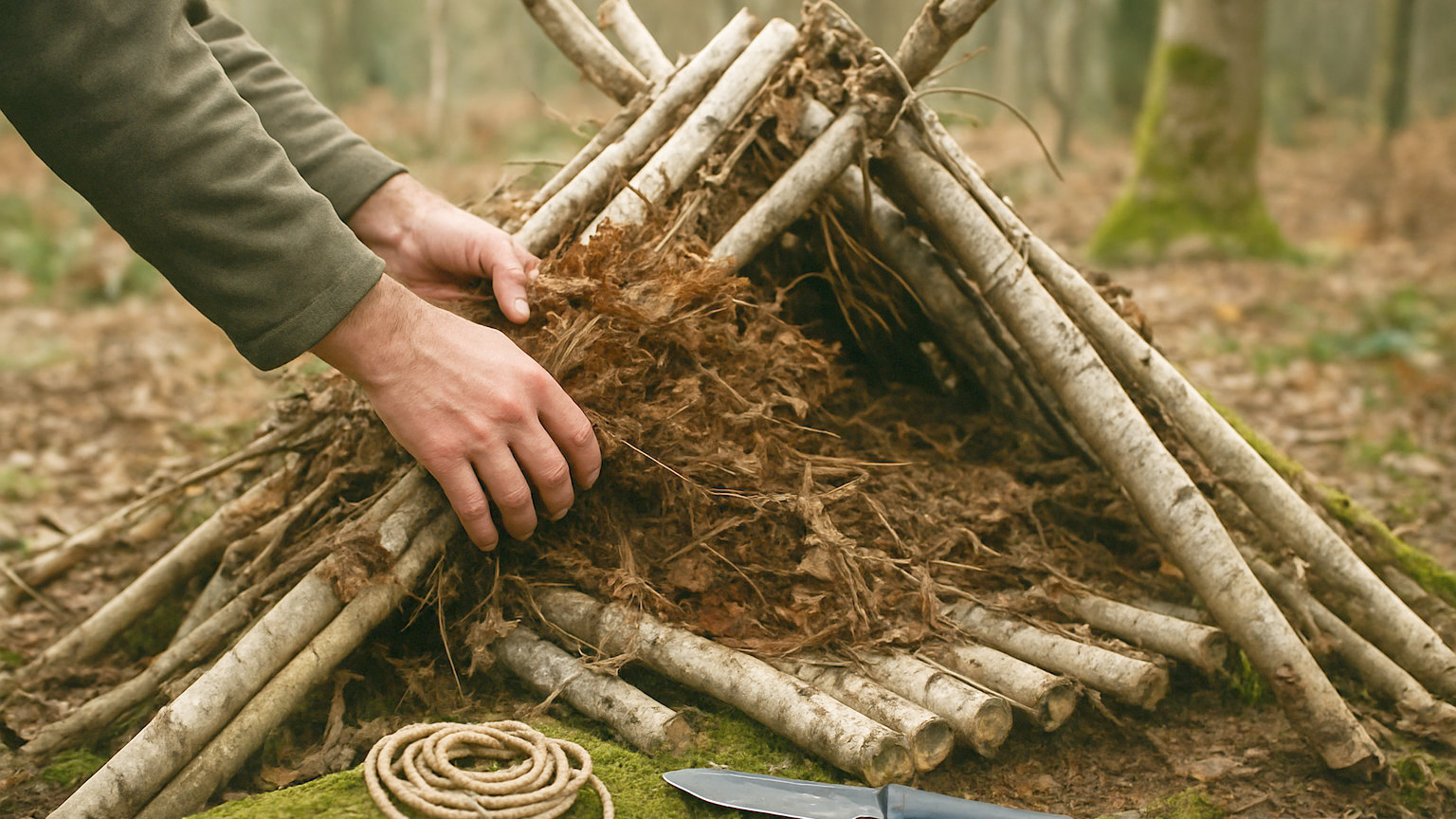
Gathering, overwhelmingly. Frame construction for a debris hut takes perhaps twenty minutes, and the remaining two hours or more is collecting debris and moving it. This is worth knowing because it identifies where to gain time: using a jacket or a bark slab as a drag sheet roughly doubles the rate of material movement, and choosing a site with deep leaf litter already present can halve the whole job.
- Bothy bag, under a minute
- Tarp shelter, five to ten minutes
- Snow trench, twenty to thirty minutes
- Improved natural feature, thirty to sixty minutes
- Thatched lean to, one to two hours
- Debris hut, two to three hours
- Quinzhee, three to four hours including settling time
When should you start?
Three hours before dark if building from scratch, and earlier in winter when the light goes quickly and the margin for error is smaller. In practice this means making the decision to stop travelling far earlier than feels natural, which is psychologically the hardest part. The instinct is always to press on for another hour, and that hour is usually the one you needed.
What should you build if time is short?
The simplest thing that solves the biggest problem, which is nearly always ground insulation and wind. A pile of bracken to lie on inside a survival bag, tucked behind a fallen trunk, takes fifteen minutes and delivers most of the benefit of a debris hut. A finished crude shelter beats an unfinished good one every time, and you can always improve it in the morning or during the following day.
How does cold change the calculation?
It shortens your working time and lengthens the job simultaneously. Manual dexterity drops sharply once hands cool, and shivering makes fine work impossible, so tasks that took twenty minutes take forty. The practical consequence is that time budgets should assume deterioration rather than steady output, and that anything fiddly, such as knots, cordage and fire preparation, should be done early while your hands still work.
Should you stop before you finish?
Yes, deliberately. Set a hard stop around an hour before dark, put on dry layers, eat something and get warm, regardless of what state the shelter is in. Working until soaked in sweat and then cooling in a half built shelter is a worse outcome than settling into something modest while still warm. Sweat is the enemy of a cold night, and it is produced by exactly the effort that builds shelters.
How do you plan the remaining daylight?
Work backwards from sunset rather than forwards from now. Decide what time it gets dark, subtract an hour for settling and eating, subtract the build time for whatever you intend to make, and that gives the moment you must stop travelling. In midwinter in Britain, with darkness arriving before four, this frequently means committing by early afternoon. Write the figure down or set an alarm, because the judgement that gets abandoned first is the one made while tired and pushing for one more hour of progress.
Start earlier than feels necessary, build simpler than you would like, and stop while you are still warm.