Compasses range from a few pounds to well over a hundred, and the expensive ones are not four times better for walking in Britain. Knowing which features actually contribute helps considerably.
What type should you get?
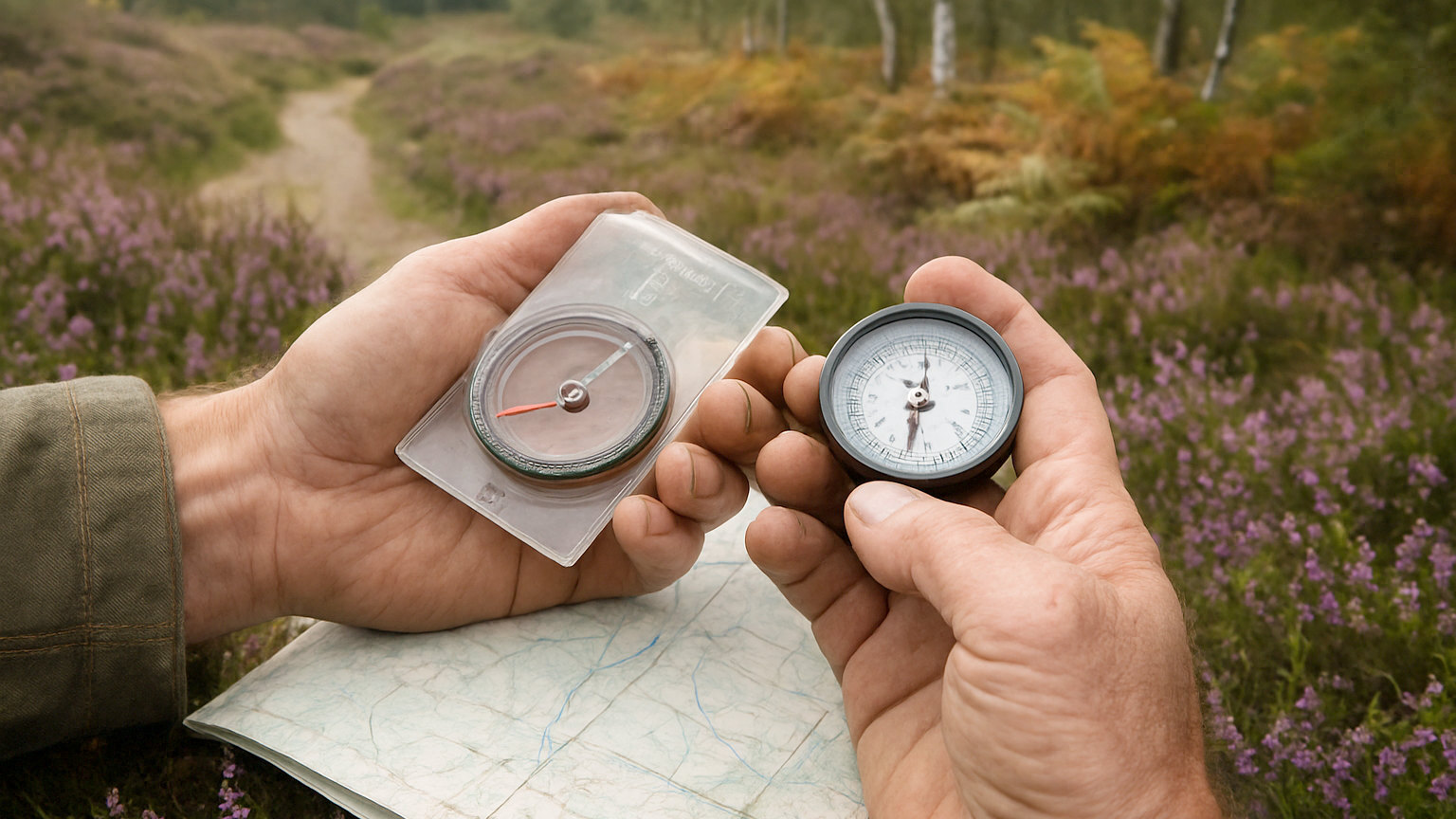
A baseplate compass, sometimes called a protractor or orienteering compass. It has a transparent rectangular base with a straight edge for laying on a map, a rotating housing marked in degrees, and a liquid filled capsule holding the needle. This design allows you to take a bearing directly from a map without any arithmetic, which is why it has been the standard for hill walking for decades. Button compasses and lensatic military compasses are both poorer tools for map work.
Which features genuinely matter?
A long straight edge, ideally the full length of the baseplate, since a short edge makes it hard to lay an accurate line across a map. Clear romer scales for one to twenty five thousand and one to fifty thousand, which make grid references far quicker and more accurate. Luminous markings on the needle and orienting arrow for use in poor light. A needle that settles quickly without excessive swinging. And a lanyard, because a dropped compass on a hillside is usually a lost compass.
- Long straight baseplate edge for accurate map work
- Romer scales for both common map scales
- Luminous needle and orienting arrow markings
- A needle that settles fast and stays settled
- A lanyard attachment point
- Degree markings at two degree intervals or finer
Is a sighting mirror worth it?
For most British hill walking, no. A mirror lets you sight along a distant object and read the bearing simultaneously, improving accuracy to perhaps one degree rather than two or three. That matters for mountaineering, for long legs in featureless terrain and for professional survey work. For walking bearings measured in hundreds of metres it adds cost, bulk and something to break, and the mirror is genuinely useful mainly for checking your face for cold injury or signalling.
What is a global needle?
A needle balanced to work in both hemispheres. The earth magnetic field dips downward at an angle that varies with latitude, so a needle balanced for northern latitudes will drag or stick near the southern hemisphere. Global needles use a mechanism allowing them to work anywhere. If you navigate only in Europe and North America, a standard northern hemisphere needle is entirely adequate and slightly steadier.
What should you avoid?
Compasses built into other objects, such as whistle compasses, watch compasses and zip pull compasses. They are toys, frequently inaccurate by tens of degrees, and their presence encourages people to leave a real compass at home. Also avoid any compass with a visible bubble in the capsule, since a large bubble affects needle movement, and avoid anything where the housing rotates loosely enough to shift in a pocket.
How do you look after one?
Keep it away from magnets and steel, which can reverse or weaken the needle polarity permanently. Phones, speakers, magnetic bag closures and camera lenses are common culprits, and storing a compass against one for months can ruin it. Avoid leaving it in direct sun or extreme heat, which can produce bubbles as the fluid expands. Check periodically against a known bearing to confirm it still reads correctly.
How much should you spend?
Around twenty to forty pounds buys a compass from a reputable maker with everything described above, and it will last decades. Below ten pounds the quality of the needle bearing and the accuracy of the markings both become questionable. Above fifty pounds you are usually paying for mirrors, clinometers and global needles, which are worth having only if you know why you want them.
Should you carry a spare?
On a serious trip, yes, and it need not be an expensive one. A compass can be dropped into a stream, sat on, or demagnetised by contact with a phone, and discovering that on a ridge in cloud is a poor moment. A second baseplate compass carried by another party member covers this at no real cost. It also allows two people to take independent bearings and compare, which catches errors that neither would notice alone.
Buy a mid range baseplate compass with romers, attach it to a lanyard, and spend the difference on a map case and a course.