Taking a bearing is the single most useful navigation skill there is. It converts a line drawn between two points on a map into a direction you can follow across ground you cannot see, and it works in fog, in darkness and on featureless moorland where nothing else will.
What are the three steps?
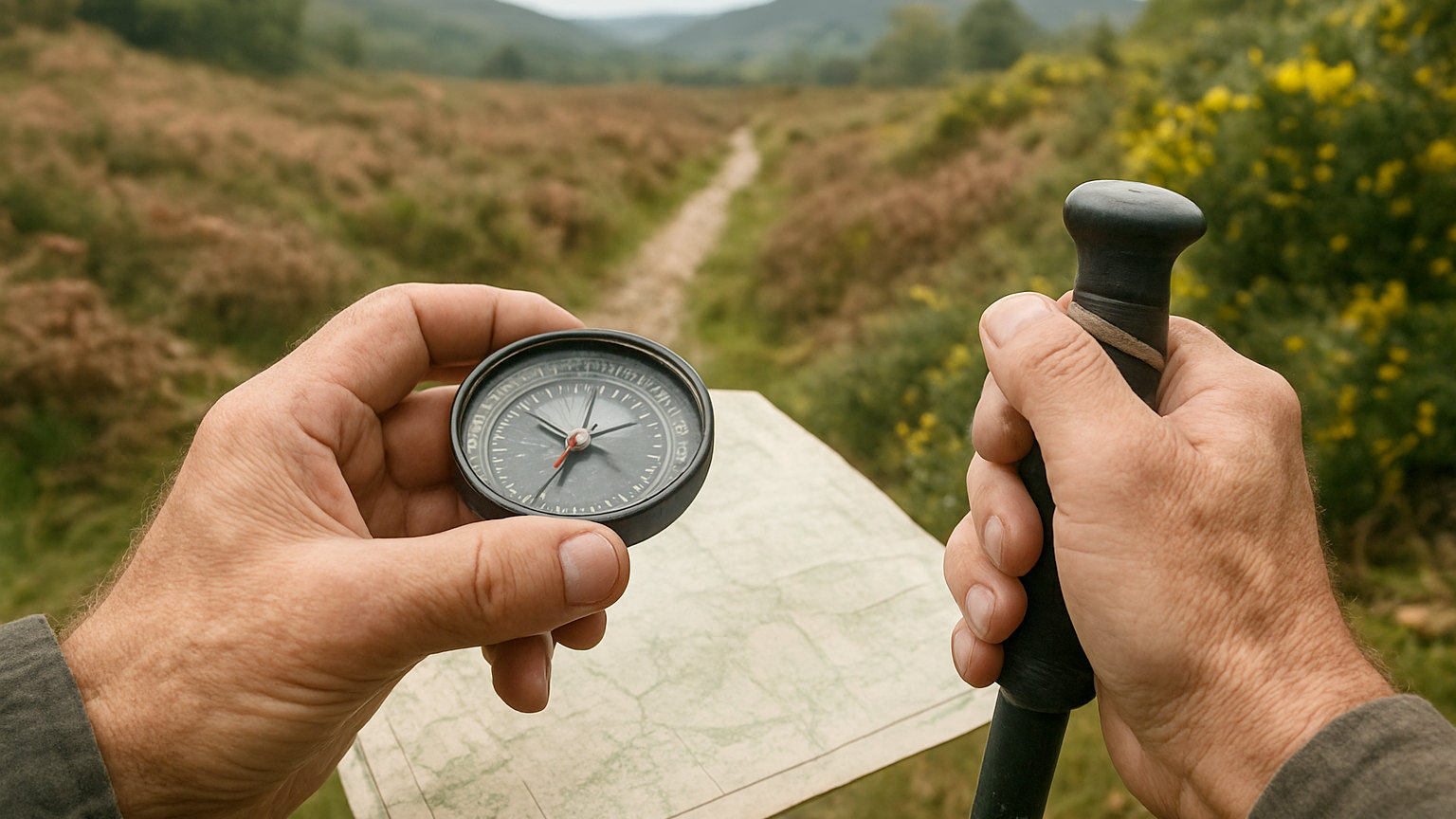
First, place the long edge of the compass baseplate along the line from where you are to where you want to go, with the direction of travel arrow pointing the way you intend to walk. Second, turn the rotating housing until the orienting lines inside it run parallel with the north to south grid lines on the map, with the orienting arrow pointing to the top of the map. Third, lift the compass off the map, hold it flat in front of you, and turn your whole body until the red magnetic needle sits inside the orienting arrow.
Why does the map stay still during the first two steps?
Because you are measuring an angle from the map, not from the ground. During those two steps the magnetic needle is irrelevant and can point wherever it likes. This is the part beginners find counterintuitive, and trying to align the needle while the compass is on the map is the most common single error. Ignore the needle entirely until the compass is off the paper and in your hand.
- Baseplate edge along the intended line of travel
- Direction of travel arrow pointing the way you are going
- Housing turned so orienting lines match the grid lines
- Orienting arrow pointing to the top of the map
- Compass lifted, body turned to put red in the shed
What does putting red in the shed mean?
It is the standard mnemonic for the final step. The red end of the magnetic needle must sit exactly inside the outline of the orienting arrow, which resembles a shed or a garage marked on the base of the housing. When the two align, the direction of travel arrow points along your bearing. Turn your body rather than the compass housing at this stage, because turning the housing changes the bearing you carefully measured.
How do you actually walk it?
Not by staring at the needle, which produces a wandering line and a sore neck. Sight along the direction of travel arrow, pick a distinctive object on that line ahead of you such as a boulder, a fence post or a distinctive tree, then put the compass away and walk to it. On arrival, take out the compass, sight again, pick another object, and repeat. This is called leapfrogging and it is far more accurate over distance than continuous needle watching.
What if there is nothing to sight on?
In fog, darkness or on featureless ground, use a person. Send a companion ahead to the limit of visibility, direct them left or right until they are exactly on your bearing, then walk to them and repeat. Alone, you can sight on a thrown object, or accept a slightly less accurate line by watching the needle intermittently while keeping a steady pace. Pairing the bearing with pacing and timing to measure distance becomes essential when visibility is poor.
Does magnetic variation need adding?
Across Britain, currently very little. Magnetic north and grid north have drifted close together over recent decades, and across most of the country the difference is now small enough to be immaterial for walking bearings. It is not zero everywhere and it changes slowly, so check the compass rose printed in the legend of your map, which states the value and the annual change for that sheet. Elsewhere in the world the difference can exceed twenty degrees and must be applied.
How accurate should you expect to be?
A carefully taken and carefully walked bearing is typically accurate to within a few degrees, which translates to roughly fifty metres of error over a kilometre. That is fine for finding a broad feature such as a ridge line or a wall, and it is not fine for finding a small one such as a gate or a cairn. For small targets, deliberately aim off to one side so you know which way to turn on arrival.
Practise the three steps in a garden until the sequence is automatic, because doing it for the first time in wind and rain is not when you want to be thinking it through.