Natural navigation will not replace a compass, and anyone suggesting otherwise is overselling it. What it will do is keep you travelling in a broadly consistent direction, which is often the difference between reaching a road and walking in a circle.
How do you use the sun?
By knowing roughly where it should be. In the northern hemisphere the sun rises in the east, is due south at solar noon, and sets in the west. Solar noon in Britain falls around one in the afternoon during British Summer Time, and the sun moves fifteen degrees per hour. This gives a usable running check on direction throughout the day, though the rising and setting points shift considerably north or south of due east and west with the seasons.
What is the shadow stick method?
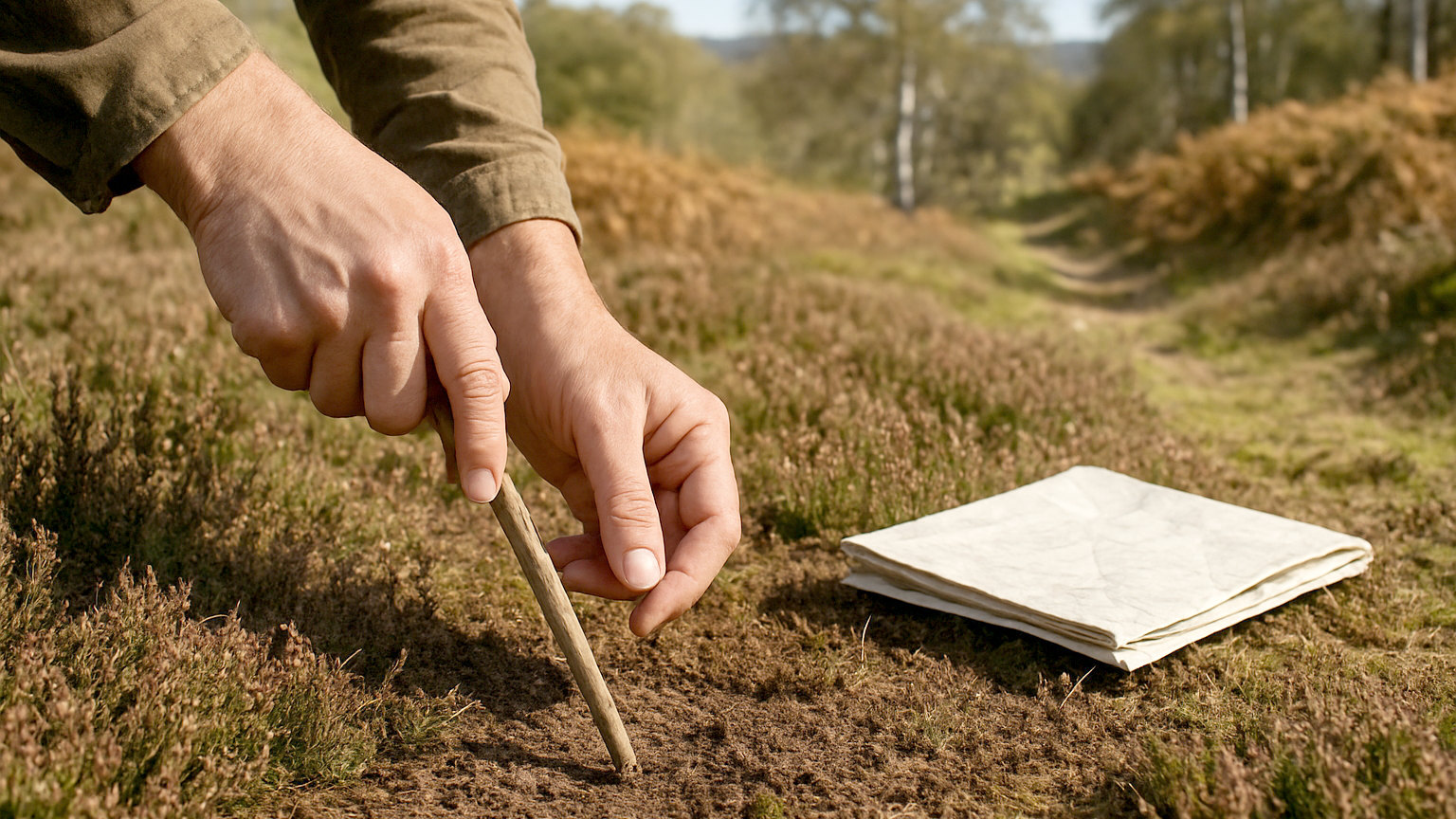
Push a stick vertically into level ground and mark the tip of its shadow with a stone. Wait fifteen to twenty minutes and mark the new tip position. A line drawn from the first mark to the second runs approximately west to east, because shadows move eastward as the sun travels west. Stand with the first mark to your left and the second to your right and you are facing roughly north. It takes twenty minutes and gives a rough but genuinely useful fix.
- Sun due south around one in the afternoon in summer time
- Shadow stick, two marks twenty minutes apart, gives west to east
- Polaris, found via the Plough, sits almost exactly north
- Analogue watch method, hour hand to sun, bisect to twelve
- Terrain features such as coastlines, rivers and ridges as handrails
How do you find north from the stars?
Through Polaris, the North Star, which sits within a degree of true north and does not move through the night. Find the Plough, the seven bright stars also called the Big Dipper, and identify the two stars forming the far side of its bowl. Extend an imaginary line upward from those two, about five times the distance between them, and it arrives at a moderately bright isolated star. That is Polaris, and it is the most reliable directional reference available without instruments.
Does the watch method work in Britain?
Approximately. Hold an analogue watch flat, point the hour hand at the sun, and bisect the angle between the hour hand and twelve to find roughly south. During British Summer Time, bisect toward one rather than twelve. It is accurate to perhaps twenty or thirty degrees at British latitudes, which is enough to avoid walking in circles and not enough to hit a small target.
Which natural signs are unreliable?
Most of the ones people quote. Moss grows on whichever side is dampest and shadiest, which is often but by no means always the north. Church orientation is a broad tendency with many exceptions. Prevailing wind shaping trees is real but varies locally with terrain. Satellite dishes pointing south east is a genuinely useful urban indicator in Britain. Treat any single sign as weak evidence and look for several agreeing before trusting the conclusion.
What matters more than finding north?
Using the landscape. Rivers run downhill and reach the sea, valleys lead somewhere, coastlines are unmistakable handrails, and following a watercourse downstream will eventually reach habitation in Britain. Contouring around a hillside rather than crossing it keeps you on a consistent level. These techniques do not require knowing which way is north at all, and in poor visibility they are considerably more reliable than any celestial method.
How accurate should you expect to be?
Within twenty degrees or so at best, which over ten kilometres is an error of several kilometres. That is perfectly adequate for reaching a long linear feature such as a road, a coast or a valley, and hopeless for finding a specific building. Plan accordingly by aiming for large targets, and treat natural navigation as a way of not getting more lost rather than as a way of arriving precisely.
Learn Polaris and the shadow stick, use rivers and ridges as handrails, and carry a compass anyway, because it weighs thirty grams.