Navigation in clear weather is largely a matter of looking around. Remove visibility and every technique that depends on seeing where you are going stops working at once, which is why poor visibility exposes weak navigation more reliably than any other condition.
What changes when the cloud comes down?
You lose landmarks, distance judgement and often any sense of direction. Featureless white ground removes depth perception entirely, so slopes, cornices and drops become invisible until you are on them. People also drift consistently to one side when walking without a reference, so a route walked on instinct curves steadily. Every one of these is addressed by working from bearings and measured distance rather than from what you can see.
How should you break up the route?
Into short legs, far shorter than in good weather. Two or three hundred metres between defined points is typical, with each leg having its own bearing and pace count. Errors then stay small and are detected quickly, whereas a single kilometre long leg lets an error grow to the point where relocation becomes difficult. Legs should end at something identifiable by touch or shape, such as a stream, a wall, a col or a break of slope.
- Break the route into legs of two to three hundred metres
- Take a fresh bearing and pace count for each leg
- Aim off deliberately toward long linear targets
- Use contour shape rather than landmarks to confirm position
- Send a companion ahead as a sighting mark
- Slow down and accept that the pace will be poor
How do you walk a straight bearing with nothing to sight on?
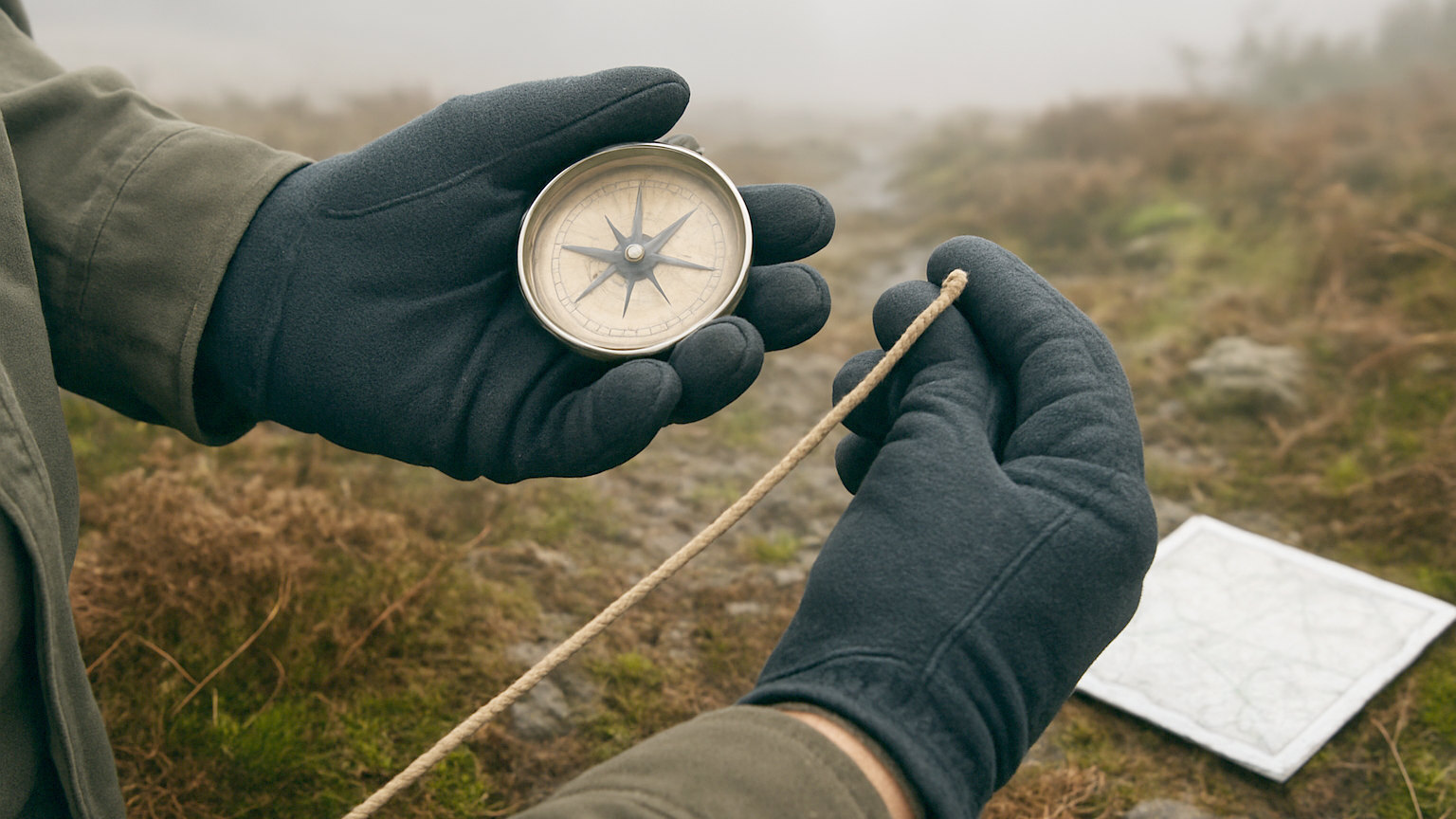
Use a person. Send a companion ahead to the edge of visibility, direct them left or right until they sit exactly on the bearing, then walk to them and repeat. This is far more accurate than following the needle alone and it keeps the group together. Alone, sight on any object you can make out even briefly, and if there is genuinely nothing, watch the needle continuously and accept reduced accuracy while pacing carefully.
What is contour interpretation?
Navigating by the shape of the ground under your feet rather than by what you can see. Which way does the slope fall, and how steeply? Has it just eased or steepened? Are you crossing a spur or entering a re-entrant? These observations are available in zero visibility and correspond directly to the contour pattern on the map. In cloud on a broad hillside it is often the only positional information available, and it is more reliable than it sounds.
What is particularly dangerous in a whiteout?
Cornices and convex slopes. A cornice is an overhanging lip of wind blown snow at a ridge crest, and it can extend metres beyond the ground beneath, breaking without warning under weight. In flat light the edge is invisible. Keep well back from ridge crests, navigate to hit a ridge at right angles rather than following its edge, and treat any ground that curves away out of sight as potentially not ground at all.
Should you carry on or turn back?
Ask whether your navigation is actually working, honestly. If legs are ending where they should and features appear as expected, continuing is reasonable. If you have missed two features in a row, or cannot confirm your position at all, the situation is deteriorating and turning back along a known route is the sound decision. Descending on a bearing into an unknown valley is a last resort, since valleys in mountainous country frequently end in crags.
How do you prepare for it?
By practising in good weather, which is the only sensible time to learn. Walk short legs on bearings with the map put away, checking afterwards. Measure your pace count on different terrain. Learn to read contour shape by predicting the ground ahead. Doing all this for the first time in cloud on a cold ridge is a poor introduction.
Short legs, careful bearings, counted paces and constant attention to the shape of the ground. It is slow, methodical and entirely learnable.