Navigating in darkness relies on the same techniques as daylight, applied with more discipline. What changes is that you lose distant reference, gain a very bright circle of nearby detail, and slow down considerably.
What does a torch do to your vision?
It trades distance for detail. A bright beam illuminates the ground immediately ahead beautifully and destroys your ability to see anything beyond it, because your eyes adapt to the bright circle. Full dark adaptation takes twenty to thirty minutes and is lost in seconds. On a clear night with moonlight or even starlight, switching the torch off entirely often reveals far more of the landscape than leaving it on, including ridge lines and skylines that are genuinely useful for orientation.
How should you use a head torch?
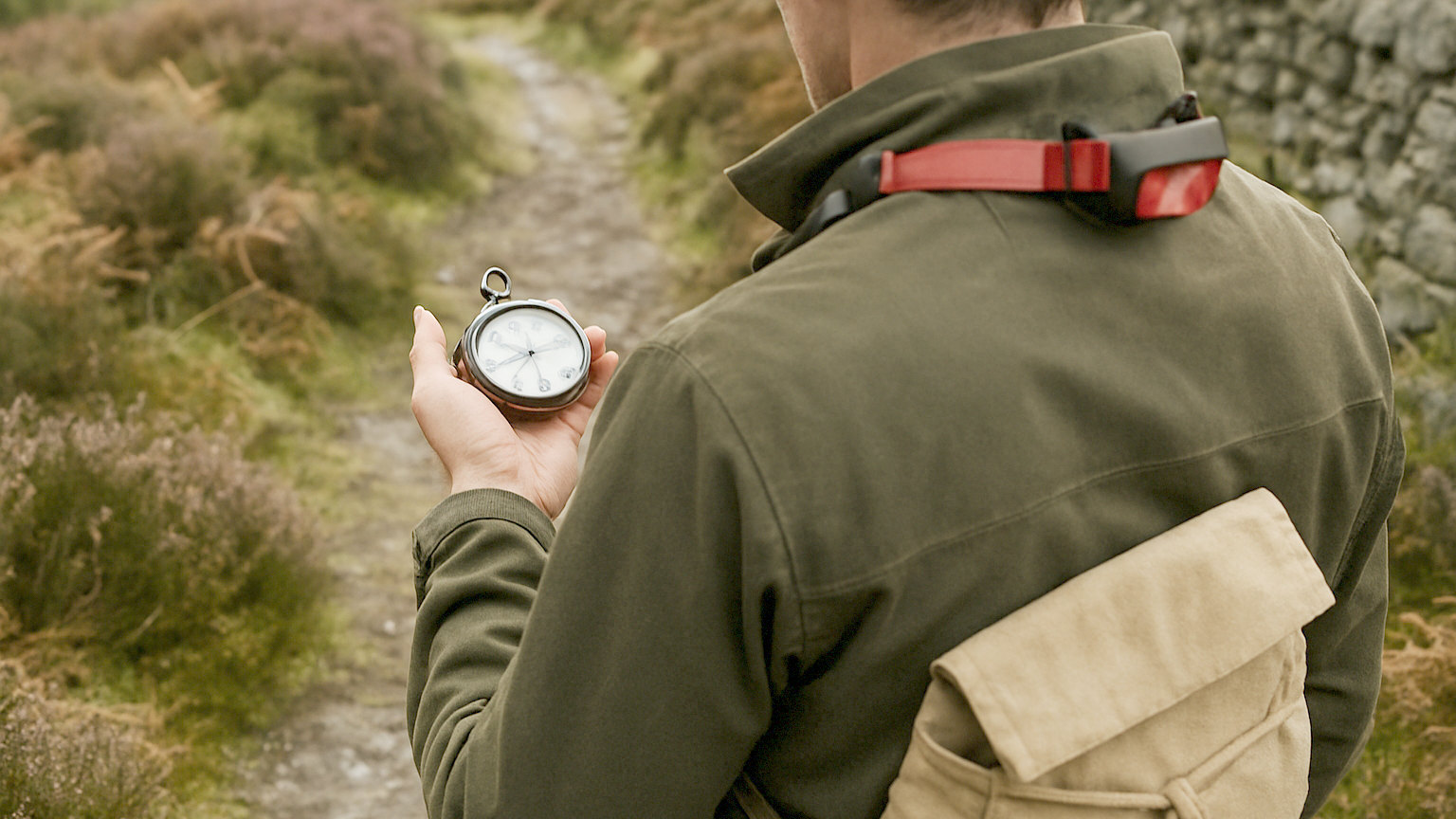
On the lowest setting that works, and off whenever practical. Use red light for reading the map, since red preserves night vision far better than white. Keep the beam angled down at the ground a few metres ahead rather than out toward the horizon, which reduces glare and keeps others from being dazzled. In mist or falling snow, a bright beam reflects straight back and makes things worse, so dropping the power usually improves visibility.
- Use the lowest useful setting and turn it off when possible
- Use red light for map reading to protect night vision
- Shorten legs and take fresh bearings more often
- Rely on pacing and timing rather than on visual estimation
- Carry spare batteries and a backup torch
- Watch the skyline, which stays visible long after the ground does not
How do the techniques change?
Legs get shorter and precision matters more. Use two hundred metre legs where you would use five hundred in daylight, take a fresh bearing for each, and count paces throughout. Aiming off becomes more valuable, since you cannot scan along a wall to spot a gate. Catching features become essential, because overshooting is easy and hard to detect. Handrails such as walls, fences and streams are worth going out of your way to use.
What is harder to judge in the dark?
Distance and angle, both substantially. Objects appear closer than they are, slopes look shallower, and drops are close to invisible until you are at them. Ground that reads as a gentle bank in torchlight may be a steep bank. Because of this, night navigation on complex or steep terrain deserves considerably more caution, and routes with any exposure should be treated as significantly more serious than the same ground by day.
What can you actually see without a torch?
More than expected once adapted. Skylines are usually visible against even a moderately clear sky, which makes ridge and summit shapes readable. Water reflects and shows as a lighter patch. Snow and light coloured rock stand out. Paths often appear as a subtle difference in texture. Learning to use this, and reserving the torch for map reading and difficult ground, makes for far more pleasant and often faster movement.
How do you keep a group together?
Deliberately, since a group spreads out much faster in darkness and someone falling behind is not noticed. Put a competent person at the back, agree that the front waits at every junction, and count heads at each stop. Reflective markings or a rear facing red light on each person help enormously. Agree in advance what happens if someone becomes separated, which is normally to stop and wait rather than to search.
How should you practise?
On familiar, gentle ground first, ideally somewhere you have walked in daylight the same week. Winter afternoons in Britain make this easy, since darkness arrives early enough that a short evening walk gives real practice without a late finish. Build up to unfamiliar terrain only once the basic routine of bearing, pacing and short legs is comfortable.
Slow down, shorten the legs, protect your night vision, and night navigation becomes a pleasant skill rather than an ordeal.