Fungi foraging is genuinely rewarding and carries a level of risk unlike anything else in British foraging. This article is about how to approach the subject safely and deliberately contains no identification guidance, because identification from written description is exactly how people are poisoned.
Why are fungi so much riskier than plants?
Because the deadly species resemble edible ones closely, because the toxins involved are among the most lethal in nature, and because there are no reliable general rules. A single death cap contains enough amatoxin to kill an adult, and amatoxins are not destroyed by cooking, drying or freezing. Identification depends on features including gill attachment, spore colour, the presence of a volva at the base, habitat and associated tree species, all of which require training to assess.
Which species should you learn first?
The lethal ones. Death cap, destroying angel, deadly webcap, fool funnel and the deadly Galerina species between them account for the great majority of fatal mushroom poisonings in Europe. Learning to recognise these before learning any edible species is the single most protective step available, and it is the approach every reputable course takes.
- Learn the deadly species before any edible ones
- Learn with an experienced forager, over several seasons
- Never rely on an app, a photograph or a written description
- Examine the whole fruiting body including the base
- Ignore all folk rules about tests, colour and animals
- Keep a sample of anything eaten, in case of illness
Why is the base of the mushroom so important?
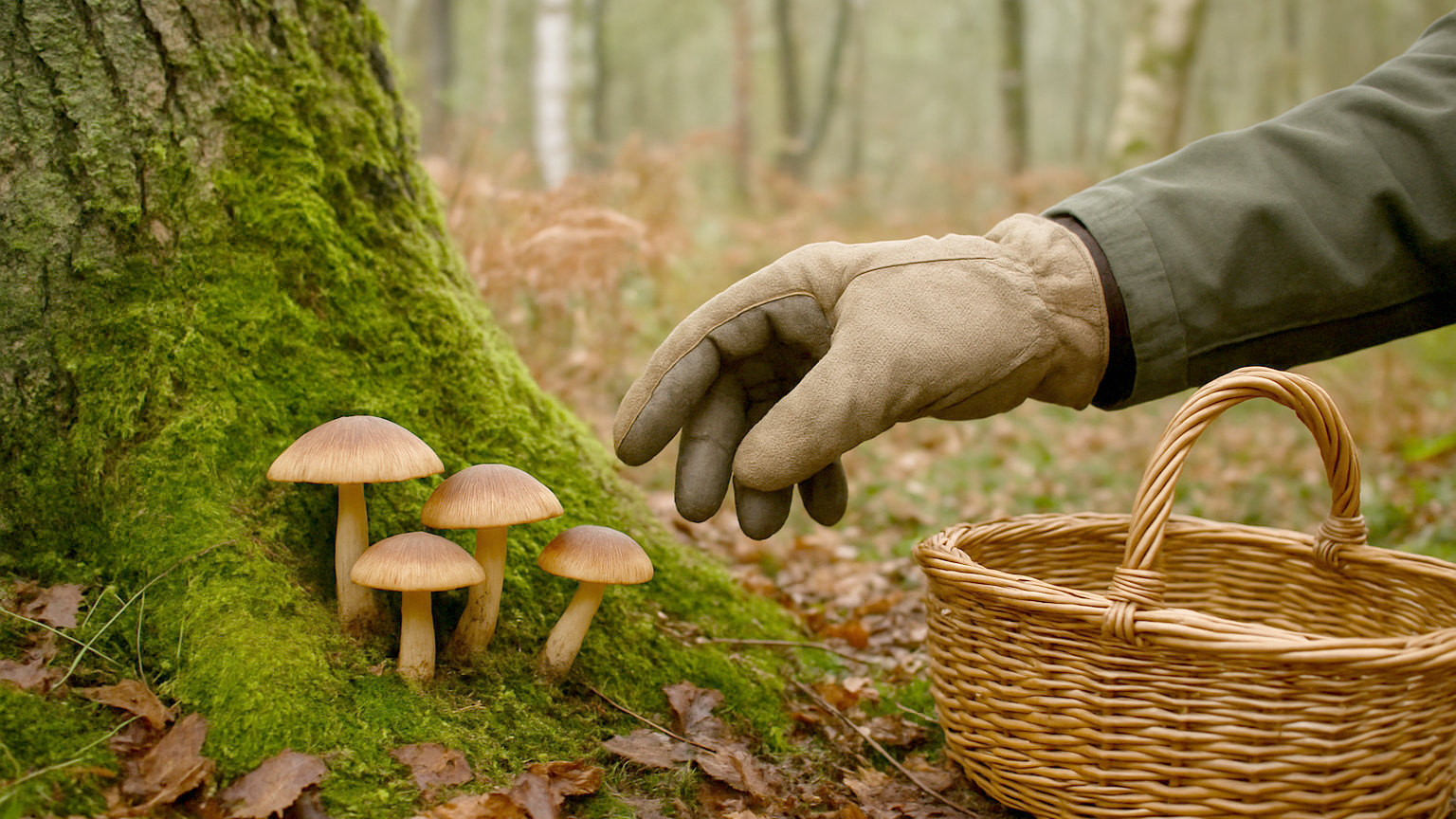
Because the features that identify the most dangerous genus are found there. Amanita species, which include the death cap and destroying angel, have a cup like structure called a volva at the base, often below soil level. Cutting a mushroom at ground level rather than lifting it removes the very evidence needed to identify it. This is why foragers dig or lever the whole fruiting body out and examine it complete.
Are the traditional tests reliable?
None of them. Mushrooms that peel are not safe, silver spoons do not tarnish in the presence of toxins, mushrooms growing on wood are not automatically edible, and the fact that a slug or a squirrel has eaten something means nothing, since animals metabolise toxins differently. Every one of these rules appears in circulation and every one has contributed to poisonings. There is no test, only identification.
Why do apps and books fall short?
Because photographs lose the information that matters. Smell, texture, how the flesh bruises, spore print colour, gill attachment and the surrounding habitat and tree species all contribute to identification, and none photographs well. Apps regularly misidentify, including confidently. They are useful for learning and for narrowing possibilities, and they are not a basis on which to eat anything.
What happens with amatoxin poisoning?
Symptoms are delayed six to twenty four hours, which is the feature that makes it so dangerous. Severe vomiting and diarrhoea follow, then an apparent recovery lasting a day or two, then liver and kidney failure. By the time anyone feels ill, the damage is under way. Treatment can require a liver transplant. Anyone who suspects they have eaten a toxic mushroom should go to hospital immediately rather than waiting for symptoms, and take a sample of what was eaten.
How should you learn properly?
By going out with people who know. Local fungus groups, wildlife trusts and dedicated courses run forays throughout autumn, and a season of these teaches more than any book. Start with a small number of species that are both distinctive and have no deadly lookalikes, learn them completely, and expand slowly. Many experienced foragers eat only a handful of species by choice.
What is a spore print and why does it matter?
A basic identification technique in which a cap is laid gill side down on paper for several hours, leaving a deposit of spores whose colour is a key identifying feature. Spore colour separates genera that look similar to the eye, and it is one of the standard checks any careful forager performs before eating anything. It also illustrates why fungi cannot be identified from a photograph, since the single most diagnostic feature is invisible until you have taken the specimen home and waited.
Learn the killers first, learn in person, and accept that this is the one area of foraging where books and articles genuinely cannot make you safe.