Wet wood does not refuse to burn out of stubbornness. Water in the wood absorbs an enormous amount of the energy your fire produces, and until that water has been driven off, the wood cannot reach the temperature at which combustion begins.
What is actually happening inside wet wood?
Wood needs to reach roughly two hundred and fifty degrees centigrade before the volatile gases inside it begin to burn. Water boils at one hundred degrees and absorbs a large amount of energy in changing to steam. Until every trace of moisture in a piece has boiled away, that piece cannot rise above the boiling point, so it sits there hissing and steaming while your fire burns through fuel trying to heat it. Freshly cut wood can be over half water by weight, which is why green wood is effectively unburnable.
How can you test wood without a meter?
Several field tests work well. Snap it: dry wood breaks with a sharp crack, wet wood bends or tears with a dull sound. Knock two pieces together: dry wood rings, wet wood thuds. Look at the ends for radial cracks, which appear as wood dries and shrinks. Feel it against your lip, where skin is sensitive enough to detect the coolness of evaporating moisture. Weight is a good guide too once you have handled enough wood, because dry pieces feel surprisingly light.
- Snap test, listening for a sharp crack rather than a dull tear
- Knock test, listening for a ring rather than a thud
- Check cut ends for radial drying cracks
- Look for loose bark, which detaches as wood dries
- Take standing dead wood rather than anything on the ground
Why is standing deadwood so much better?
Wood on the ground is in contact with soil and constantly wicks moisture upward, so even after a dry week it will be wet through. Wood still standing, or leaning clear of the ground, is exposed to air on all sides and dries continuously. Dead branches still attached to a tree are the single best source of usable fuel in a wet landscape, particularly the lower dead limbs of conifers which sit under the shelter of the canopy above.
How does splitting help?
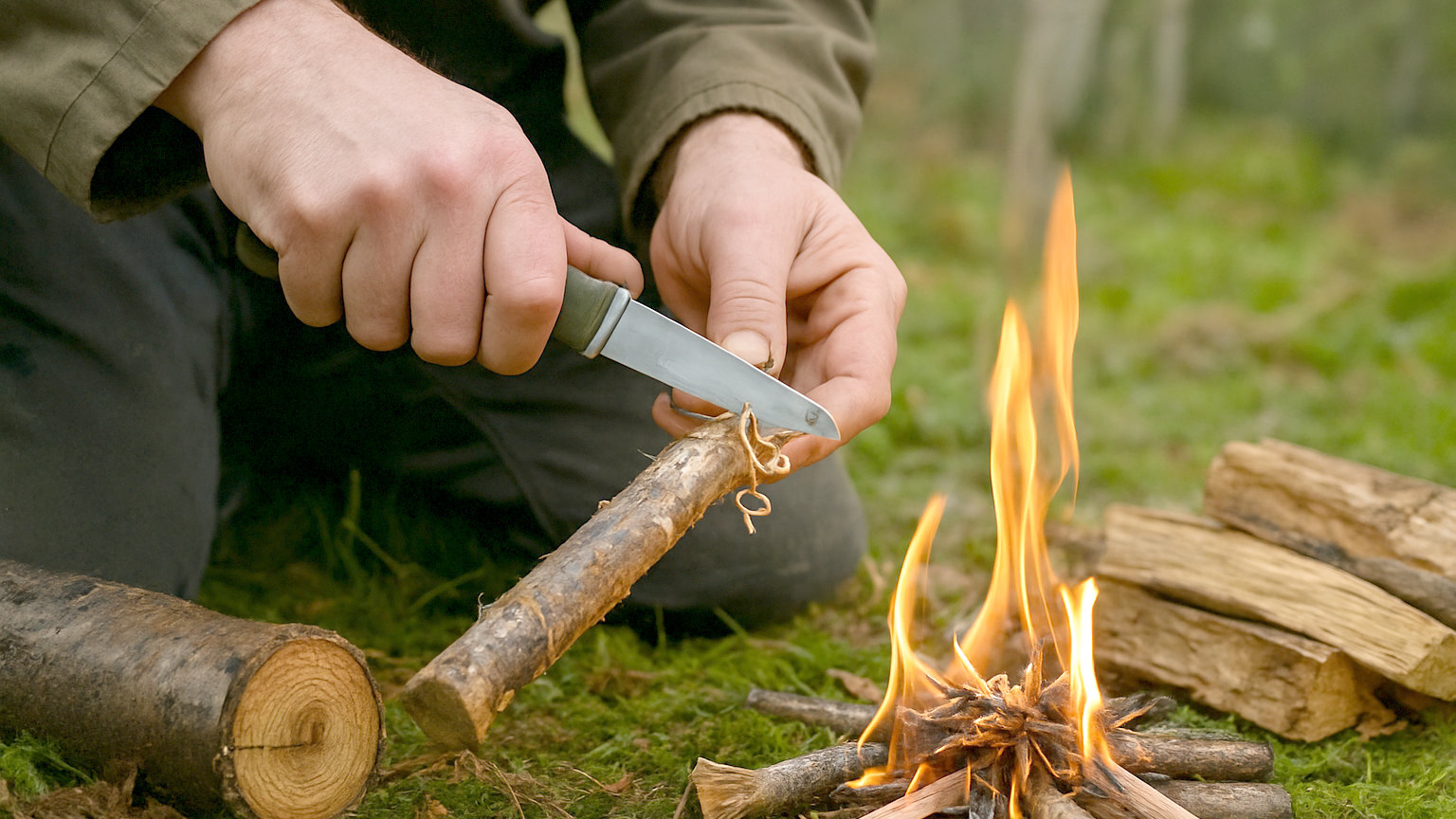
Enormously, and it is the most useful technique available. Rain penetrates wood slowly, so the interior of a soaked log is usually dry. Splitting exposes that dry heartwood, and splitting repeatedly produces fine dry kindling from material that looked useless. It also increases surface area, which speeds both drying and ignition. A knife that can be batoned through wood, or a small axe, turns a wet woodland from a problem into a fuel supply.
Can you dry wood at the fire?
Yes, and you should do it routinely. Once a fire is established, stack damp wood around and above it, close enough to receive heat but not close enough to catch. The rising heat drives moisture out over twenty to thirty minutes, so by the time you need each piece it is far more usable than when you collected it. Keep a continuous rotation going: wet wood drying, dry wood burning. On a long evening this is the difference between a fire that struggles and one that behaves.
What about seasoned firewood at home?
Properly seasoned firewood sits below twenty percent moisture, which takes twelve to twenty four months of covered air drying. Burning wetter wood wastes most of its energy, coats the flue in creosote and raises chimney fire risk. Since 2021 it has been illegal in England to sell wood above that threshold in volumes under two cubic metres.
Which species cope best with being damp?
Ash is the traditional answer and deserves its reputation, because it has a lower green moisture content than most native hardwoods and burns acceptably sooner. Birch lights readily thanks to the oils in its bark, though it burns fast. Conifers such as pine and spruce are resinous, catch easily and are excellent for kindling even when the surface is damp, but they spit and produce more soot. Willow, poplar and alder hold water badly and are frustrating unless very well dried. None of this outranks how and where the wood has been stored, but it is a useful tiebreaker when you have a choice.
Split it, raise it off the ground, dry it beside the fire, and wet wood becomes an inconvenience rather than a barrier.