Char cloth is one of the oldest pieces of fire lighting technology still in regular use, and it solves a specific problem: catching a spark too weak or too brief for ordinary tinder. It is also almost free to make from material you already have.
What actually is char cloth?
It is cotton fabric that has been heated in a low oxygen environment until the volatile compounds have driven off, leaving behind a fragile black carbon structure. The process is pyrolysis, the same chemistry that turns wood into charcoal. What remains ignites at a much lower temperature than untreated cotton and will smoulder rather than flame, holding an ember steadily while you transfer it into a tinder bundle.
Why does it catch a spark when nothing else will?
Ordinary tinder needs enough energy to first drive off moisture and volatiles before it can burn. Char cloth has already been through that stage, so a spark only has to raise the carbon to its ignition point. It also has an enormous surface area relative to its mass and almost no thermal inertia. The result is that a single spark from flint and steel, which is far cooler than a ferro rod spark, will take hold immediately. That is precisely why it was standard equipment in tinder boxes for centuries.
What do you need to make it?
A metal tin with a tight fitting lid, such as an old sweet or tobacco tin. A small hole punched in the lid. Some hundred percent cotton fabric, which is the crucial detail, because synthetic or blended fabric melts rather than chars. Old cotton tea towels, denim, flannel and cotton t shirt material all work well. And a fire or a stove burner to heat it on.
- Cut cotton fabric into squares of roughly five centimetres
- Pack them loosely into the tin without compressing them
- Punch a single small hole in the lid to let gases escape
- Place the tin in the embers of a fire, hole side up
- Watch for smoke or a jet of flame venting from the hole
- When the smoke stops, remove the tin and let it cool fully sealed
How do you know when it is done?
The hole is your gauge. Within a few minutes you will see thick smoke pouring out, which is the volatiles burning off, and often a small jet of flame. When that smoke thins and stops entirely, the process is complete, usually after five to ten minutes depending on fire heat and how much cloth is inside. Take the tin off the heat immediately and leave it sealed until completely cool. Opening it while hot lets oxygen in and the contents will burst into flame and turn to ash.
What does good char cloth look like?
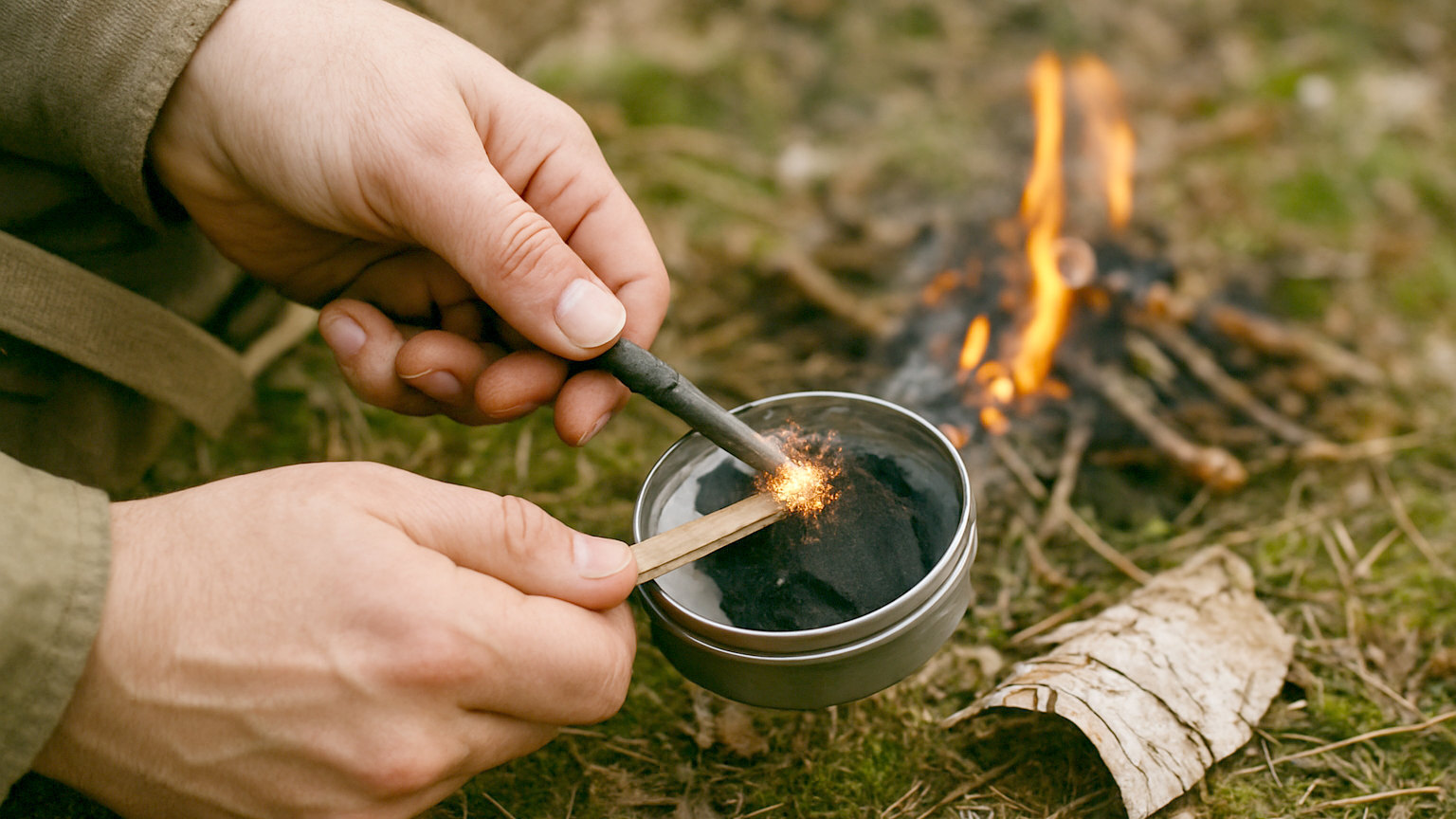
Uniformly black, holding its woven structure, and flexible enough to be handled without crumbling. If it is brown or grey in patches it needs longer. If it disintegrates at a touch it has been overcooked. Good cloth should take a spark from flint and steel or a ferro rod on the first or second attempt, glowing with an orange edge that spreads slowly across the surface.
How do you use and store it?
Place a piece on top of your flint or hold it beside the ferro rod, direct sparks onto it, and once an edge glows, fold it into the centre of a fine tinder bundle and blow steadily. The cloth carries the ember and the bundle turns it into flame. Store it in the same airtight tin it was made in, away from moisture and away from being crushed, and it will keep indefinitely. Many people keep the tin as a permanent part of their fire kit and simply top it up.
An afternoon making char cloth produces enough for dozens of fires and gives you a tinder that works with the weakest ignition sources you are likely to carry.