
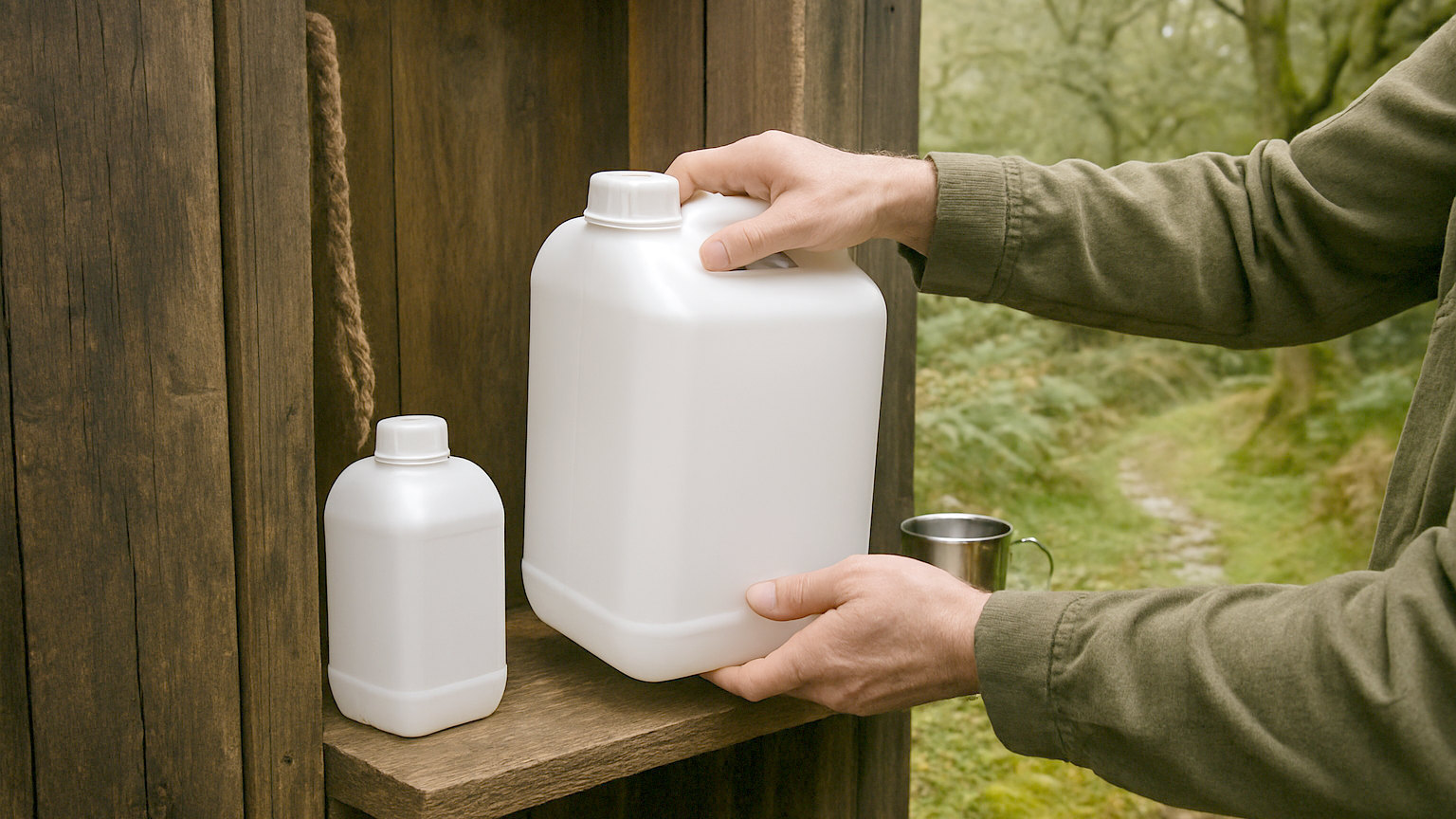
Container choice decides whether a water store is genuinely usable. The wrong ones taint the contents, grow algae, leak, or turn out to weigh more than anyone in the household can carry.
What does food grade mean?
Plastic manufactured and certified for contact with food and drink, without additives that could migrate into the contents. Most suitable containers are high density polyethylene, marked with recycling code two, or PET, marked with code one, which is what bottled water arrives in. Look for a food safe symbol, often a glass and fork logo, and buy containers sold specifically for drinking water rather than repurposing something else.
What sizes are practical?
Smaller than instinct suggests. Water weighs a kilogram per litre, so a twenty five litre container weighs twenty five kilograms full and is effectively immovable for many people. Two litre bottles, five litre bottles and ten litre jerry cans are the useful range, with ten litres already a substantial lift at ten kilograms. A mix of sizes works best: small ones for carrying and larger ones for bulk.
- Food grade plastic, usually HDPE code two or PET code one
- Two to ten litres for anything you may need to lift
- Opaque or stored in the dark to prevent algae
- A screw cap with a seal rather than a push fit lid
- A tap or a handle on anything above five litres
- Collapsible carriers for storing flat and filling on warning
Is commercially bottled water the simplest answer?
For most households, yes. It arrives sealed, dated and sterile, requires no preparation, needs no rotation for years, and comes in convenient sizes. The disadvantages are cost, plastic waste and bulk. A practical arrangement is bottled water for the drinking reserve and refillable containers for the larger volume covering cooking and washing.
What about collapsible containers?
Genuinely useful and frequently overlooked. Collapsible carriers and bladders store flat, taking almost no space, and are filled when a warning is issued or supply starts to degrade. They solve the storage problem entirely for anyone with advance notice, which covers flood warnings, planned works and most boil notices. They are less robust than rigid containers, so treat them as a supplement rather than the whole store.
Does colour matter?
Yes, because light drives algae. Clear containers standing in daylight will develop green growth within weeks, which is unpleasant rather than immediately dangerous and makes the water unusable in practice. Opaque blue or black containers prevent it, and clear bottles are fine provided they are stored in a dark cupboard or under a bed rather than on a windowsill or in a conservatory.
What about glass?
Inert and impermeable, which is ideal chemically, and heavy and breakable, which is a problem practically. Glass will not taint water or allow vapours through, so it is excellent for small quantities. For a household store measured in tens of litres, the weight and breakage risk outweigh the benefit, particularly if the store is under a bed or has to be moved.
What should you look for in the lid?
A proper screw cap with a gasket or a moulded seal. Push fit lids work loose, leak when moved and admit air. A container that will be handled needs a lid that stays shut when it falls over. Check any tap fitting too, since taps on larger containers are a common leak point and are worth testing with water before relying on them.
How many should you have?
Enough to split the store across containers rather than concentrating it. Several smaller containers are more robust than one large one, since a single failure does not lose everything, and they can be distributed around the house and carried individually. For a household of four aiming at a week, that means a mixture of bottles and cans rather than one enormous drum.
Buy food grade plastic in sizes you can lift, keep it opaque or in the dark, use proper screw caps, and split the store across several containers.


