
Water is the bulkiest thing in any preparedness store, and lack of space is the most common reason people skip it. In practice a useful quantity fits into places most flats already have.
How much space does it actually take?
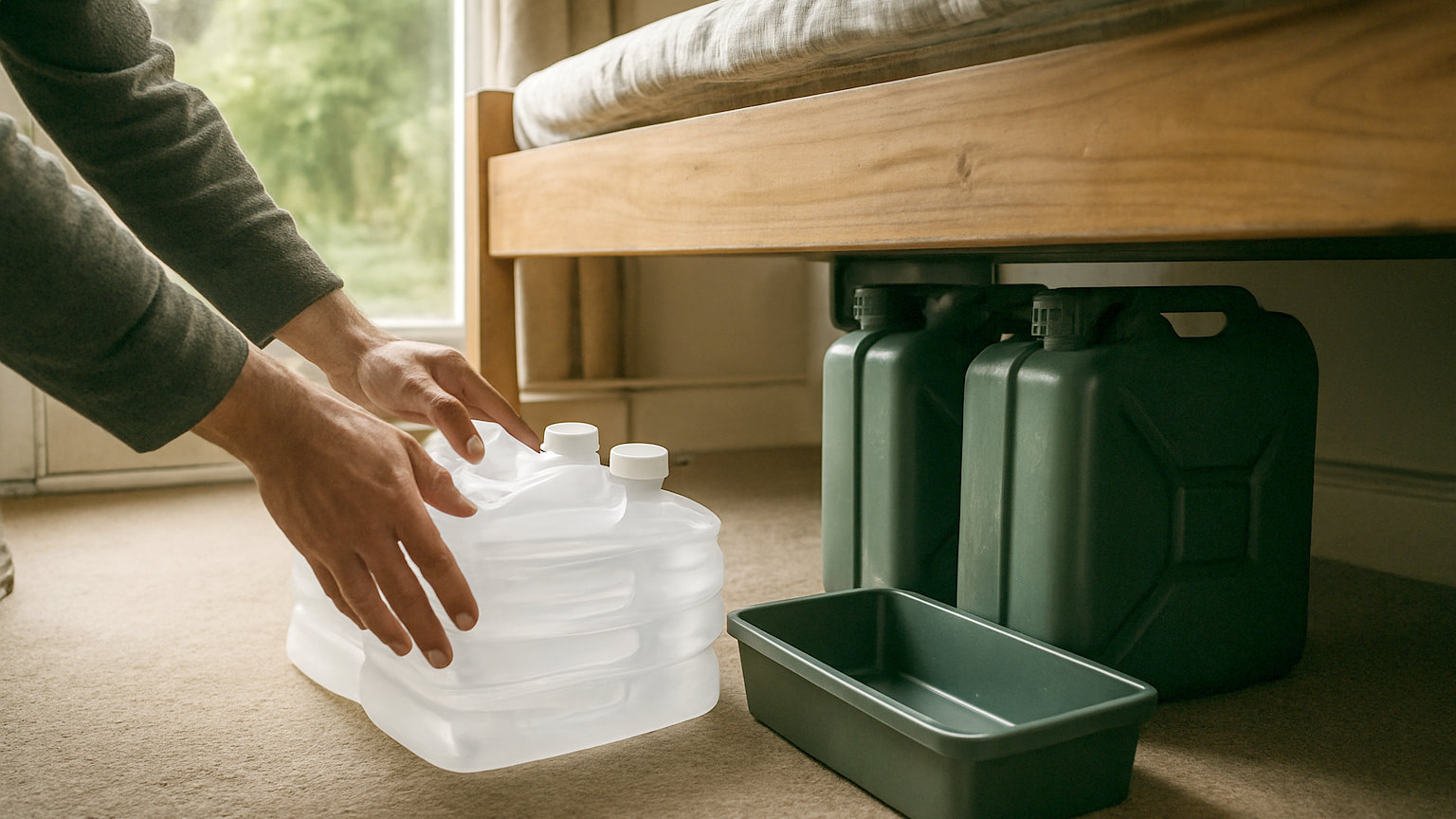
Less than expected. A week for one person at four litres a day is twenty eight litres, which is fourteen two litre bottles and occupies roughly the volume of a small suitcase. For a couple it is around fifty six litres, which slides under a double bed in two shallow crates with room left over. Seeing the actual footprint usually removes the objection.
Where does it go in a flat?
Under the bed first, since the space is cool, dark, stable and otherwise wasted. Then the bottom of a wardrobe, the back of a hall cupboard, under the stairs if there are any, behind or under a sofa, and the space above kitchen units. Bottles stack well in flat crates and can be spread across several small spaces rather than needing one large one.
- Under beds, using flat crates of two litre bottles
- Wardrobe bases and hall cupboards
- Behind and under sofas
- Collapsible containers stored flat, filled on warning
- Stackable water bricks that interlock
- Fill the bath the moment a warning is issued
What do collapsible containers solve?
The storage problem entirely, for anyone with warning. A collapsible carrier or bladder folds to a fraction of its volume and is filled when a flood warning arrives, works are announced or supply starts to degrade. Several of them take up almost no cupboard space empty and hold a substantial quantity full. They are less robust than rigid containers, so keep some rigid stock as well.
What about stackable containers?
Worth considering where you have height but not floor area. Interlocking water bricks and rectangular containers stack securely and waste far less space than round bottles, which lose volume to the gaps between them. They cost more per litre than bottled water and are reusable indefinitely, and they can be carried individually since they are sized to be liftable.
Does the bath count?
As a large reserve available at short notice. A bath holds well over a hundred litres, which dwarfs anything you could store in a flat, and takes a few minutes to fill. It is not drinking water, since baths are not clean, and it is invaluable for flushing lavatories, which is the use people most consistently underestimate. Bath bladder liners exist that make the contents usable for washing.
Should you store less if space is tight?
Store what fits and rely on filling at short notice for the rest. Three days of drinking water for the household is a legitimate target in a small flat, covers most realistic interruptions, and takes far less room than a week. Combining that with collapsible containers and the bath gives depth without permanent storage.
What is the priority if you can only store a little?
Drinking water for three days, in sealed commercial bottles, kept under a bed. That is the highest value use of limited space, since drinking water is the requirement that cannot be substituted. Washing and flushing water can come from the bath and from collapsible containers filled when something happens.
What about shared housing?
Keep your own supply in your own room rather than in communal space, since shared stores get used and not replaced. Under the bed works in almost any room, and a crate of bottles is unobtrusive. Twenty or thirty litres per person is achievable in even a small bedroom and covers the realistic scenarios comfortably.
What about a balcony?
Usable for non drinking water with care. A balcony is outdoor storage, so it brings freezing in winter, heat and sunlight in summer, and a weight consideration that matters more than on a ground floor. Opaque containers with headspace against freezing, secured so they cannot be blown or knocked over the edge, work for flushing and washing water. Keep drinking water inside where conditions are stable.
Use under the bed, keep collapsible containers to fill on warning, store three days of drinking water as the priority, and fill the bath when something happens.


