
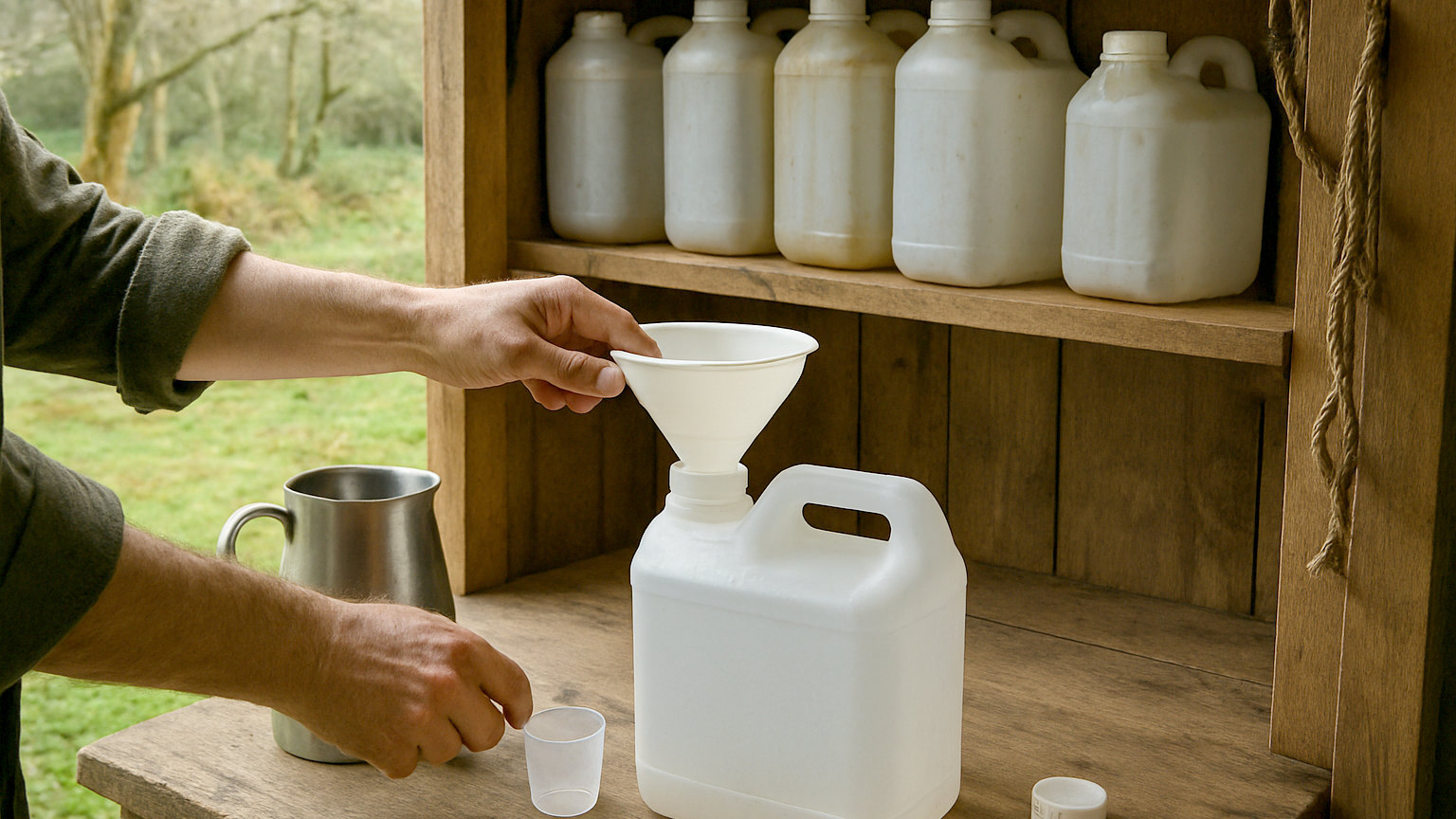
Most households need a week of water and can hold it in bottles. Going substantially beyond that changes the nature of the problem from storage to maintenance, and is worth doing deliberately rather than by accumulation.
Who needs a larger store?
Households on a private supply, which has no network behind it if the pump or the borehole fails. Rural properties at the end of long mains where interruptions are longer. Smallholdings with animals, whose requirement dwarfs the human one. Anyone with a medical need for reliable water. For most people in a town, a week is genuinely sufficient.
What containers suit bulk?
Purpose made water tanks and drums in food grade polyethylene, typically from a hundred to over a thousand litres. Interlocking water bricks for modular storage that can still be moved. Intermediate bulk containers, the caged cubes used industrially, which are cheap secondhand and must have a verified food safe history since many have held chemicals. Anything above about twenty five litres will be static and needs a tap.
- Food grade tanks and drums for genuine bulk
- Stackable water bricks for modular liftable storage
- A tap and a stable base, since these cannot be tipped
- Site them where the floor takes the weight
- Keep them dark, cool and away from chemicals
- Plan a rotation schedule before you fill them
What about the weight?
It becomes a structural question. A thousand litre tank weighs a tonne when full, which is fine on a concrete ground floor and not acceptable on a suspended timber floor or upstairs. Even two hundred litres is two hundred kilograms concentrated in a small footprint. Site bulk storage at ground level on a solid base, and take advice if you are unsure about the floor.
How do you rotate a large volume?
With a plan made before filling, since this is where large stores fail. Options include plumbing the tank into the garden supply so it turns over naturally, drawing from it for the washing machine or the garden, or emptying and refilling on a schedule. A tonne of water that has sat untouched for five years is not a resource, it is a task nobody wants to face.
What preparation do the containers need?
Thorough cleaning and, for anything secondhand, certainty about its history. Wash with hot soapy water, rinse very thoroughly, and use a sterilising solution of the type sold for brewing or baby equipment. Never use a container that held chemicals, however clean it appears, since plastics retain and release absorbed compounds indefinitely.
Should you treat bulk stored water?
Treat at the point of use rather than trying to preserve the whole volume. A filter and a means of boiling or chemical treatment lets you draw clean drinking water from a large store whose overall condition you cannot guarantee. This is more practical and more reliable than attempting to keep hundreds of litres in drinking condition for years.
What about rainwater harvesting?
A sensible route to genuine bulk for non drinking use. A proper harvesting system with a large underground or above ground tank, a first flush diverter and filtration provides substantial volume for flushing, washing and the garden, and can be plumbed into the house for those uses. It is a considered installation rather than a preparedness purchase, and it pays for itself on a metered supply.
Is it worth it?
For the households listed at the start, yes. For everyone else, a week of bottled water under a bed plus a water butt in the garden delivers most of the benefit for a tiny fraction of the cost and effort, and it stays current without a maintenance regime. Depth that is never rotated is not depth.
What about a swimming pool or hot tub?
A substantial non drinking reserve that people forget they have. A pool holds thousands of litres, entirely adequate for flushing, washing and cleaning through a long interruption. It is not drinking water, since the chemistry is wrong and the concentration of pool chemicals varies, and treating it properly is beyond ordinary field methods. Treat it as a large tank of washing water rather than as a reserve you could drink.
Use food grade tanks on a solid base, verify the history of anything secondhand, plan the rotation before filling, and treat at the point of use.


