Ultraviolet purifiers inactivate everything biological in about ninety seconds and depend on two things that can fail: batteries and water clarity.
How does it work?
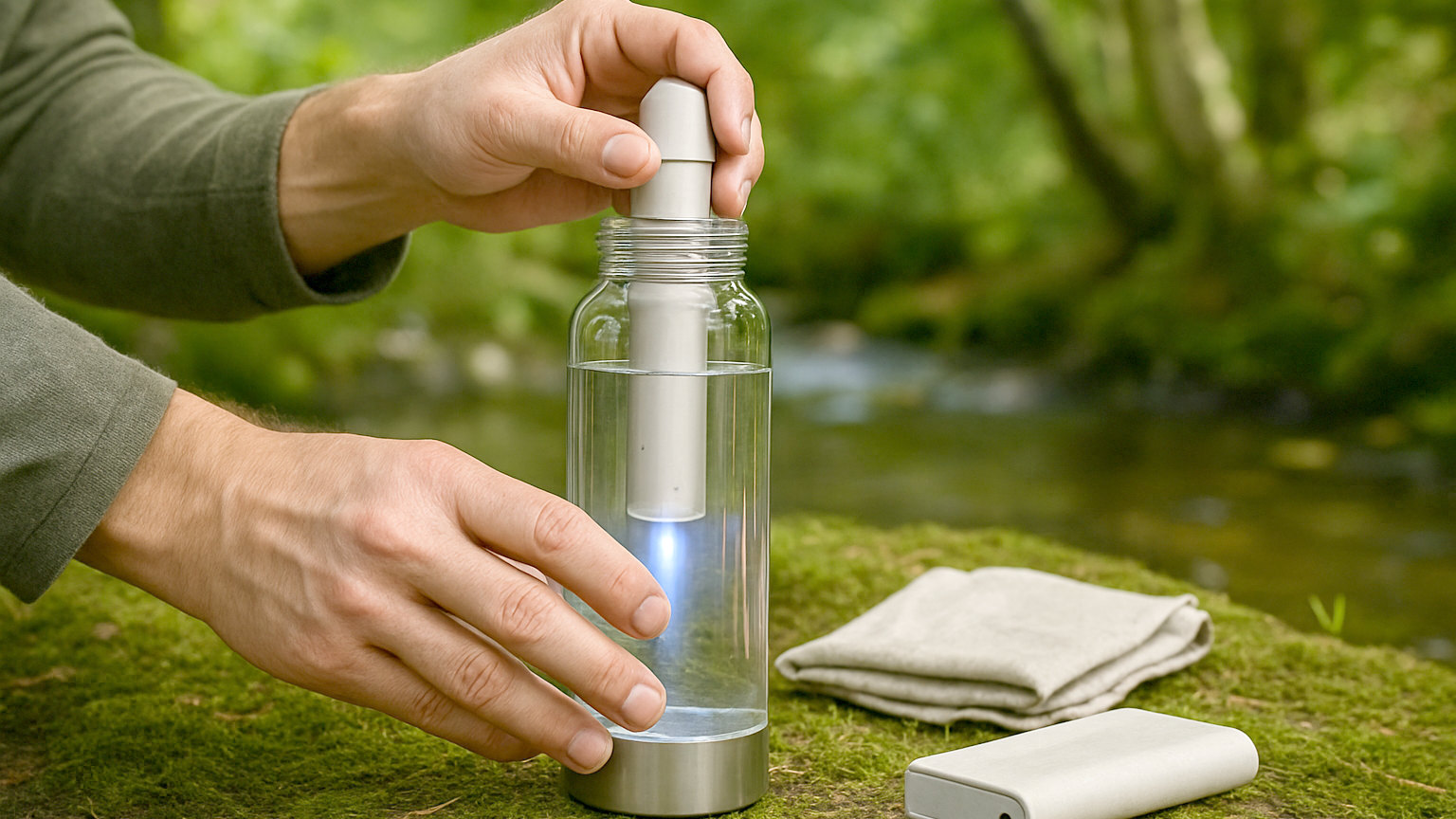
Ultraviolet light at a specific wavelength damages the genetic material of bacteria, viruses and protozoa so they cannot reproduce, which makes them harmless. A handheld unit is stirred in a container for a timed period, typically around ninety seconds a litre. Nothing is removed from the water, so it looks and tastes exactly as it did before.
What are the advantages?
Speed and completeness. It handles viruses, which most filters do not, along with bacteria and protozoa including cryptosporidium, which resists chlorine and iodine. It adds no taste, requires no waiting period beyond the treatment itself, and produces no waste. For treating water abroad where viruses are a genuine risk, it is genuinely effective.
- Inactivates bacteria, viruses and protozoa in around ninety seconds
- Adds no taste and removes nothing from the water
- Requires clear water, since turbidity shields organisms
- Requires working batteries and a functioning lamp
- Does not remove sediment, chemicals or metals
- Best used alongside a filter rather than instead of one
Why does clarity matter so much?
Because ultraviolet light cannot reach what it cannot see. Suspended particles shield organisms in their shadow, so cloudy water may leave a proportion untreated even after a full cycle. The water must be genuinely clear, which usually means filtering or letting it settle first. This is the most common way UV treatment fails, and it fails silently.
What about the batteries?
They are the other failure point. A unit with flat batteries is useless, and cold weather reduces battery capacity sharply at exactly the times you are likely to be outdoors. Carry spares, keep them warm in an inside pocket, and check the unit before a trip. Some models are rechargeable by USB, which pairs well with a power bank and adds another dependency.
Is it fragile?
Moderately. The lamp is a glass tube and the unit contains electronics, so it is more vulnerable to being dropped than a filter or a strip of tablets. Most have a case or a protective design. Treat it as a piece of equipment rather than a rugged item, and do not make it your only means of treatment on a trip where a failure would matter.
How does it compare with tablets?
Faster and more fragile. Chlorine dioxide tablets take thirty minutes for most pathogens and four hours for cryptosporidium, weigh a few grams and cannot fail. A UV pen treats in ninety seconds including cryptosporidium and depends on power and clarity. Carrying both is sensible, since they fail in completely different ways.
Where does it fit best?
Travel to places with poor sanitation, where tap water is clear but microbiologically suspect. That is the ideal case: the water needs no filtering for clarity, viruses are the concern, and treatment is quick and repeated. For British hill walking, where the water is often peaty and viruses are not the main risk, a filter is the better primary tool.
Should you buy one?
As a second method if you travel, and not as a sole method anywhere. Filter for clarity and protozoa, then UV or chemical for viruses, gives complete coverage. If you only ever walk in Britain, a filter and tablets covers everything for less money and with nothing to go flat.
How do you know it worked?
You do not, directly, which is the uncomfortable part. Nothing is removed and the water looks identical before and after, so there is no visible confirmation. Most units indicate a completed cycle with a light or a symbol, and that tells you the lamp ran for the correct time rather than that the treatment was effective, since turbidity could still have shielded organisms. This is the argument for pre filtering rigorously and for carrying tablets as a check.
Buy one for travel alongside a filter, always pre filter for clarity, carry spare batteries, and keep tablets as the failure proof backup.