
More filters are ruined in cupboards than in use. Two failure modes account for nearly all of it, and both are avoided by decisions taken when the trip ends.
Why does it need to be dry?
Because a damp membrane in a warm dark place grows a biofilm. The filter is designed to trap organisms on its surface, and a wet element sealed in a bag provides moisture, warmth and a nutrient supply for them. The result is a filter that smells stale, that may pass organisms from the accumulated growth, and that is unpleasant to use. Drying it fully stops the process.
How do you dry one properly?
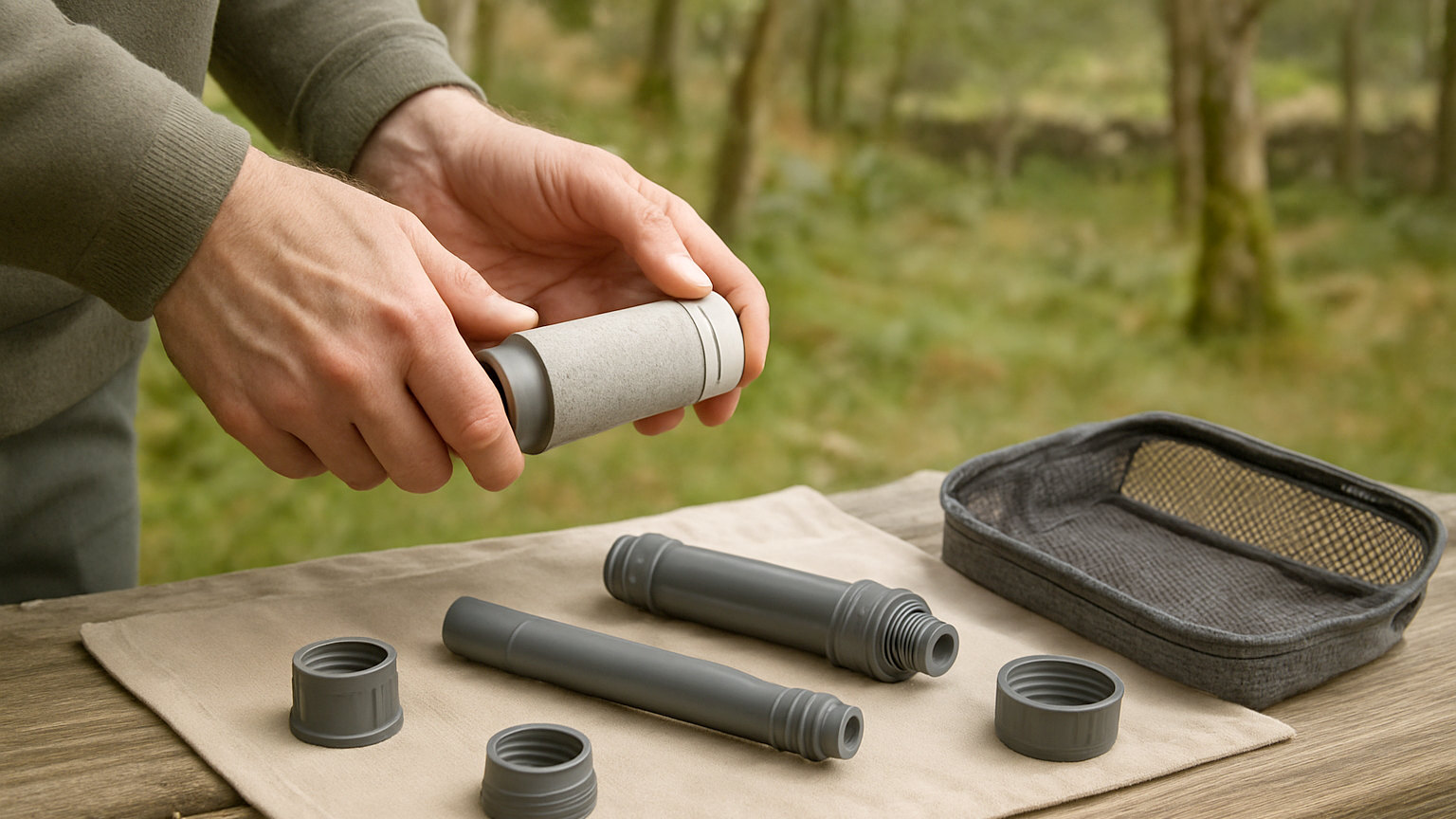
Backflush thoroughly first, then leave it somewhere warm and airy with the caps off for several days. Hollow fibre elements hold water in a great many tiny channels and take longer to dry than they appear to. Shaking out as much water as possible first helps. Do not use heat, an oven or a hairdryer, since excessive temperature can damage the membrane.
- Backflush before putting it away
- Dry completely, over several days with caps off
- Store somewhere that never freezes
- Keep it away from solvents, fuel and strong smells
- Check flow rate before the first trip of the season
- Follow the manufacturer instructions on storage solutions
Why is freezing so serious?
Because it destroys the filter invisibly. Water remaining inside hollow fibres expands as it freezes and ruptures them, creating channels that let anything through, with no external sign and often no change in flow. There is no field test for it. A filter that has been left in a garage, a shed, a car boot or an outbuilding over winter while damp must be assumed compromised.
Where should it live?
Inside the house, in a cupboard, at stable room temperature. That single decision removes the freezing risk entirely. Keep it away from fuel, paint and solvents, since the plastic components absorb vapours in the same way water containers do, and a filter that tastes of white spirit is unpleasant to drink through.
Should you use a storage solution?
Only if the manufacturer says so, and follow their instructions rather than improvising. Some manufacturers recommend storing the element wet with a specified dilute solution, and others recommend drying completely. The approaches are not interchangeable and the wrong chemical can damage a membrane. Check the documentation and keep it with the filter.
What should you check before using it again?
Flow rate and smell. Flush it through with clean water, time how long a litre takes, and compare with what you remember when it was new. A rate that has dropped substantially suggests clogging that needs backflushing. Any musty smell suggests a biofilm that needs cleaning. Anything suggesting it may have frozen means replacement rather than testing.
What about carbon elements?
They are the shortest lived component and the most affected by storage. A damp carbon element left for months is the worst case for bacterial growth. Where the design allows, remove and discard the carbon element at the end of a season and fit a fresh one at the start of the next, which is inexpensive and removes the problem.
How long can one sit unused?
Indefinitely if dry, at stable temperature and undamaged. Membranes do not degrade sitting in a cupboard. What ends them is moisture, freezing and physical damage, none of which are functions of time. A filter dried properly and stored in a warm cupboard will be as good in five years as the day it went in.
What about the rest of the system?
Dry and check everything, not just the element. Pouches and bags harbour growth in their folds and should be turned inside out where possible and left open to dry. Hoses hold water in their length and should be blown through. O rings and seals benefit from an occasional wipe and, on pump filters, a little of the lubricant the manufacturer specifies. Store hoses loosely coiled rather than tightly bent, which sets a kink over months.
Backflush, dry it fully with the caps off, keep it indoors where it cannot freeze, and check the flow rate before the first trip of the year.


