Rated capacities range from a few hundred litres to figures in the hundreds of thousands, and the number on the box describes performance under conditions that rarely match real use.
What do the ratings assume?
Reasonably clear water and regular maintenance. A manufacturer testing a filter uses water of a defined turbidity and backflushes to schedule, which produces the headline figure. Water from a peaty upland stream after rain, or a silty lowland river, carries far more suspended material and loads the membrane much faster, sometimes reducing effective life by more than half.
What actually ends a filter life?
Four things. Irreversible clogging, where the membrane will no longer recover its flow after backflushing. Freezing, which ruptures the fibres invisibly. Physical damage from being dropped, particularly with ceramic elements. And, for carbon and chemical elements, exhaustion of the active material, which happens on a much shorter timescale than membrane clogging.
- Rated capacities assume clear water and regular cleaning
- Silty water can halve effective life or worse
- Freezing ruins hollow fibre filters permanently and invisibly
- Carbon elements exhaust far sooner than membranes
- Flow rate that will not recover indicates the end
- Pre filtering is the single best way to extend life
How do you tell when it is finished?
By flow rate that no longer recovers. A filter that is slow before backflushing and still slow afterwards, repeatedly, has reached the end of its useful life. Ceramic elements have a physical gauge, since each cleaning removes material and the element must be replaced when it wears below a marked diameter. Carbon elements have no visible indicator and should be replaced on the stated schedule.
Why is freezing so serious?
Because it destroys the filter with no external sign. Water trapped inside hollow fibres expands as it freezes and splits them, creating channels that pass anything, while the filter looks and often flows entirely normally. There is no field test. Any filter that may have frozen while wet must be assumed compromised and replaced, which is why they belong in an inside pocket in winter rather than in a pack or a car.
How do you extend it?
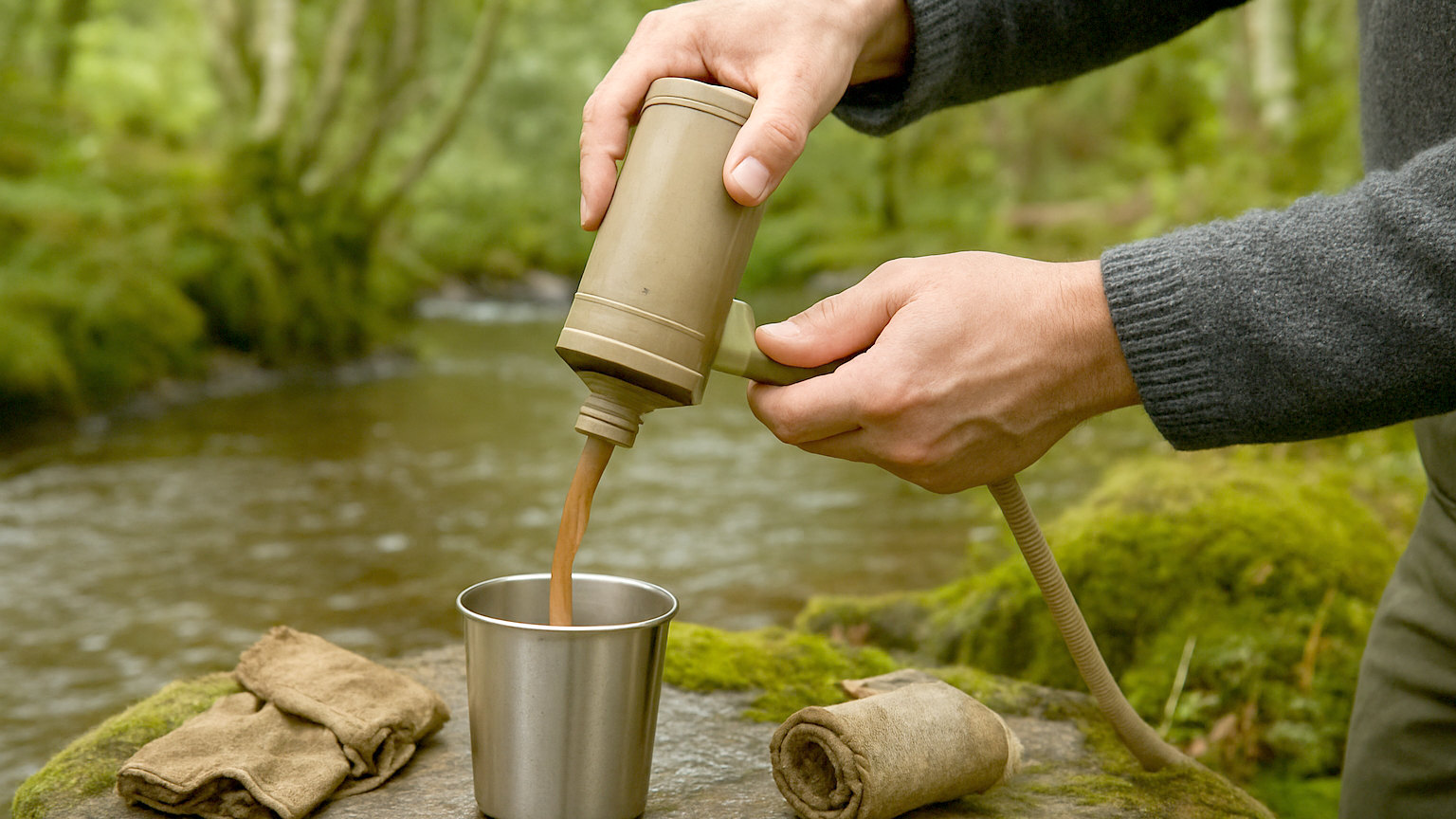
Pre filter and backflush. Letting silty water settle and pouring it through a cloth removes the bulk of the sediment before it reaches the membrane, which does more for element life than anything else. Backflushing regularly, rather than waiting for the flow to stop, prevents the compaction that becomes permanent. Together these can double the working life.
Should you track how much you have filtered?
Roughly, rather than precisely. Most people have no idea whether they are at two hundred litres or two thousand, and a rough sense based on trips and seasons is enough. Flow rate is the more useful indicator in practice, since it reflects the actual condition of the element rather than an assumption about volume.
Should you carry a spare?
On a long or remote trip, yes, or carry chemical tablets as the backup instead. Tablets weigh a few grams, cost very little and cover a filter failure completely. For a weekend in Britain that is more than sufficient. For an expedition where resupply is impossible, a second filter is reasonable insurance.
What about home emergency filters?
They are used so infrequently that clogging is rarely the issue, and storage condition is. A gravity system kept in a cupboard for five years should be inspected, flushed thoroughly and checked for flow rate before being relied upon, and it must never have been left anywhere that freezes.
Does the water source change the figure?
More than anything else does. Clear water from a spring or a fast upland stream loads the membrane very slowly, and a filter used exclusively on such sources may approach its rated figure. Peaty water carrying fine organic particles, glacial melt full of rock flour, and lowland rivers with suspended silt all load it many times faster. Two identical filters can have working lives differing by a factor of five purely on where they were used.
Judge by flow rate rather than the rated figure, pre filter to extend life, replace anything that may have frozen, and carry tablets as backup.