
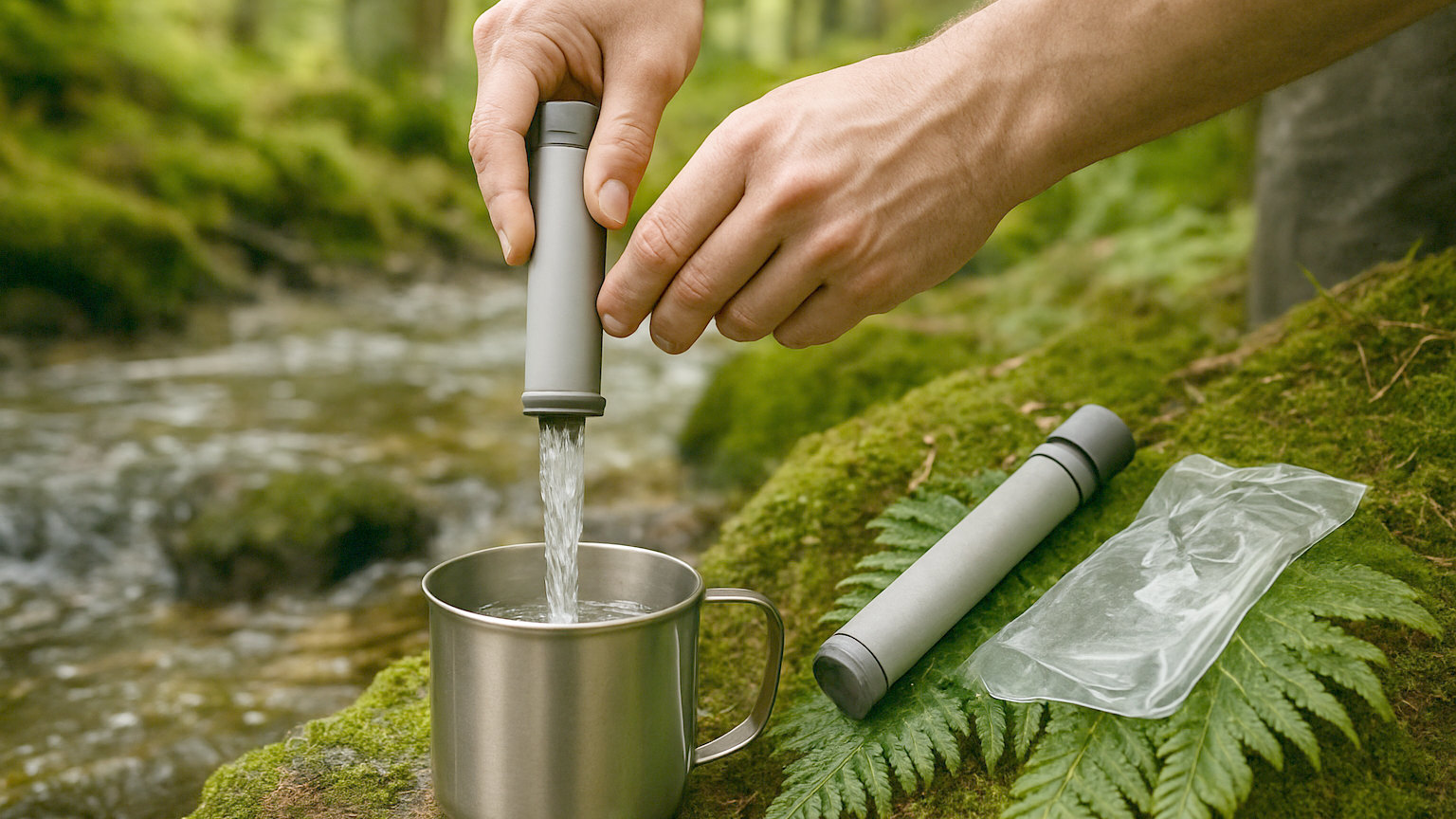
Squeeze and straw filters dominate the entry level market and are frequently treated as equivalent. They are not, and the difference matters once you consider how water is actually used on a walk.
How does a squeeze filter work?
Water is forced through a hollow fibre cartridge by hand pressure from a soft pouch or a flexible bottle. The output can go straight into your mouth, into a bottle, or into a container for cooking. Most weigh under a hundred grams, cost modestly and process a litre in a minute or two. They are the default choice for individual walkers for good reason.
What is the limitation of a straw?
You can only drink from the source. A straw filter is used by putting one end in the water and sucking, which means you cannot fill a bottle, cannot carry treated water, and cannot cook with it. You must physically go to the water each time you are thirsty, which on a hill walk is impractical. That single constraint is why straws are a poor primary choice.
- Squeeze: fills bottles and containers, usable for cooking
- Straw: drink at the source only, cannot carry water
- Both use hollow fibre and both need backflushing
- Both are ruined by freezing, invisibly
- Squeeze pouches split and are the usual failure point
- Neither removes viruses, so add tablets abroad
Where does a straw earn its place?
As a backup and in a grab bag. It weighs very little, costs almost nothing, requires no technique and has no pouch to split. Kept in a bag or a car as insurance, it means you are never entirely without a means of drinking safely. As a supplement to a squeeze filter or tablets it is sensible, and as the only thing you carry it is a compromise.
What goes wrong with squeeze filters?
The pouches, almost always. Repeated rolling and squeezing splits the seams, usually at an inconvenient moment. Carrying a spare pouch, or using a compatible soft drink bottle, which many cartridges thread onto directly, removes the problem. The cartridge itself is generally robust and long lived, and the soft parts around it are what fail.
How fast are they in practice?
Fast enough for one person and tedious for four. A litre through a clean squeeze filter takes a minute or two of steady effort. Filling six litres for a group means ten minutes of squeezing and a sore hand, which is why gravity systems exist. For an individual topping up at streams through a day, the speed is entirely adequate.
Can you use one as a gravity system?
Many can, which is a genuinely useful trick. Hanging the filled pouch from a branch with the cartridge below lets gravity do the work slowly and unattended, turning a squeeze filter into a low volume gravity system. Some manufacturers sell a hose kit for exactly this. Flow is slower than a purpose built gravity unit and it costs nothing to try.
What about freezing?
It ruins them, invisibly and permanently. Water inside a hollow fibre membrane expands when it freezes and ruptures the fibres, creating channels large enough for anything to pass through, with no external sign. A filter that may have frozen must be replaced rather than trusted. Keep it in an inside pocket overnight in winter, and never leave one in a car boot in a cold snap.
Which should you buy?
A squeeze filter as the primary, a straw only as a spare. Add a strip of chlorine dioxide tablets and you have a complete and very light system that handles British water, covers viruses abroad, and still works if the filter clogs or splits.
How do you fill the pouch?
By scooping rather than dipping, which is more awkward than it sounds in a shallow stream. A wide mouthed pouch fills more easily than a narrow one, and a small rigid cup or a folding scoop makes it straightforward from a trickle. Some people carry a lightweight cut down bottle purely as a scoop. Filling in a hurry from an awkward source is the most common frustration with the format and a scoop solves it.
Buy a squeeze filter for real use, keep a straw as a cheap backup, carry a spare pouch, and never let either freeze.


