
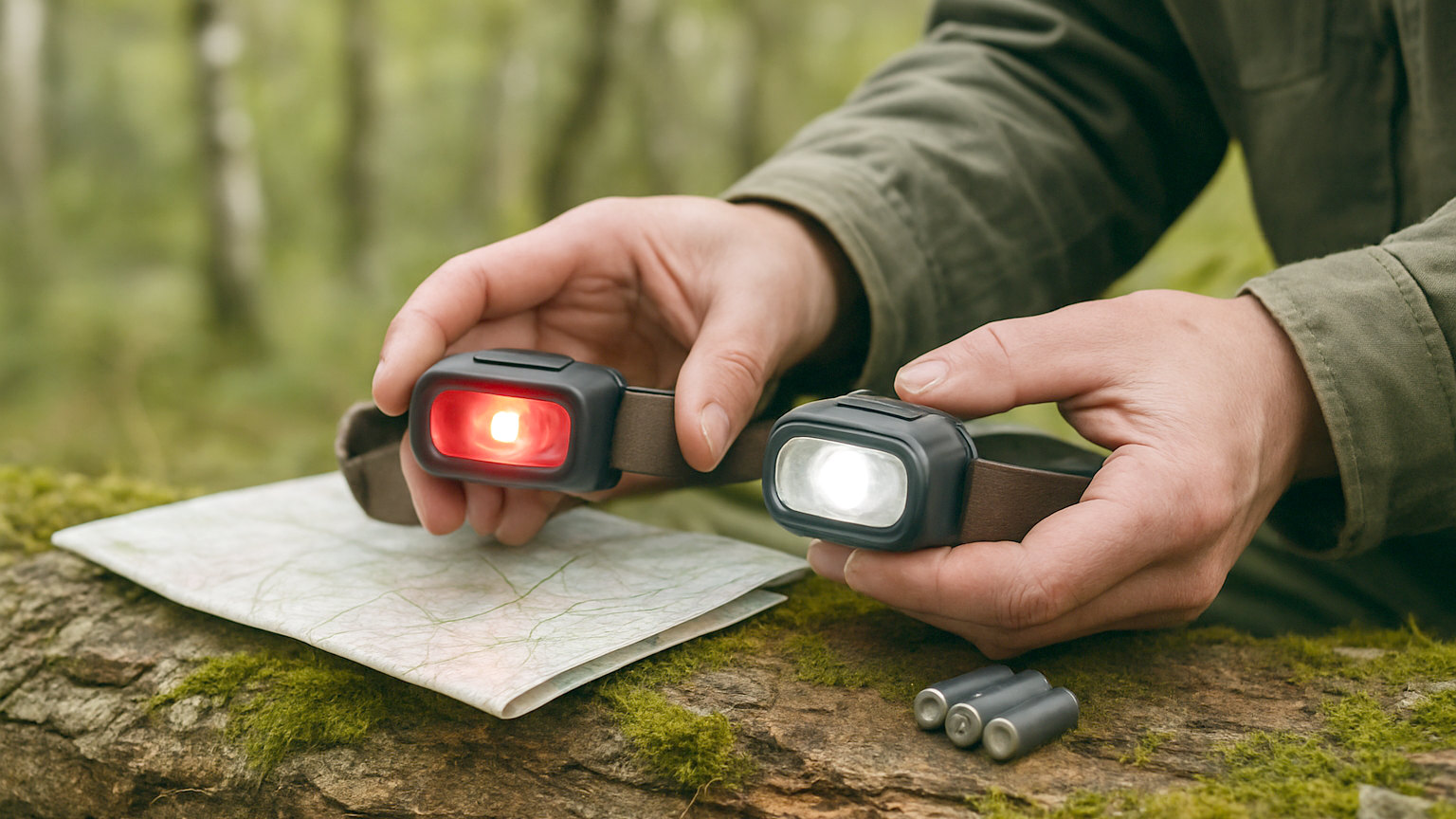
Head torches are marketed on lumens, and lumens are close to irrelevant for how the torch is actually used. The specifications that matter are further down the box.
Why do lumens mislead?
Because the highest setting is used rarely and for short periods. Walking a path, reading a map, cooking, finding something in a tent and moving around a house all work perfectly on a low setting of a few tens of lumens. Manufacturers quote the maximum, which typically runs for a couple of hours before dropping, while the low setting runs for tens or hundreds of hours.
What should you look at instead?
Runtime at a usable setting, the presence of a red mode, waterproof rating and how the battery is supplied. A torch giving fifty hours on a low setting is far more useful in an emergency than one giving five hundred lumens for two. Check whether the output is regulated, meaning it holds brightness, or whether it fades gradually as the battery drains.
- Runtime on a low setting matters more than maximum lumens
- A red mode preserves night vision and disturbs others less
- Look for at least an IPX4 rating for rain
- Replaceable batteries suit emergencies, rechargeable suits regular use
- A lock function prevents it switching on in a bag
- Check it can be operated with gloves on
Why does red light matter?
Because it preserves dark adaptation. Full dark adaptation takes twenty to thirty minutes and is destroyed within seconds by white light, so a red mode lets you read a map or find something without losing the ability to see the landscape afterwards. It also avoids dazzling companions and is far less disruptive in a shared tent or a room where someone is sleeping.
Which battery type?
It depends on the use. Rechargeable is cheaper to run, brighter for its weight and better for regular use, and it fails completely when flat with no way to continue. Replaceable AAA cells can be swapped in the field and carried as spares, which suits emergency kit. Torches accepting both are increasingly common and are the sensible compromise for a household.
What about cold weather?
It reduces capacity substantially, particularly for lithium rechargeable cells. A torch that runs for ten hours indoors may manage far less on a cold hillside. Keeping spare batteries and any rechargeable unit in an inside pocket until needed largely solves it. Lithium primary cells perform considerably better in cold than alkaline and are worth buying for winter and for stored kit.
What is a reserve mode?
A very low output setting that engages automatically when the battery is nearly flat, giving several more hours of dim but usable light. It is a genuinely valuable feature in an emergency context, since running out of light entirely is considerably worse than having a little. Not all torches have it, and it is worth checking.
How many should a household have?
One each, plus a couple of spares. Head torches are inexpensive and having one per person means nobody is left in the dark while someone carries the only light to another room. Keep one in each bedroom, one with the emergency kit and one in each vehicle. Giving children their own makes a power cut considerably less frightening for them.
What should you avoid?
Very cheap unbranded torches with implausible lumen claims, which typically deliver a fraction of what is stated and fail quickly. Also single mode torches with no low setting, which waste battery constantly. And anything without a means of preventing accidental activation, since a torch that switches on in a rucksack arrives flat.
How bright do you actually need?
Far less than the marketing implies for most use. Around ten to thirty lumens is ample for camp tasks, reading a map and moving around indoors. A hundred lumens lights a path comfortably. Two hundred and above is for genuinely fast movement over rough ground or searching. Buying a five hundred lumen torch and using it on low is common and sensible, and it means the headline figure was never the reason to choose it.
Buy on low setting runtime and a red mode, get one per person, keep spare lithium cells warm, and choose something that can be worked with gloves.


