
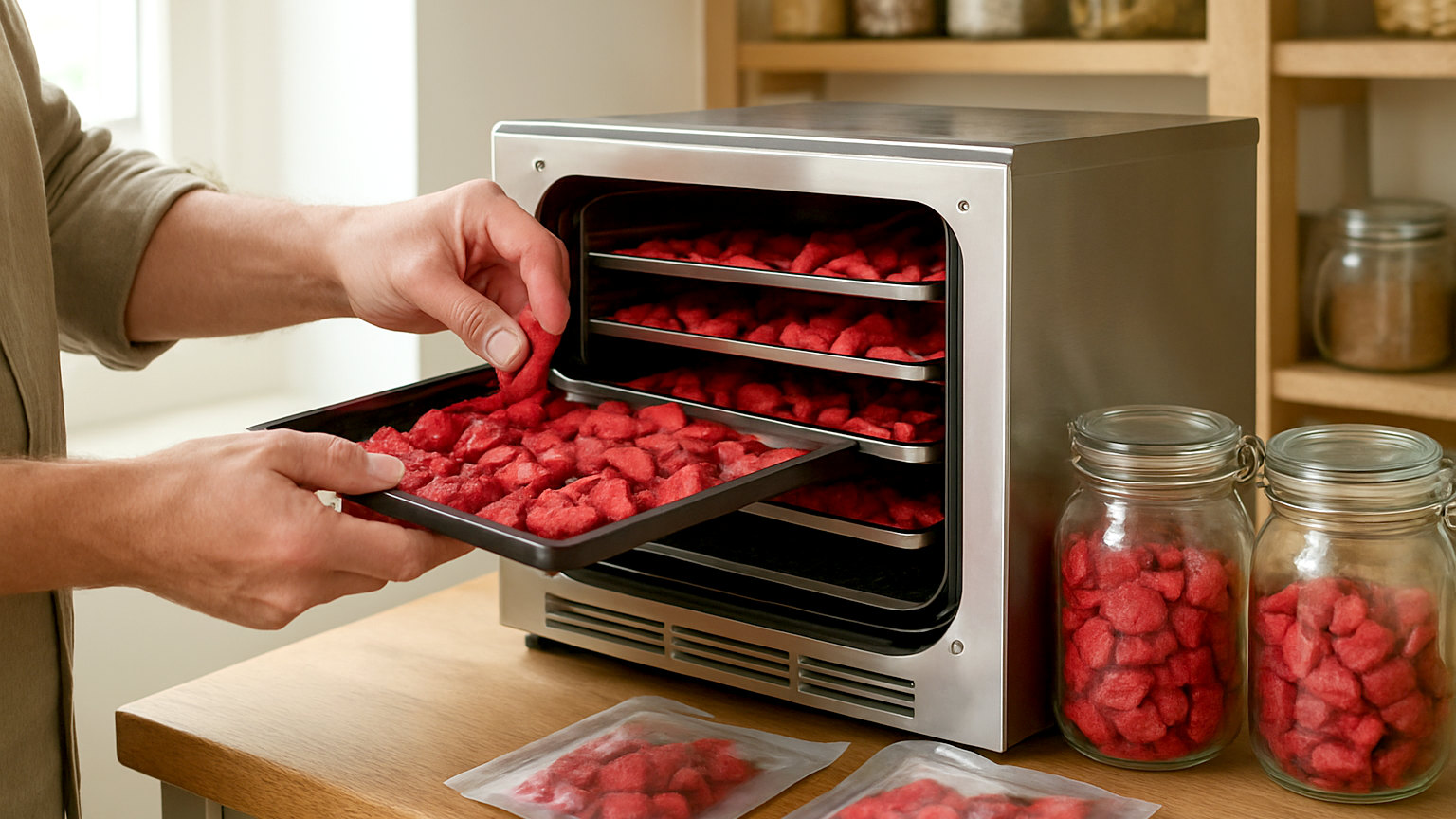
Home freeze dryers have moved from industrial equipment to a domestic appliance, and they produce results nothing else matches. They are also expensive, slow and noisy, and the case for one depends entirely on circumstances.
What does a freeze dryer do?
Freezes food solid and then removes the ice by sublimation under vacuum, turning it directly to vapour without passing through liquid. That preserves structure, colour, flavour and most nutrition, and produces something that rehydrates close to the original. It is a fundamentally different process from a dehydrator, which uses warm air and produces something chewy and shrunken.
How long does the food keep?
Decades, packed properly. Freeze dried food sealed in mylar with oxygen absorbers is credibly good for twenty five years or more, and it retains far more of its original character than anything dried by heat. This is why commercial long term food and expedition rations use the process.
- Preserves structure, flavour and most nutrition
- Decades of shelf life when packed with absorbers
- Machines cost thousands and run for twenty to forty hours a batch
- Meaningful electricity cost per batch
- Noisy, and needs a permanent space with ventilation
- Pump oil and maintenance are ongoing commitments
What does it cost?
Several thousand pounds for the machine, plus running costs. A batch takes twenty to forty hours of continuous operation and uses a substantial amount of electricity, and machines with an oil vacuum pump need the oil filtering and changing. Bags, absorbers and sealing equipment add more. The total cost per kilogram of finished food is not trivial.
What is it genuinely good for?
Preserving garden produce and reducing waste. Anyone with an allotment or a smallholding producing gluts of fruit and vegetables can preserve them at peak quality rather than watching them go over. It also handles leftovers, complete meals, dairy and eggs, which no other domestic method does well. For a household producing a lot of food, that changes the economics considerably.
Who else benefits?
People with restricted diets who cannot buy suitable long term food. Anyone preparing their own expedition or backpacking meals, where weight matters enormously and commercial options are expensive. Households in remote locations building genuine depth. And people who would use it regularly, since a machine used monthly is a very different proposition from one used twice a year.
What are the practical drawbacks?
Noise, space and time. The vacuum pump runs continuously for a day or two per batch and is loud enough to be intrusive in a house, so most owners put it in a garage or utility room, which then needs to be somewhere it will not freeze. Batches are small relative to the time, so preserving a substantial harvest takes weeks of continuous running.
How does it compare with a dehydrator?
Better results at many times the cost. A dehydrator costs a fraction as much, runs for hours rather than days, and produces perfectly good dried fruit, vegetables, herbs and jerky with a shelf life of months to a few years. For most households wanting to preserve produce, a dehydrator delivers most of the practical benefit for a tiny fraction of the outlay.
Should you buy one?
Only if you can point to regular use. If you produce significant quantities of food, have a specific dietary requirement, or make your own expedition meals frequently, the case is real. If the motivation is general preparedness, the same money buys a decade of packed staples, a stove, water storage and a great deal else, and the marginal benefit of freeze dried variety is small.
What do you need alongside the machine?
The packing equipment, which is frequently left out of the cost. Freeze dried food must be sealed in mylar with oxygen absorbers immediately, since it is extremely hygroscopic and will reabsorb moisture from room air within hours. That means a heat sealer, a supply of bags and absorbers, and somewhere to work quickly. Budget for it, because food freeze dried and then stored badly loses the shelf life that justified the machine.
Buy one if you grow a lot of food or have a specific need, buy a dehydrator if you simply want to preserve produce, and buy staples if the goal is depth.


