
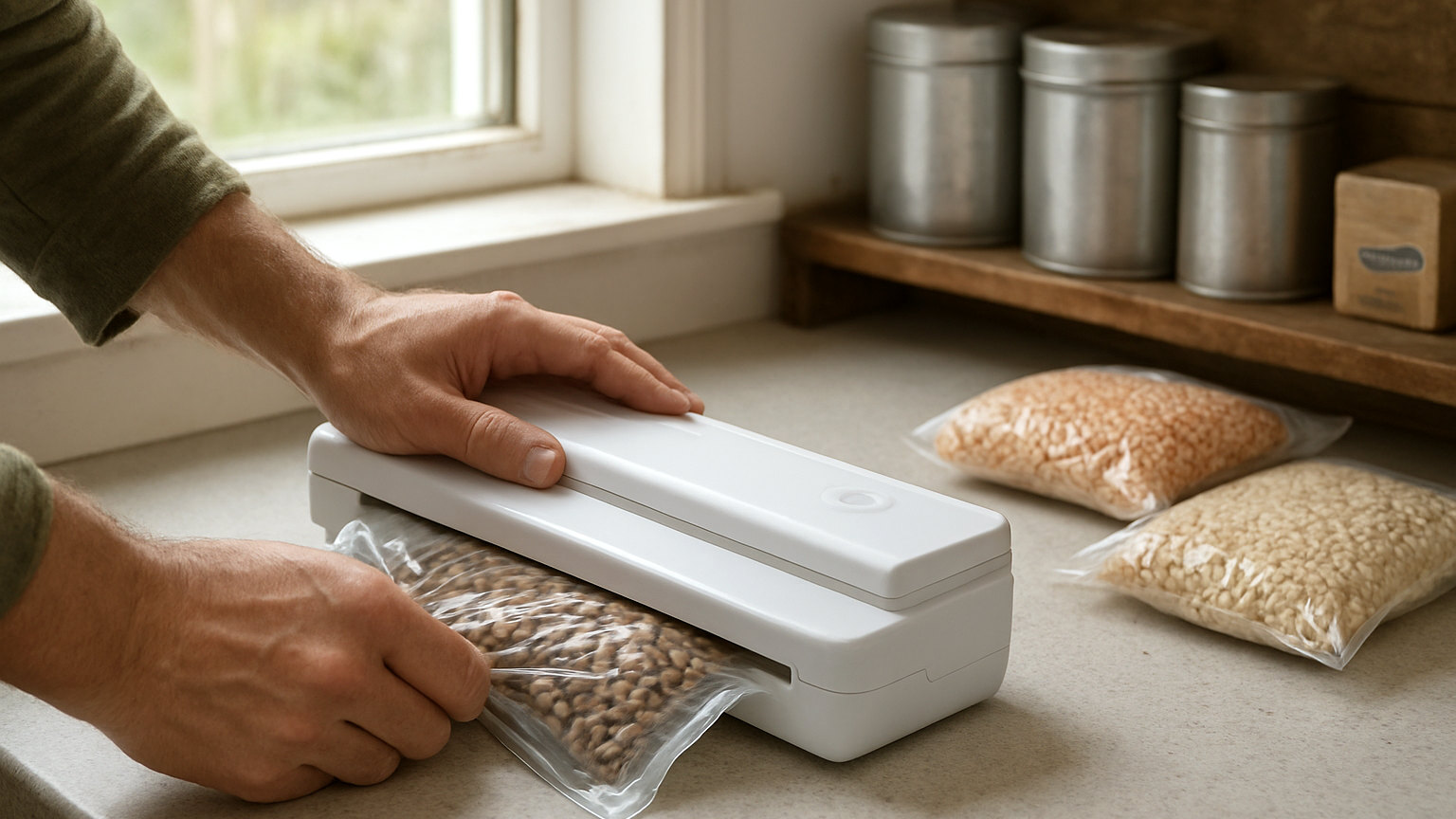
Vacuum sealing is widely available, straightforward and excellent for a range of purposes. Decade scale storage is not one of them, and the reason is a property of the bags rather than the technique.
Why does it fall short over decades?
Because ordinary vacuum bags are plastic laminates that allow oxygen through slowly. The vacuum removes most of the air at the moment of sealing, and over months and years oxygen migrates back in through the bag wall. Metallised mylar is essentially impermeable, which is why it is used where the timescale is measured in decades rather than months.
Does the vacuum hold?
Partially and not permanently. Bags gradually relax as air permeates in, and sharp contents such as rice, pasta and dried beans puncture the film, which loses the vacuum entirely. Anyone who has vacuum sealed pasta has found bags soft again within weeks. Double bagging or wrapping the contents in kitchen paper first reduces the punctures without solving the permeability.
- Good for months to a few years, not decades
- Bags are slowly permeable to oxygen
- Sharp dry goods puncture the film and lose the vacuum
- Excellent for freezer storage and preventing freezer burn
- Combining a vacuum sealed bag inside mylar adds little
- Vacuum sealing plus an oxygen absorber is a reasonable middle route
What is it genuinely good for?
Freezer storage above all, where it prevents freezer burn and dramatically extends quality. Also for medium term storage of dried goods over a year or two, for portioning bulk purchases, for keeping things dry, and for compressing bulky items. In a kitchen it earns its keep several times a week, which is more than most long term storage equipment does.
Can you combine it with absorbers?
Yes, and it is a sensible middle route. Vacuum sealing removes most of the air mechanically and an oxygen absorber consumes what remains and what leaks in over time. That combination in a decent bag gives considerably longer life than either alone, though still short of mylar. For a five to ten year horizon it is a reasonable and convenient approach.
What about vacuum sealing in jars?
Effective for the vacuum and limited by the same considerations. Jar sealer attachments pull a vacuum in a glass canning jar, which is genuinely impermeable, so the barrier is better than a bag. The weakness is the lid seal, which relies on a rubber gasket that degrades over years. Glass jars with absorbers are a good option for smaller quantities kept in the dark.
Does it stop pests?
Physically, until something punctures it. A sealed bag excludes insects arriving from outside, and it does nothing about eggs already present in flour or grain when you bought it. Those eggs cannot hatch without oxygen, which is why an absorber matters even when the bag looks well sealed. Freezing new grain for seventy two hours before packing is the other half of the answer.
What about the machine itself?
Domestic sealers vary considerably. Cheaper models struggle with anything moist, cannot pull a strong vacuum, and their bags are thinner and more permeable. Chamber sealers used commercially do a far better job and cost accordingly. For household use a mid range model with the option of an external hose for jars covers most needs.
What should you actually use it for?
Everyday food management, freezer storage and medium term dry goods, which is where it excels and pays for itself. If you want decade scale storage, use mylar and absorbers in a bucket, which costs less per unit and does the job properly. There is no need to choose one, since they suit different timescales.
What about moist foods?
Vacuum sealing them and storing at room temperature is genuinely unsafe. Removing oxygen from a moist food creates conditions favouring Clostridium botulinum, which is why vacuum sealed fresh and cooked foods must be refrigerated or frozen rather than left in a cupboard. The convenience of a strong seal makes it easy to forget that the seal alone preserves nothing, and temperature is still doing most of the work.
Use vacuum sealing for the freezer and for a few years, add an absorber to extend it, and use mylar in a bucket for anything measured in decades.


