Storage conditions matter more than almost any other choice in food storage, and the relationship between temperature and shelf life is steep enough to be worth understanding properly.
What is the temperature rule?
As a broad working principle, the rate of chemical deterioration roughly doubles for every ten degree rise in temperature. Applied to food, that means a store held at thirty degrees ages at something like four times the rate of one held at ten. This is why the same tin can be excellent after five years in a cool cupboard and disappointing after eighteen months in a loft.
What should you aim for?
Between ten and twenty degrees, and stable. Cooler is better provided it does not freeze, since freezing and thawing damages tins, jars and some packaging. Stability matters as much as the number, because repeated cycling drives moisture in and out of packaging and stresses seals. An interior cupboard within the heated part of the house achieves both without any effort.
- Aim for ten to twenty degrees, and stable
- Deterioration roughly doubles for each ten degree rise
- Keep relative humidity below about sixty percent
- Avoid anywhere that swings between hot and cold
- Avoid freezing, which damages tins and jars
- Measure rather than assume, with a cheap monitor
Why does humidity matter?
Because moisture enables mould, rusts tins, softens cardboard and clumps dry goods. Relative humidity below around sixty percent is a reasonable target. Above that, condensation becomes likely as temperature varies, and condensation is what actually causes the damage. Damp is the reason cellars, garages and sheds fail as storage locations even when their temperature is acceptable.
How do you measure it?
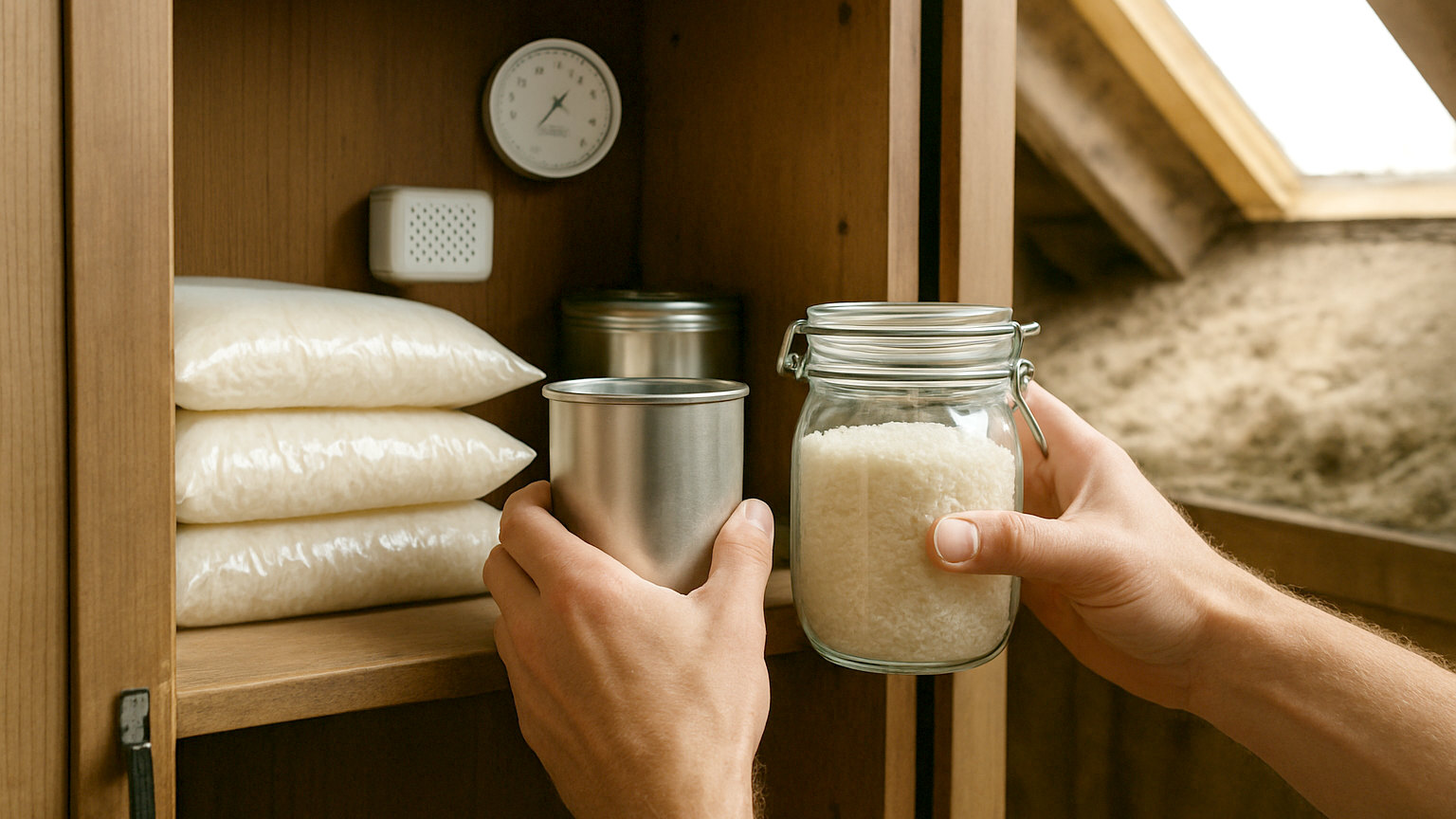
With an inexpensive combined thermometer and hygrometer, left in the intended location for a few weeks. This costs very little and answers the question definitively rather than by assumption. People are frequently surprised by how warm a cupboard next to a boiler runs, or how damp a cellar is, and a fortnight of readings settles it before anything is committed to the space.
What about the extremes in a British house?
Lofts and garages are the problem areas. A loft under a dark roof can exceed thirty five degrees on a summer afternoon and drop below freezing in winter, which is close to the worst possible combination. Garages track outdoor conditions and add damp from a concrete floor. Conservatories are worse again in summer. None of these are suitable for food.
Can you improve a location?
Sometimes, cheaply. A dehumidifier transforms a cool but damp cellar into an excellent store. Insulating a cupboard shared with a boiler or hot water tank reduces the heat reaching it. Lifting everything off a concrete floor onto a pallet removes both cold and moisture transfer. Small interventions often convert a marginal space into a good one.
Does light matter as much?
Less than heat and damp, and it is not nothing. Light degrades fats, oils and some vitamins, and it is the reason cooking oil is sold in dark bottles and why clear jars of dried goods should not sit in sunlight. Storing in a cupboard or a box addresses it completely at no cost, which makes it an easy factor to eliminate.
What is the practical conclusion?
Use the house rather than the outbuildings. Interior cupboards, under beds and wardrobe bases are all within the stable heated envelope and are the best storage most homes have. The instinct to put bulky stores in the garage or loft is understandable and works directly against shelf life.
What about seasonal variation?
It is worth checking a location across a full year rather than a single fortnight. A cupboard that reads sixteen degrees in April may reach twenty five in August or drop close to freezing in January if it backs onto an external wall. Leaving a cheap monitor that records maximum and minimum readings in the space through a summer and a winter gives a far more useful picture than a single measurement.
Ten to twenty degrees, under sixty percent humidity, dark and stable. Measure it for a fortnight before committing anything to a new space.