
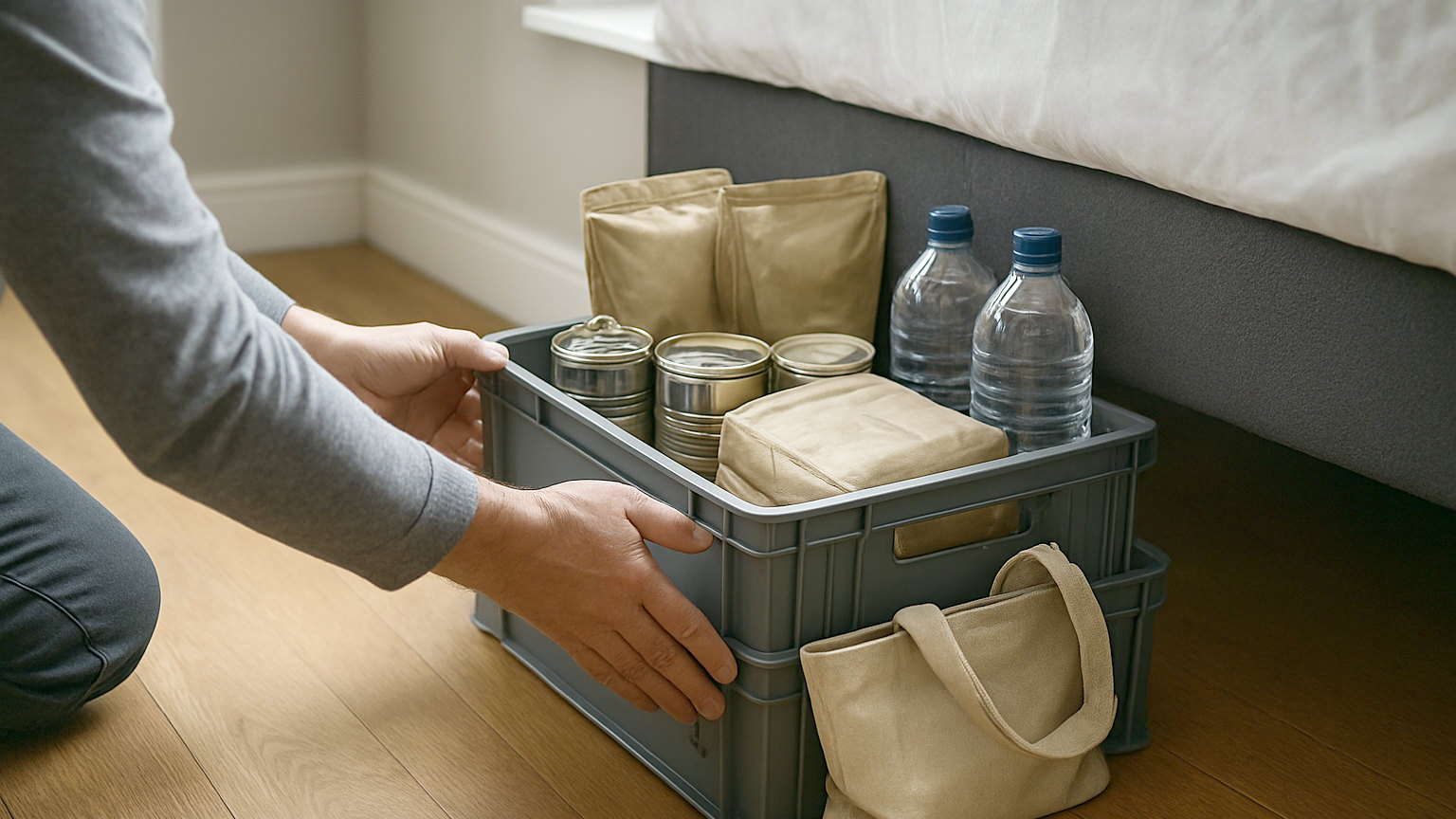
Lack of space is the most common reason people give for not keeping a food store, and it is usually solvable. A week of food for a household of four takes up less room than most people imagine.
How much space does it actually need?
Less than a suitcase. A week for four people, in tins, dried goods and packets, occupies roughly the volume of two large storage boxes. Laid out on a kitchen floor it looks substantial, and packed into flat crates it slides under a double bed with room to spare. Seeing the actual volume usually removes the objection entirely.
Which spaces work best?
Under beds first, since the space is large, cool, dark, stable and otherwise wasted. Shallow crates or vacuum bags fit under most bed frames, and divans with drawers are better still. Then the bottom of wardrobes, the backs of hall cupboards, the tops of kitchen units, the space above a wardrobe, and behind or beneath a sofa.
- Under beds, using shallow crates that slide out
- Wardrobe bases and the space above hanging rails
- Tops of kitchen units and high cupboard shelves
- Behind and beneath sofas and armchairs
- Hallway cupboards and the space under stairs
- Split across several locations rather than one
What should you store given limited space?
Dense, high calorie, low volume items. Tinned protein, rice, pasta, oats, nuts, dried fruit, long life milk and cooking oil deliver far more calories per litre of storage than bulky items such as breakfast cereal, crisps and large packets of low density snacks. If space is genuinely tight, prioritise on calories per volume and the store becomes considerably more efficient.
Does packaging help?
Yes, in a small space. Decanting into square or rectangular containers wastes far less volume than round jars or irregular packets, and stacking becomes possible. Vacuum bags compress soft items usefully, though they are unsuitable for anything that could be crushed. Removing outer cardboard packaging from cereal and similar items saves noticeable space and lets you see what you have.
What about water?
It is the harder problem, since it is heavy and bulky and the requirement is large. Under beds is again the best answer, using flat crates of two litre bottles. Collapsible containers store flat and can be filled when a warning is issued, which solves the storage problem entirely for anyone with advance notice. Filling the bath at the first sign of a problem adds over a hundred litres instantly.
Should you keep less if you have less space?
Sensibly, yes. Three days is a legitimate target for a small flat, and it covers a large share of realistic disruptions. A smaller store that is properly rotated and genuinely accessible beats an ambitious one crammed into an unsuitable space. Depth is not the only measure of preparedness, and the plan, the torch and the power bank matter at least as much.
What about shared housing?
Keep a personal store in your own room rather than in communal space, since shared supplies get used and not replaced. Under the bed works in almost any room. Keep it modest, keep it labelled, and consider that flatmates may have their own arrangements or none, which is worth a conversation.
What is the most efficient single item?
Cooking oil, at around nine hundred calories per hundred millilitres, followed by nuts and peanut butter. Rice and pasta are dense and cheap. A small flat with limited storage gets the most from a few kilograms of rice, some tins, oil and peanut butter, which together represent a great many calories in very little volume.
How do you keep it accessible?
By storing in units you can move. A single enormous box under a bed is difficult to reach past and tends to become archaeology, whereas three shallow crates slide out individually and can be rotated properly. Label the end of each crate with its contents so you can identify them without pulling everything out, and keep the crate holding the items nearest their date at the front.
Use under the bed, choose dense high calorie items, decant into square containers, and accept three days rather than skipping it entirely.


