
Quantity is where households either do too little or considerably too much. The useful range is narrower than the preparedness market suggests, and it is bounded at the top by whether you can rotate what you have.
What is the baseline?
Three days as a minimum and a week as a comfortable target, which is broadly what United Kingdom preparedness guidance suggests for household supplies. Almost every British disruption resolves well within a week. That target is achievable for most households within a couple of months of adding a few items to the normal shop.
How many calories per person?
Around two thousand per adult per day as a planning figure, more for anyone active and more again in a cold house without heating. Children need less by weight and more than people expect proportionally. Being cold and anxious both increase consumption, and people eat more when bored and confined, not less. Planning at the higher end rather than the lower is sensible.
- Three days minimum, seven days as a target
- Around two thousand calories per adult per day
- Add extra for cold conditions and for children growing
- Include food for pets, which is easily forgotten
- Beyond a month, rotation becomes genuinely difficult
- Depth is worthless if the household will not eat it
What does a week actually look like?
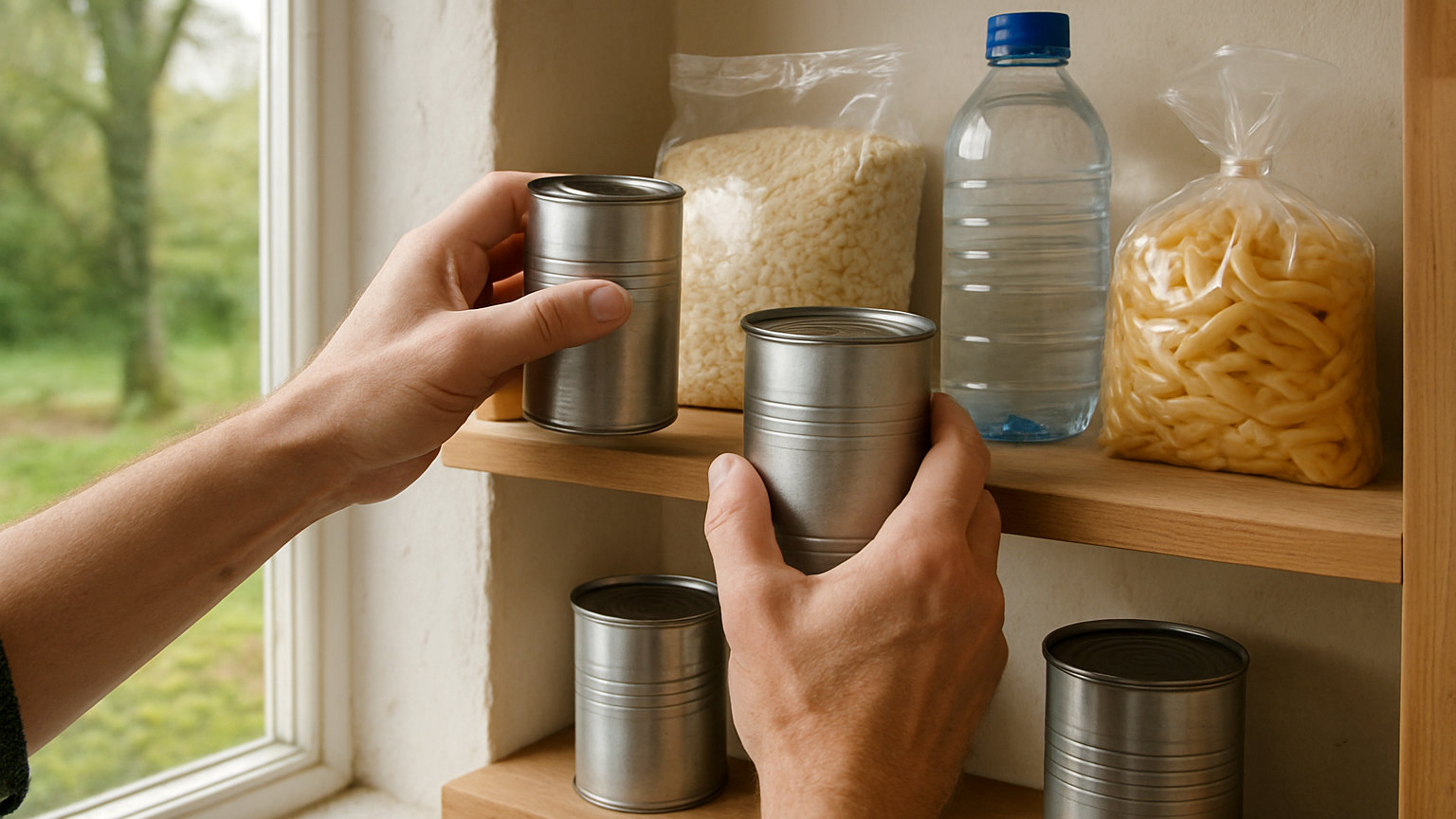
Less than people picture. For a family of four, roughly fifty six thousand calories, which is perhaps two large boxes of tins, pasta, rice, cereal, long life milk and snacks. It fits under a bed. Seeing it laid out is usually reassuring rather than daunting, and it demonstrates that the target is modest rather than a lifestyle change.
Why does rotation limit the depth?
Because a store you cannot eat through will expire. A week of food rotates naturally, since the household consumes that much anyway. A month requires attention but is manageable. Three months means a substantial proportion is always approaching its date, and beyond that most households simply cannot consume it fast enough, so waste becomes the outcome rather than resilience.
Should you go deeper than a week?
Only with reason and method. Rural properties at the end of long supply chains, households with dietary requirements that are hard to source, and people who genuinely cannot restock easily all have a case. Going deeper properly means using long term storage methods rather than kitchen quantities, and accepting a maintenance commitment.
What else should the quantity include?
Water, which is heavier and bulkier than the food and more urgent. Around four litres per person per day covering drinking and basic use, which for a family of four over a week is over a hundred litres. Pet food. Baby formula. Anything required for a restricted diet. These are frequently forgotten in calculations focused on human meals.
How do you build it without noticing the cost?
A few extra items each week. Four tins this week, a bag of rice and some long life milk next week, a box of cereal after that. Over eight or ten weeks the store assembles itself at a few pounds at a time. Buying items on offer and buying own brand reduces it further, and none of it is money wasted since it all gets eaten.
What is the honest answer for most people?
A week, integrated into the normal cupboard, rotated through normal use, containing food the household actually eats. That covers the overwhelming majority of what will realistically happen, costs very little, and requires almost no maintenance. Everything beyond that is a specific decision requiring a specific reason.
What about people who are away or visiting?
Plan for the household as it usually is and accept some variation. A store sized for four covers four, and an emergency arriving while a relative is staying simply means the week becomes five days. Conversely, students and adult children who return unexpectedly during a disruption are a genuine possibility worth a little slack. A modest margin above the headcount is sensible without trying to model every scenario.
Aim for a week, plan two thousand calories per adult per day, remember water and pets, and stop where rotation stops being realistic.


