
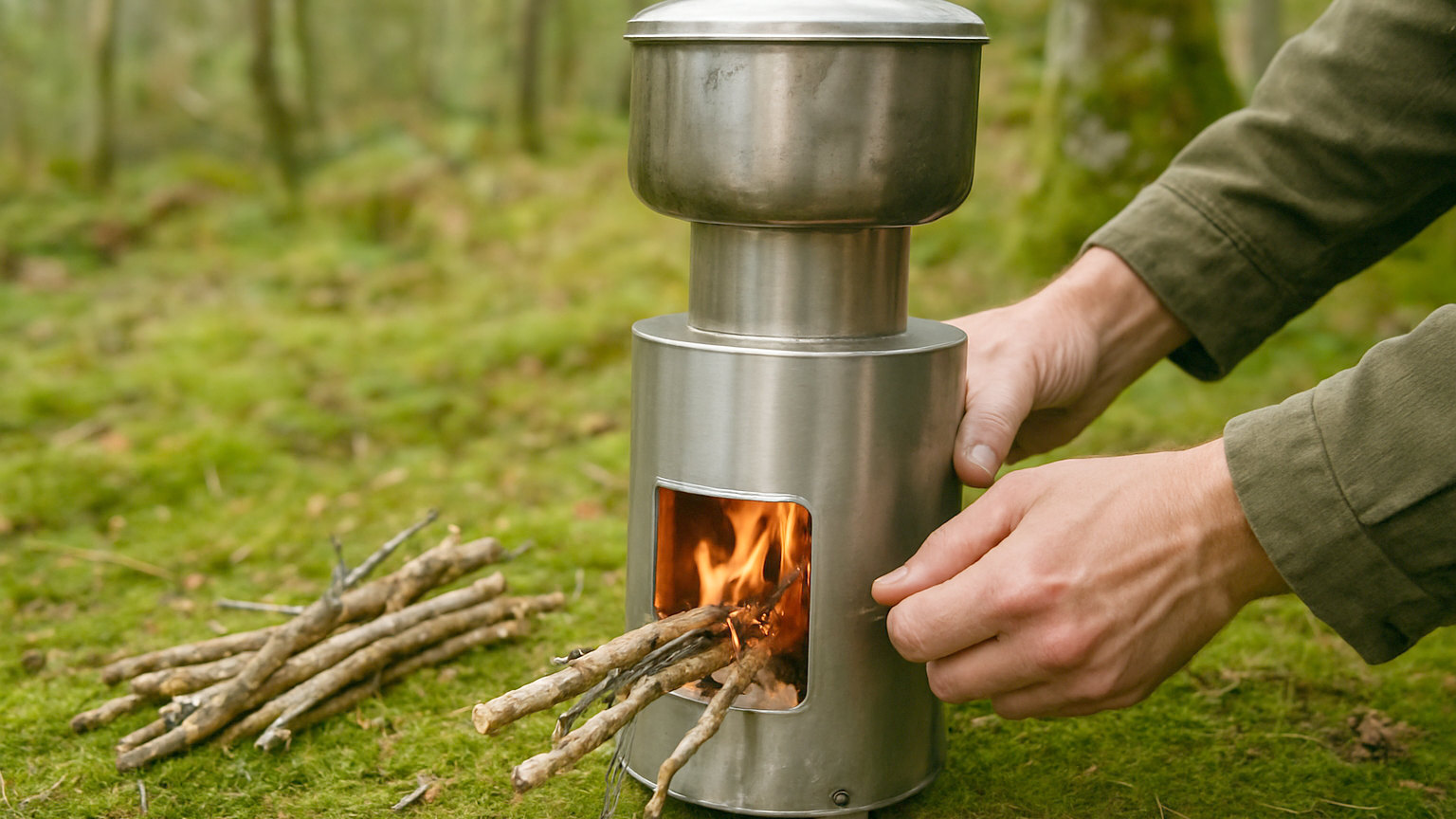
A rocket stove is a simple design that burns small wood far more completely than an open fire, producing high heat from a handful of twigs. It works, it is genuinely efficient, and it demands attention while cooking.
How does it work?
Fuel burns in a short horizontal chamber feeding into an insulated vertical chimney. The insulation keeps combustion temperature very high, so the wood gases burn rather than escaping as smoke, and the chimney creates a strong draught that pulls air through the fuel. The result is near complete combustion, high heat concentrated at the pot, and very little smoke.
What fuel does it use?
Small dry wood, which is the main appeal. Twigs, sticks the thickness of a finger, wood offcuts and pine cones all work, and the stove burns them so efficiently that a surprisingly small quantity boils a large pan. There is no need to split logs or build a substantial fire, and fuel can be gathered as you go in any wooded area.
- Burns twigs and small sticks rather than logs
- Insulated chamber gives near complete combustion
- Very little smoke compared with an open fire
- Needs feeding continuously while cooking
- Outdoor use only, as with any combustion appliance
- Requires genuinely dry fuel to perform
What are the advantages?
Free fuel, high efficiency and independence from any supply chain. A rocket stove needs no gas, no petrol and no cartridges, which makes it the one cooking method that cannot run out provided you have dry wood. It also produces far less smoke than an open fire, which matters in a garden or on a campsite where neighbours are close.
What are the drawbacks?
Constant attention and dry fuel. Because it burns small pieces quickly, someone has to feed it every minute or two throughout cooking, which is fine for a twenty minute meal and tedious for anything longer. Damp wood performs badly and smokes heavily, which in a British winter is a real limitation. The stove body also becomes extremely hot and needs a safe place to stand.
Are commercial ones worth buying?
The good ones are, and there is a wide quality range. Well made stainless steel rocket stoves are compact, durable and effective, and cheap ones are thin, warp with heat and lose the insulation that makes the design work. Look for a genuinely insulated combustion chamber rather than a plain metal tube, which is simply a wood burner in a can and much less efficient.
Can you build one?
Yes, and the designs are widely published. The classic self build uses tin cans with insulation between an inner chimney and an outer body, and larger versions use bricks or a metal drum. Building one is a straightforward project and getting the proportions right matters, since the whole efficiency depends on chamber dimensions and insulation. A commercial stove removes the guesswork.
How does it compare with a gas stove?
Slower to start, cheaper to run, more demanding to use. Gas lights instantly, simmers on demand and needs no attention, and it runs out. A rocket stove takes a few minutes to establish, needs feeding, and will cook indefinitely as long as you can find dry twigs. Owning both covers different failure modes, which is the sensible arrangement.
Who should have one?
Anyone with a garden, access to wood and an interest in cooking outdoors. As a preparedness item it is genuinely valuable because it removes dependence on stored fuel entirely. For a flat with no outdoor space it is impractical, and a gas stove used in a doorway is the better answer.
How do you keep dry fuel for one?
By collecting ahead and storing under cover, since that is the constraint that decides whether the stove is usable. A sack of dry twigs, kindling offcuts or bagged kindling from a garage forecourt kept in a shed costs almost nothing and removes the problem entirely. Damp wood gathered off the ground during a wet week produces smoke and frustration rather than heat, which is the most common reason people conclude the stove does not work.
Buy an insulated stainless model rather than a plain tube, keep dry twigs aside, expect to feed it constantly, and use it outdoors only.


