
Improvised cooking arrangements are a genuine fallback and they are also where people get hurt, so the useful ones are worth knowing alongside a clear sense of their limits.
What is the simplest option?
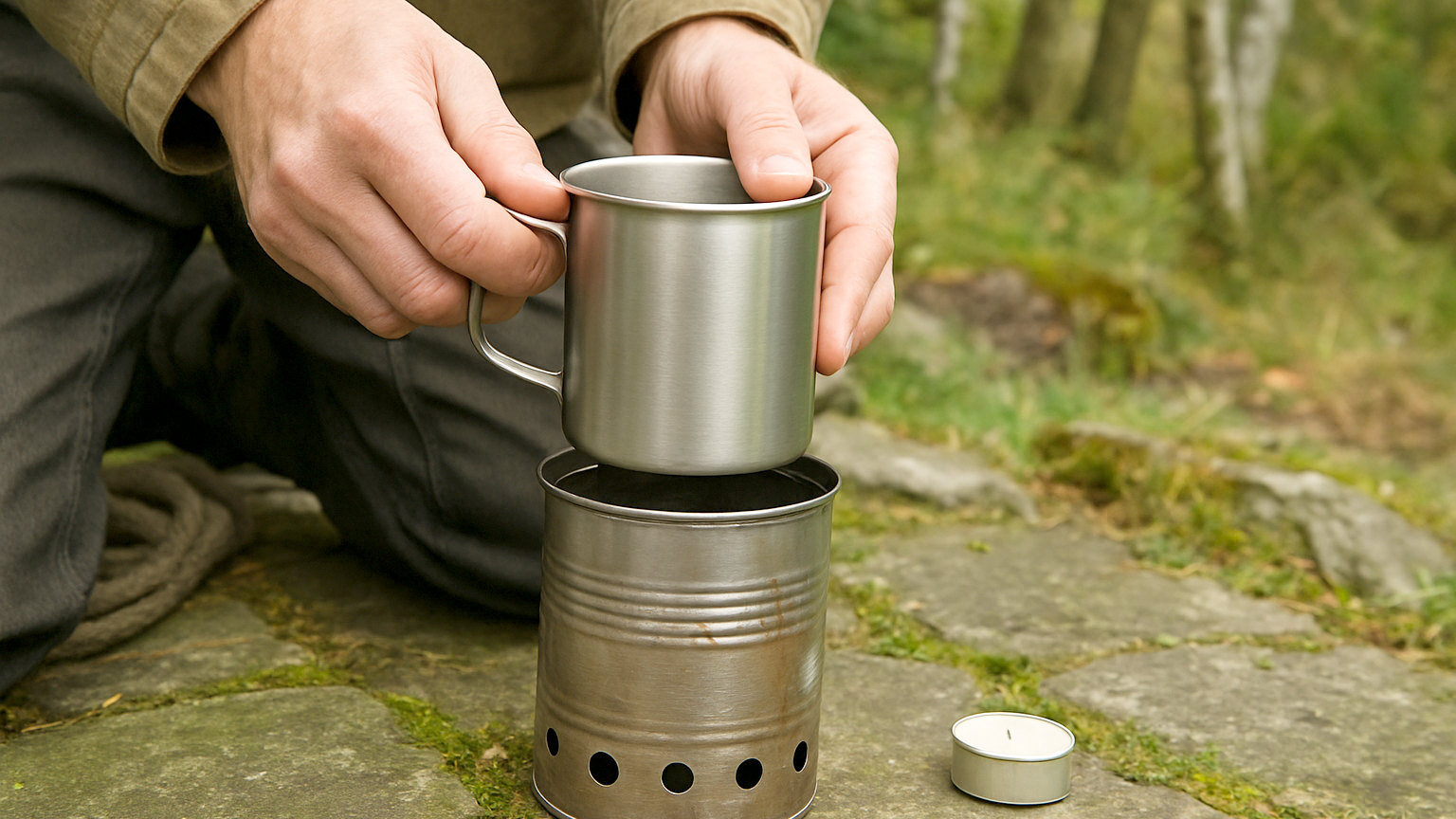
A tin can stove. A large tin with ventilation holes punched around the base and near the top, holding a small fire of twigs or a solid fuel tablet, with a pan resting on the rim. It costs nothing, takes ten minutes to make with a tin opener and a nail, and boils a mug of water perfectly well. Used outdoors on a non flammable surface it is safe and effective.
Do tealight arrangements work?
For warming rather than cooking. Several tealights under a suspended tin will slowly warm soup or a tin of beans, and they will not boil a pan of water in any useful time. They also present a real fire risk if left unattended or placed near anything flammable, and the practice of inverting flowerpots over tealights to heat a room has been strongly discouraged by fire services after fires and casualties. Treat tealights as light rather than as a heat source.
- Tin can stove burning twigs or solid fuel, used outdoors
- Solid fuel tablets, cheap and long lasting in storage
- Retained heat cooking after a short boil on any heat source
- Heating tins directly at the edge of a fire
- Never leave any improvised burner unattended
- Never use any of these in an unventilated room
What about solid fuel tablets?
Genuinely useful and worth keeping. Hexamine and similar tablets are cheap, store indefinitely, take almost no space, light easily and burn for around ten minutes each. A folding solid fuel stove costs very little and packs flat. They smell unpleasant and leave residue, which is why they are unpopular for regular use and entirely acceptable as an emergency backup.
Can you heat food without any burner?
Directly at a fire, yes. An opened tin placed at the edge of an ember bed heats through in a few minutes with no pan at all. Foil parcels cook in ashes. A flat stone heated in a fire will cook an egg or a flatbread. These are practical techniques, and all of them require a fire, which brings you back to the same permission and safety questions.
What is retained heat cooking?
Bringing food to the boil briefly, then insulating the pot heavily so it continues cooking in its own heat. A pot wrapped in blankets in a box, or a purpose made insulated cooker, will keep a stew or rice cooking for hours on ten minutes of fuel. It is the single most fuel efficient technique available and it works with any heat source, which makes it valuable when fuel is short.
What about chemical heaters?
Flameless ration heaters warm a food pouch using a chemical reaction and a little water, producing no flame at all. They are the safest way to get hot food where no cooking is possible, which makes them well suited to a car or a rest centre. They generate hydrogen and should be used with ventilation and not in a sealed space.
What should you not attempt?
Anything involving burning fuel in a closed room, improvised fuel such as petrol or spirits in an open container, or a barbecue brought under cover. Improvised burners using alcohol are particularly risky because the flame is nearly invisible in daylight and spilled fuel spreads burning liquid. If it feels ingenious and unfamiliar, that is usually a warning.
What is the sensible fallback?
A packet of solid fuel tablets and a folding stove in the cupboard, costing a few pounds and taking no space, plus food that needs no cooking. Between them these remove any need to improvise, which is far safer than any technique in this article.
Keep solid fuel tablets as the cheap fallback, use retained heat to stretch fuel, cook outdoors, and never improvise a burner indoors.


