
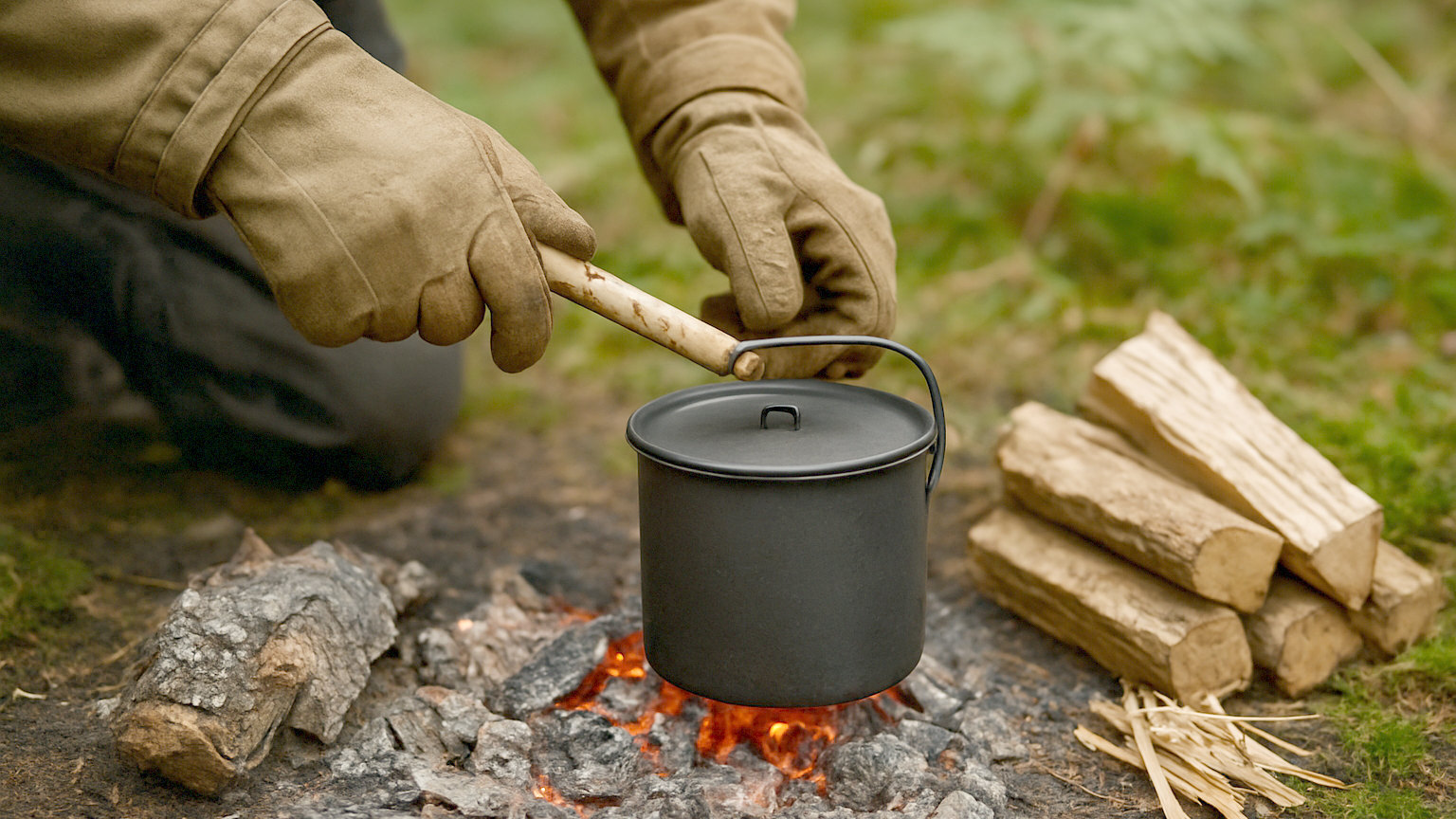
Cooking over wood is entirely practical and is done badly by most people, almost always because they cook over flames rather than embers and build a fire far larger than the job requires.
Why cook on embers?
Because flames are inconsistent, sooty and difficult to control, while a bed of embers radiates steady even heat. Flames lick around a pan and produce hot spots, coat everything in soot and burn food while leaving it raw. Embers give you something close to a hob. Let the fire burn down for twenty or thirty minutes before cooking, which requires patience and produces far better results.
How do you control the heat?
By moving the pan, not the fire. Rake embers into a shallow bed and cook over the thickest part for high heat and the edges for a simmer. Raising the pan on stones or a grill reduces heat, and lowering it increases it. A pot hung from a tripod can be raised or lowered on a chain or a notched stick. This is far more responsive than trying to adjust the fire itself.
- Let the fire burn down to embers before cooking
- Rake a bed of embers and use different parts for different heats
- Raise or lower the pan rather than adjusting the fire
- Use a grill, tripod or flat stones as a stable support
- Expect soot and blacken pans deliberately or bag them
- Cook outdoors only, and never in a tent or under cover
What support do you need?
Something stable, which matters more than anything else. A grill from a barbecue laid on stones or bricks is the simplest and best option. A tripod with a chain suits a single hanging pot. Two parallel logs or flat stones with the pan bridging them works. What you must avoid is balancing a pan of boiling water on something that can shift, since a scald over a fire in an emergency is a serious problem.
What can you cook?
Almost anything, with adjustment. One pot dishes work best. Tinned food heats through directly, and a tin opened and placed at the edge of the embers heats without any pan at all. Foil parcels of vegetables and fish cook well buried in ashes. Bread can be baked in a lidded pot with embers on the lid. Toasting anything on a stick is straightforward and popular with children.
What about the soot?
It is unavoidable and manageable. Pans used over wood blacken permanently, which does no harm and transfers to everything they touch. Either dedicate old pans to fire cooking, or rub the outside with washing up liquid before use so the soot washes off more easily. Carry blackened pans in a bag so they do not mark everything in the pack.
How much wood do you need?
More than expected for cooking and less than for warmth. A cooking fire should be small, and a bed of embers adequate for a meal requires perhaps an armful of dry wood burned down over half an hour. The common error is building a large fire, which wastes wood, is hard to cook on and takes longer to reach a usable state.
What wood should you use?
Dry hardwood for embers, softwood for getting going. Softwoods light readily and burn fast without producing much of an ember bed. Hardwoods such as oak, ash, beech and birch produce dense long lasting embers, which is what you want. Avoid anything painted, treated, or from unknown salvage, since the fumes and residues are genuinely harmful.
Where can you do it?
Where you have permission. There is no general right to light a fire in England and Wales, and byelaws restrict it in national parks, on National Trust land, on nature reserves and on most commons. Scotland permits small fires under the access code with conditions. A garden, a campsite that allows it, or a raised fire bowl are the practical answers.
Burn down to embers, use a stable grill or tripod, control heat by moving the pan, keep the fire small, and check you are allowed a fire at all.


