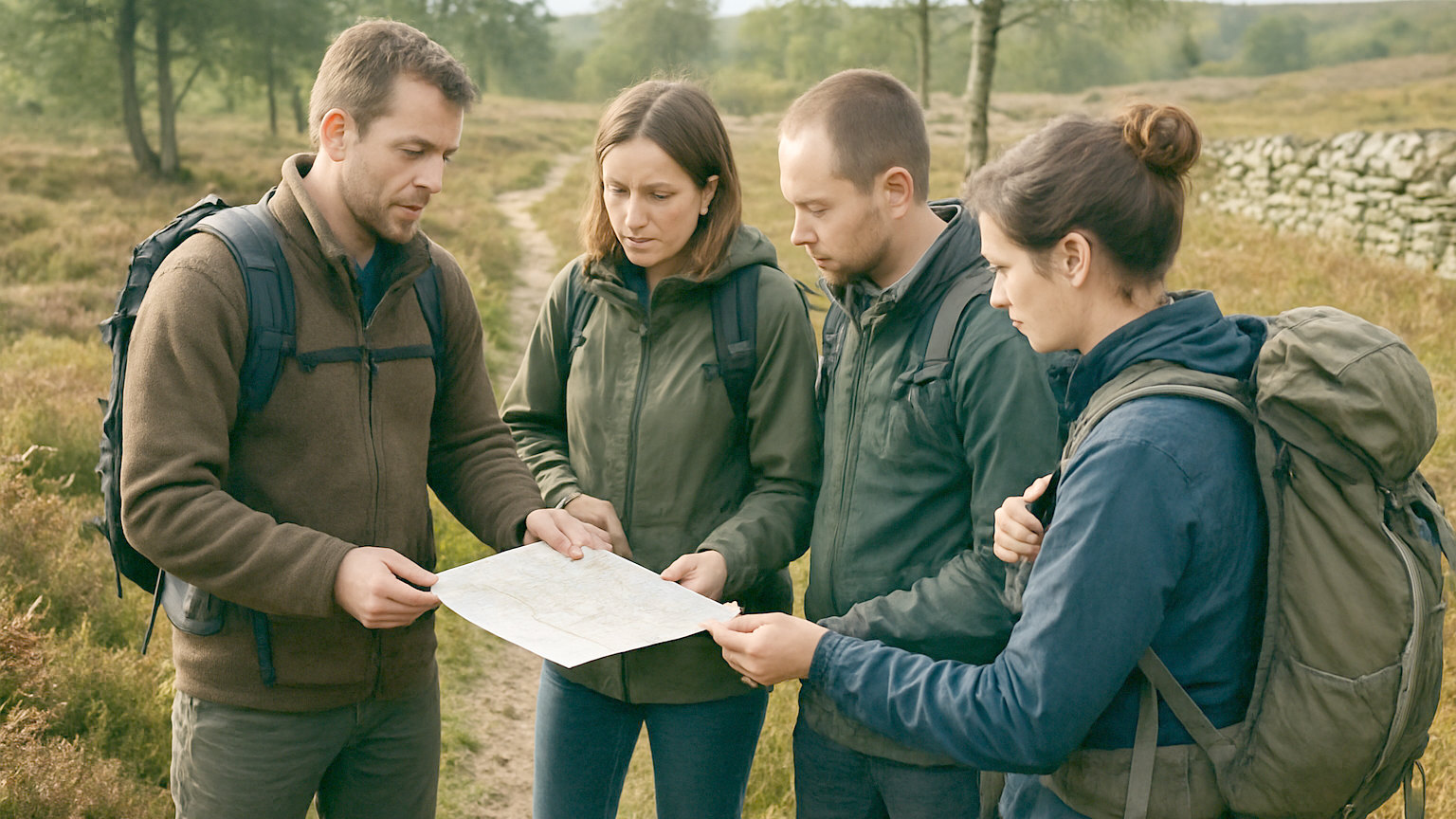
Groups can be an enormous asset or a serious liability in an emergency, and the difference is mostly organisational. Unmanaged groups reliably make worse decisions than an individual would.
Why do groups decide badly?
Because responsibility diffuses. Everyone assumes someone else is monitoring the time, the weather or the person at the back, and nobody raises a concern because nobody else has. The result is a decision nobody actually made, arrived at by drift. Naming one person to decide removes most of it.
Who should lead?
Someone, agreed explicitly, and preferably the most experienced or the least stressed. It does not need to be permanent or formal, and it does need to be stated: I am going to make the calls, tell me if you disagree. In an established group this may already be understood, and in a casual one it almost never is.
- Name one person to make decisions, explicitly
- Say the plan out loud so everyone hears the same thing
- Pace to the slowest member, always
- Count heads at every stop and every transition
- Give people specific jobs, which reduces stress
- Avoid splitting the group unless there is no alternative
Why pace to the slowest?
Because the group moves at that speed regardless, and pretending otherwise splits it. A party strung out over a hillside in poor visibility becomes several parties, and the person at the back is the one most likely to be in difficulty. Put a competent person at the back, keep the front in sight of them, and accept the pace.
How do you avoid separation?
Count heads deliberately at every stop, every junction and every change of ground. Assign a back marker who does not overtake anyone. Agree in advance what someone does if they become separated, which is normally to stop and stay where they are rather than searching. Agree a rendezvous point before you need it.
Why give people jobs?
Because purposeful activity reduces stress and stops people getting cold and worried. Someone puts the shelter up, someone gets the casualty insulated, someone makes the call, someone looks after the children, someone gets food out. Specific instructions to named people work far better than general appeals, which nobody acts on.
How do you handle disagreement?
Hear it briefly, then decide and move. Genuine concerns should be voiced, and a group debating options on an exposed hillside in worsening weather is losing the thing it most needs. Take the input, state the decision and the reason, and act. Reviewing it afterwards is fine, and doing it at the time is not.
What about children in the group?
Assign each child to a named adult rather than assuming shared supervision, which is how children get left behind. Give them jobs, which occupies them and reduces fear. Keep them warm and fed ahead of the adults, since they cool faster. Keep the tone calm, since they read adult behaviour rather than adult words.
When should you split?
Rarely, and only with a clear reason. Sending for help when there is no signal is the main legitimate case, and it should involve at least two people, written details and a clear plan. Splitting because people want to move at different speeds is how one half ends up unaccounted for, and it is the origin of a great many callouts.
What about mixed ability groups?
Plan for the least capable member from the outset rather than discovering the gap on the hill. Ask directly about experience, fitness, equipment and any medical condition before setting off, since people rarely volunteer limitations and frequently overestimate themselves. A route chosen for the strongest member is a route the group cannot do.
How do you brief people beforehand?
Briefly and concretely at the start of the day. Where you are going, roughly how long, what the weather is doing, what to do if separated, and where the rendezvous point is. Two minutes before setting off means everyone has the same picture, and it establishes that decisions get communicated, which makes the difficult ones later far easier to convey.
Name someone to decide, say the plan out loud, pace to the slowest, count heads at every stop, give people jobs, and avoid splitting up.