
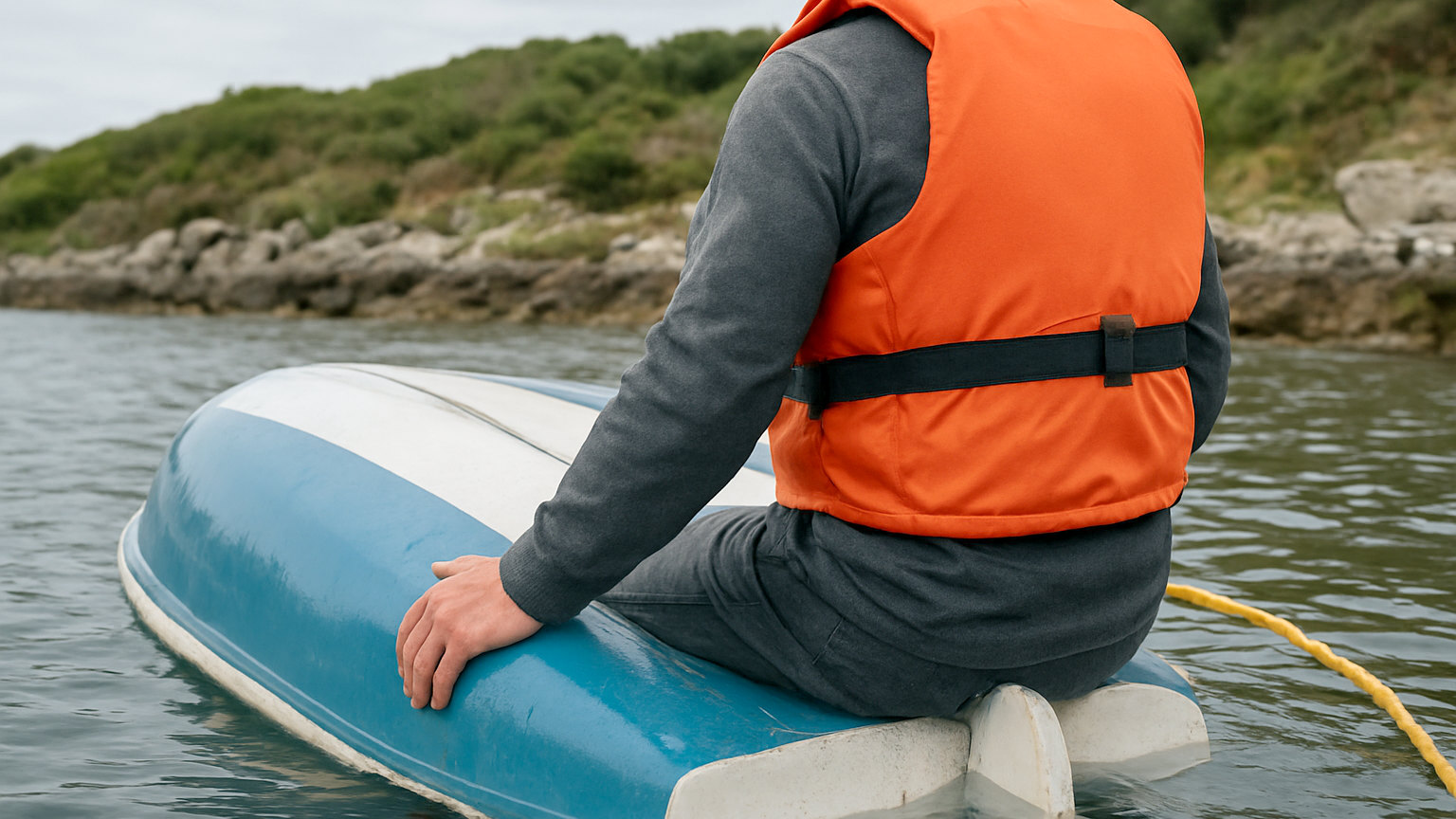
The instinct after a capsize is to swim for shore, and it is almost always wrong. The boat is the best thing available to you in nearly every respect.
Why stay with the boat?
Because it floats, it is dramatically more visible than a head in the water, and it allows you to get part or all of your body out of the water, which slows cooling enormously. Searchers look for vessels. A person swimming away from an upturned hull has given up all three advantages at once.
What comes first?
Account for everyone. Count heads immediately and keep counting, since people can be trapped under the hull, under sails or under rigging. Check inside any enclosed space. If someone is missing, that changes everything and needs to be established at once rather than discovered later.
- Stay with the boat, which floats and is visible
- Count everyone immediately and keep checking
- Get as much of your body out of the water as possible
- Call for help before attempting to right the boat
- Do not swim for shore, which is further than it looks
- Keep everyone together and in the huddle position
Why not swim for shore?
Because distance over water is consistently underestimated, cold water causes swim failure within tens of minutes, and currents can be stronger than anything you can swim against. A shore that looks a few hundred metres away may be far further and take far longer than you can manage. People have drowned close to land after leaving a floating hull.
Should you right the boat?
For a dinghy or a small sailing boat, yes if you can, since a righted boat with a crew aboard is a far better position. Practise it before you need it, since technique matters. For larger vessels, righting is not realistic and staying on or beside the hull is the answer. Call for help first either way.
How do you get out of the water?
Onto anything. The upturned hull, a floating section, the centreboard, a buoyancy bag or a liferaft if you have one. Even getting your torso partially out substantially reduces heat loss, since water conducts heat many times faster than air. This is worth real effort and is frequently overlooked in favour of holding on.
How do you call for help?
With whatever survives. A handheld VHF in a waterproof pouch clipped to a lifejacket, a personal locator beacon, an AIS beacon or a phone in a waterproof case. Fixed equipment on the boat is likely to be underwater or inaccessible, which is the argument for carrying something on your person rather than on the vessel.
What about people trapped underneath?
Look immediately and do not dive under repeatedly in cold water. An upturned hull frequently traps air and a person may be in that space, so knocking on the hull and listening is worth doing. Anyone entangled in rigging needs freeing quickly, which is why a knife on a lifejacket is standard practice for sailors.
How do you prevent it?
Reef early, watch the weather, keep weight low, avoid overloading, and know the limits of the boat and the crew. Most capsizes involve conditions the boat could handle and a crew that was slow to reduce sail or was caught by a gust. Wearing a lifejacket and carrying a means of calling for help are what make the difference afterwards.
What about the engine kill cord?
Attach it, every time, on any powerboat with one. If the helm goes over the side without it, the boat continues under power and circles, which has killed and severely injured people in the water including the person who fell. The cord takes two seconds to clip on and is one of the most consistently ignored safety devices there is.
Stay with the boat, count everyone at once, get as far out of the water as you can, call for help before righting, and never swim for shore.


