
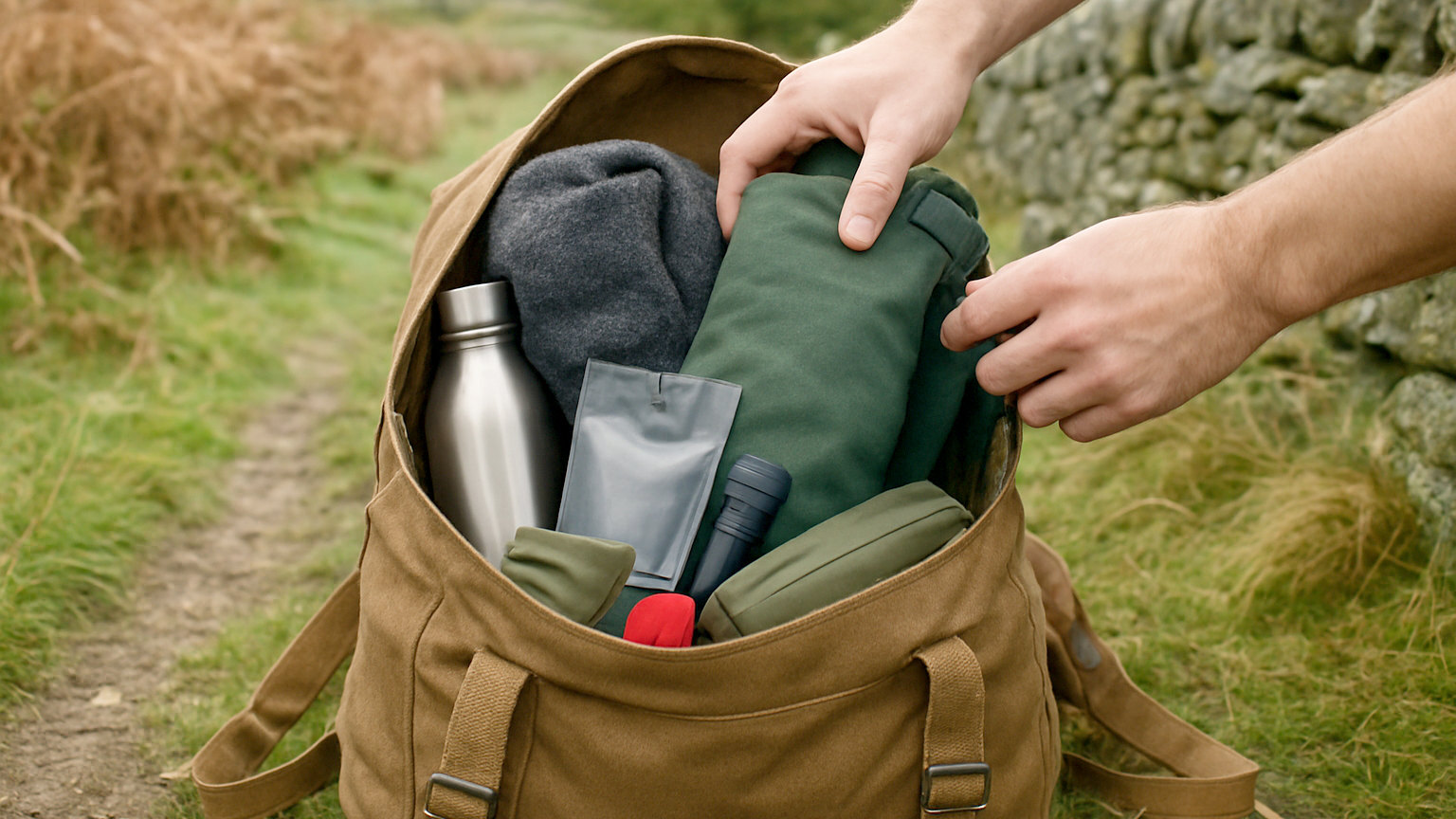
The day walk kit list is short, weighs little and reflects what rescue teams repeatedly find missing. Carrying it costs almost nothing and prevents most of the situations that produce callouts.
What is essential?
Waterproof jacket and trousers, spare warm layer, hat and gloves, head torch with spare batteries, food and water, map and compass, whistle, a group shelter or survival bag, a small first aid kit, and a charged phone with a power bank. That list fits in a twenty five litre pack with room to spare.
Why a torch in summer?
Because walks overrun and a delay of two hours in the afternoon puts you in darkness in autumn and winter, and even a June evening on the wrong side of a hill gets dark under cloud. Being caught out without light is one of the most common causes of a rescue callout, and a head torch weighs a few tens of grams.
- Waterproof jacket and trousers
- Spare warm layer, hat and gloves, whatever the season
- Head torch with spare batteries, every walk
- Map and compass, and the ability to use them
- Group shelter or survival bag
- Food, water, whistle, first aid kit and a power bank
Why a group shelter?
Because it is the highest value safety item available for the weight. A floorless fabric bag that a group sits inside raises the internal temperature dramatically within minutes, deploys in under a minute anywhere, and turns waiting for help from serious to merely unpleasant. Most walkers do not own one and rescue teams consistently wish they did.
How much food and water?
More than you plan to eat, and roughly a litre for a half day or two for a full day, more in heat. Carry something extra that you would not normally eat, kept for emergencies, since a delayed party with nothing left makes worse decisions. Snacks eaten hourly work better than one large stop.
Why a map if you have a phone?
Because a phone is a single point of failure that runs out of battery, breaks, gets wet and can be dropped. Mapping apps are excellent and should be backed by paper and a compass and the ability to use them. A great many callouts involve a party whose phone died, and navigation is the largest single category of callout.
What about a first aid kit?
Small and relevant: blister tape, plasters, a couple of dressings for a bigger wound, painkillers, any personal medication, and a triangular bandage. Anything more elaborate is unnecessary for a day walk. Knowing how to use it matters far more than the contents, and a short course is worth more than an expensive kit.
What can you leave behind?
Most of what the outdoor shop sells. Multiple knives, elaborate fire lighting, a full survival kit, and heavy items you have never used. Weight has a disproportionate effect on how tired you are, and being tired is itself a risk factor. Carry the list above properly and skip the rest.
Does it change in winter?
Substantially. Add more insulation, a warmer hat and spare gloves, a flask, goggles in windy snow, and for any route with snow or ice an axe and crampons plus the training to use them. Winter days are shorter and colder and the margin for error is much smaller, so the kit grows accordingly.
How should you pack it?
With the things you need quickly where you can reach them. Waterproofs, torch, food, map, hat and gloves in the lid or an outside pocket, so stopping to put a layer on takes thirty seconds rather than emptying the pack in the rain. Line the pack or use dry bags, since no rucksack is genuinely waterproof and a rain cover blows off in wind.
What about weight?
Keep it modest, since tiredness is itself a risk factor. Everything listed here together comes to a few kilograms, which is entirely manageable, and packs get heavy through accumulated items nobody uses. Empty the pack occasionally and be honest about what has not come out in a year.
Carry waterproofs, spare layers, a torch, food, water, map and compass, whistle and a group shelter, and leave the survival gadgets at home.


