River crossings are among the most consistently underestimated hazards in British walking. Water that looks manageable from the bank frequently is not, and the consequences of getting it wrong are severe.
Why is water so dangerous?
Because force rises sharply with depth and speed, and because it is difficult to judge either from the bank. Water at knee height moving quickly will take an adult off their feet, and once you are down in cold moving water with a pack on, self rescue becomes extremely difficult. Cold shock also affects breathing and strength within seconds.
When should you not cross?
When the river is in spate, discoloured, carrying debris or noticeably loud. When you cannot see the bottom. When it is above knee height and moving with any force. When there is a hazard downstream such as a fall, a strainer or rapids. When anyone in the party is uncertain. Any of these means find another way.
- Do not cross a river in spate or carrying debris
- Do not cross where you cannot see the bottom
- Look downstream: what happens if you are swept
- Walk upstream or downstream to find a bridge or wider shallower section
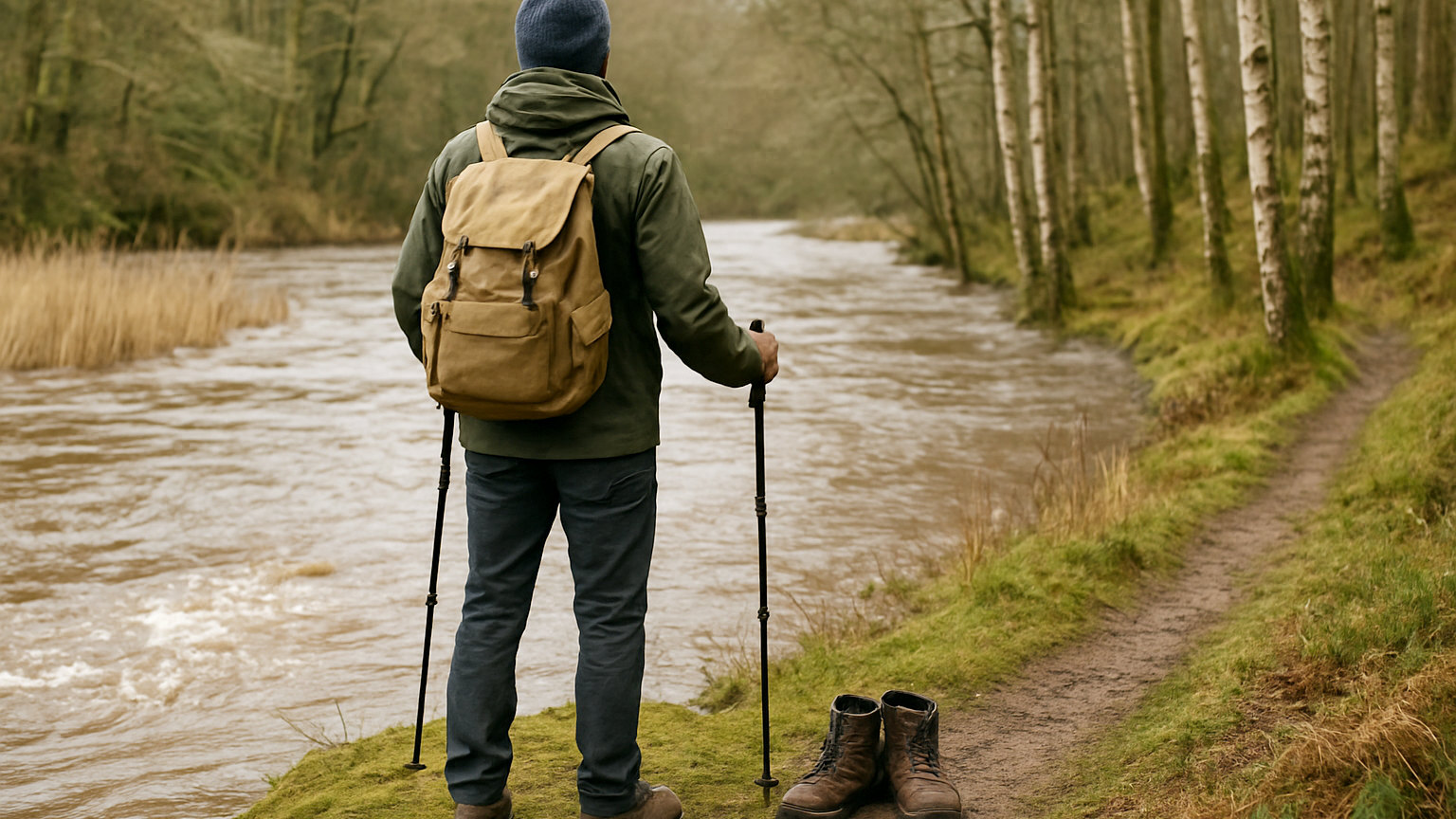
- Unbuckle the waist belt and chest strap before entering
- Waiting for a spate to drop is usually the right answer
What is the alternative?
Walking to a bridge, waiting, or turning back. British rivers in spate drop quickly once rain stops, sometimes within hours, so waiting is frequently viable. Walking a few kilometres to a bridge is inconvenient and rarely as inconvenient as the alternative. Turning back and coming another day is a perfectly good outcome.
If you must cross, where?
The widest, shallowest section, where the flow is spread out, rather than the narrowest, which looks easier and is deeper and faster. Avoid the outside of bends where the water is deepest. Look for a straight section with a clear runout downstream and a bank you can get out onto. Never cross immediately above a fall, rapid or obstruction.
What is the technique?
Unbuckle the rucksack waist belt and chest strap first, so the pack can be shed if you go in. Face upstream and move sideways with a wide stance, using a pole or a stout stick as a third point of contact planted upstream. Shuffle rather than crossing your feet. Keep boots on for grip and protection. Move one point of contact at a time.
What about crossing as a group?
Linking arms in a line facing upstream, with the strongest person at the upstream end breaking the flow, is the standard method and it is considerably safer than crossing alone. Move together and slowly. Never rope people together in a way they cannot release, since that has caused drownings when one person went down and took the others with them.
What if someone is swept away?
Get them to shed the pack, get onto their back with feet downstream to fend off obstacles, and aim for the bank. Do not enter the water to help. Move downstream along the bank ahead of them and try to reach them with a pole or a branch from a stable position. Call 999 immediately and ask for the fire service or the coastguard.
What is the honest advice?
Plan routes that do not require unbridged crossings, particularly after heavy rain, and treat any need to cross as a signal to reconsider the route. Experienced walkers and mountaineers have drowned in British rivers, and almost every case involved a crossing that looked acceptable at the time.
How quickly do rivers rise?
Very quickly in British upland, where steep catchments and saturated ground send rain into watercourses within hours. A stream crossed easily in the morning can be impassable by afternoon after a day of rain, which catches out parties on circular routes. Consider the return crossing before committing to the outward one, and watch the weather upstream as well as overhead.
Turn back or find a bridge, never cross in spate, unbuckle the pack if you must, face upstream with a pole, and treat this as one of the serious hazards.