
Walking in darkness is a normal part of British hill walking for much of the year, either by choice or because the day overran. It is manageable and it changes almost everything.
What changes at night?
You lose the landmarks, the sense of scale and most of the terrain information. Navigation shifts from recognising features to careful compass work, pacing and timing. Ground that reads clearly by day becomes ambiguous, and the small visual cues that keep you on a path disappear. Everything takes longer, and judging distance becomes very difficult.
What torch do you need?
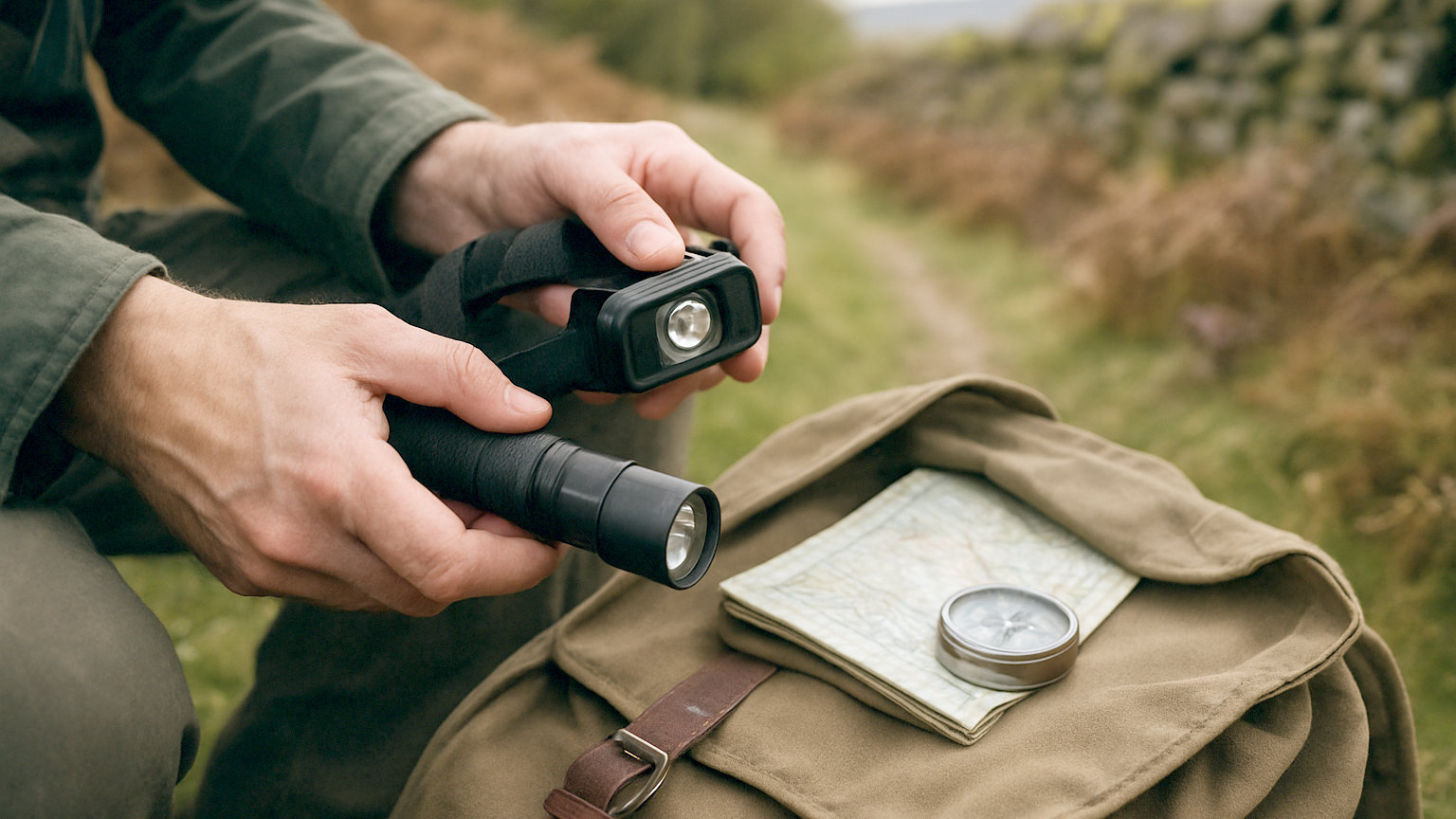
A head torch, so your hands are free, with spare batteries carried separately. Brightness matters less than runtime on a usable setting and a red mode for map reading. Carry a second small torch as a backup, since a failed torch in the dark on rough ground is a serious problem. Keep spare batteries warm, since cold reduces capacity sharply.
- Head torch with spare batteries, plus a backup torch
- Use the lowest setting that works, to preserve night vision
- Use a red mode for map reading
- Slow down substantially and shorten navigation legs
- Watch for the loss of depth perception on descent
- Allow far more time than the daytime estimate
Why use a low setting?
Because full dark adaptation takes twenty to thirty minutes and is destroyed within seconds by bright light. A dim setting preserves it, lets you see beyond the beam, and lasts far longer on the battery. A very bright beam creates a tunnel of light with total darkness beyond, which makes it harder to read the ground and to see companions.
How does navigation change?
It becomes deliberate and short legged. Break the route into two or three hundred metre sections, each with a bearing, a distance and a pace count, and check off each one. Rely on the shape of the ground, slope direction and aspect rather than landmarks. Aim off toward large linear features rather than trying to hit a point.
What are the terrain risks?
Loss of depth perception, principally. Drops, steps and changes in gradient are hard to judge in a beam, and it is easy to walk over an edge or misjudge a descent. Crags, quarries and steep ground that would be obvious by day are invisible. Go slowly, particularly on descent, and use poles to test ground ahead.
Is it worth doing deliberately?
Yes, and practising in good conditions is the best preparation for doing it unintentionally. A night walk on familiar ground in settled weather teaches a great deal about how different navigation becomes, and it is genuinely enjoyable. Deliberate night walking is far better preparation than an unplanned benightment.
How much longer does it take?
Substantially, particularly on rough or pathless ground. Add a large margin to any daytime estimate, and expect descents in particular to take far longer than usual. This matters when planning a walk that finishes in the dark, since the last section is the slowest part of the day rather than the quickest.
What about the group?
Stay closer together than by day, since it is easy to lose sight of someone. Count heads frequently. Avoid shining torches into each other faces, which destroys night vision. Put a competent person at the back, and agree what happens if someone becomes separated, which is normally to stop and use a whistle.
What about the cold?
Temperatures drop after sunset and continue falling through the night, usually reaching their lowest just before dawn. A layer that was ample at four in the afternoon will not be at nine in the evening, particularly once you slow down. Put an extra layer on as the light goes rather than when you start to feel cold, and expect to need more than you would by day.
Carry a head torch and a backup, use a low setting, shorten navigation legs, slow right down on descent, and practise deliberately before you need to.


