
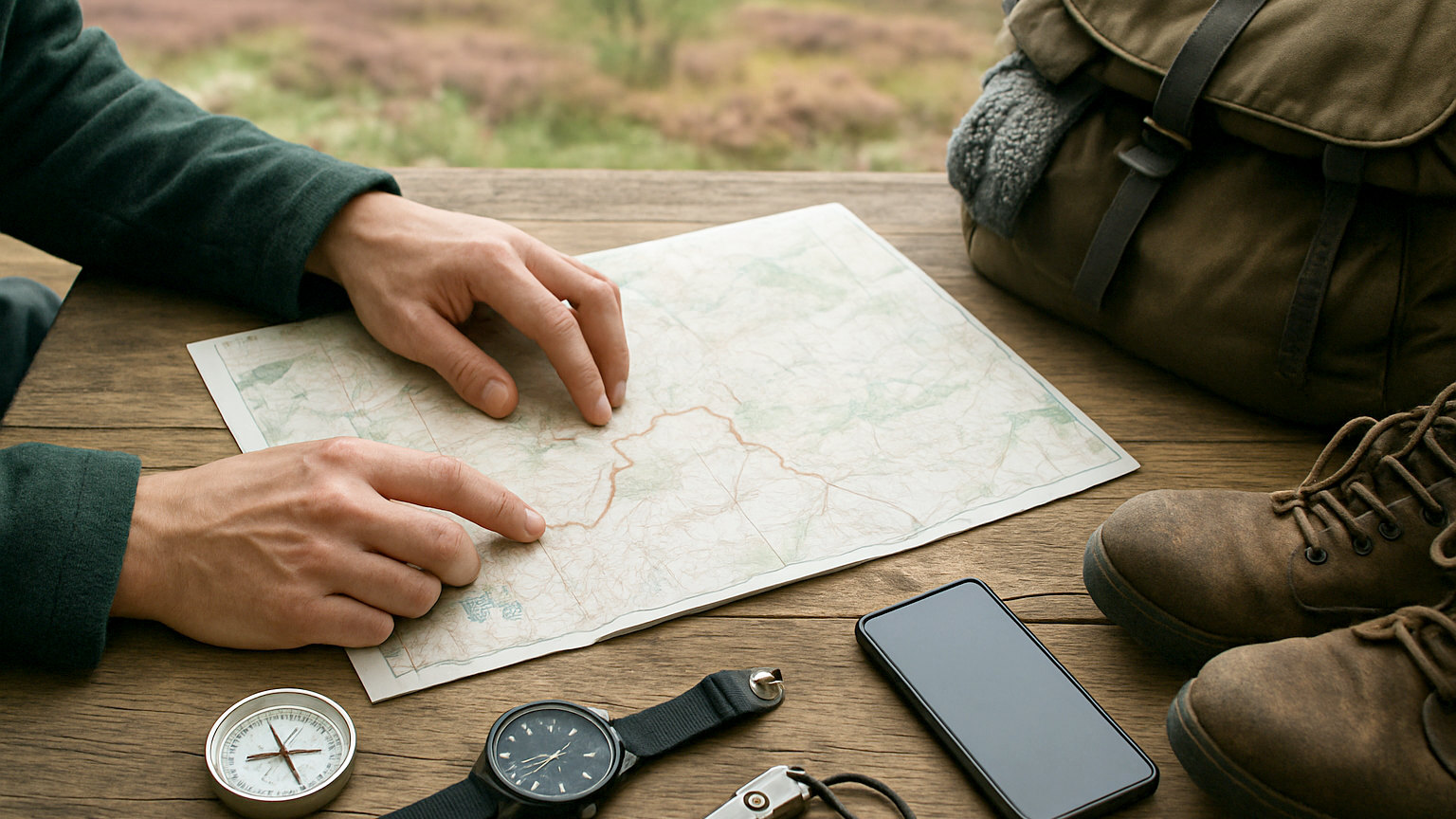
Planning is the least interesting part of walking and the part that determines whether the day goes well. Twenty minutes with a map answers most of the questions that otherwise get answered badly at four hundred metres.
What should the plan contain?
The route, the distance and ascent, an estimated time, escape options, a turnaround time, and a note of who is coming and what they can manage. Written down or at least worked out properly rather than held vaguely in mind. That is the whole of it and it takes very little time once you have done it a few times.
How do you measure the route?
Distance from the map or a mapping app, and ascent by counting contour intervals, which matters more than distance for how long it takes. A ten kilometre walk with a thousand metres of ascent is a considerably bigger day than a fifteen kilometre flat one. Note the total climb rather than just the summit height, since routes go up and down repeatedly.
- Measure distance and total ascent, not just the distance
- Estimate time and add a margin for the party
- Identify escape routes off the high ground
- Set a turnaround time before setting off
- Check daylight hours and work backwards
- Leave the route and return time with someone reliable
What are escape routes?
Ways off the high ground short of finishing the route, identified before you set off and marked on the map. Knowing that there is a descent into a valley at a particular col, and roughly how long it takes, means a deteriorating situation has an answer other than pressing on or retracing everything. This single habit prevents a great many callouts.
How does daylight affect it?
It sets the whole timetable, and British daylight is short for much of the year. Work backwards from sunset, allow for the walk taking longer than estimated, and add margin for the descent, which is slower than people expect when tired. In November a start time of nine leaves considerably less usable light than the same start in June.
How do you match it to the party?
Plan for the least capable person, not the average. A route is only as achievable as the slowest, least experienced or least equipped member can manage, and groups routinely plan for the strongest. Ask directly about experience, fitness, equipment and any medical condition beforehand, since people rarely volunteer limitations and frequently overestimate themselves.
What should you check about the ground?
Whether the route involves anything beyond walking. Look for crags marked on the map, closely spaced contours indicating steep ground, scree, river crossings without bridges, and sections along ridges or edges. A line drawn on a map can cross terrain requiring skills the party does not have, and that only becomes apparent when you look at what the contours are doing.
What about the season?
Treat a familiar summer route as a new route in winter. Snow and ice change an easy path into ground requiring an axe, crampons and the skills to use them, daylight is much shorter, and conditions change faster. Many incidents involve people repeating a route they know well in conditions that made it a different proposition entirely.
Who should you tell?
Someone reliable, with the route, the expected return time and who is with you, and agree what they do if you do not make contact. Without this no search begins. It is the cheapest and most consequential part of planning, and it converts a night out from an emergency into an inconvenience.
Should you have an alternative plan?
Always, and choose it before you leave rather than in a car park in rain. A lower level walk, a shorter version of the same route or a different valley entirely gives you somewhere to go when the forecast turns out worse than hoped. Parties without an alternative tend to attempt the original plan regardless, because the only other option feels like going home.
Measure distance and ascent, estimate time honestly, mark escape routes, set a turnaround time, plan for the weakest member, and tell someone your route.


