
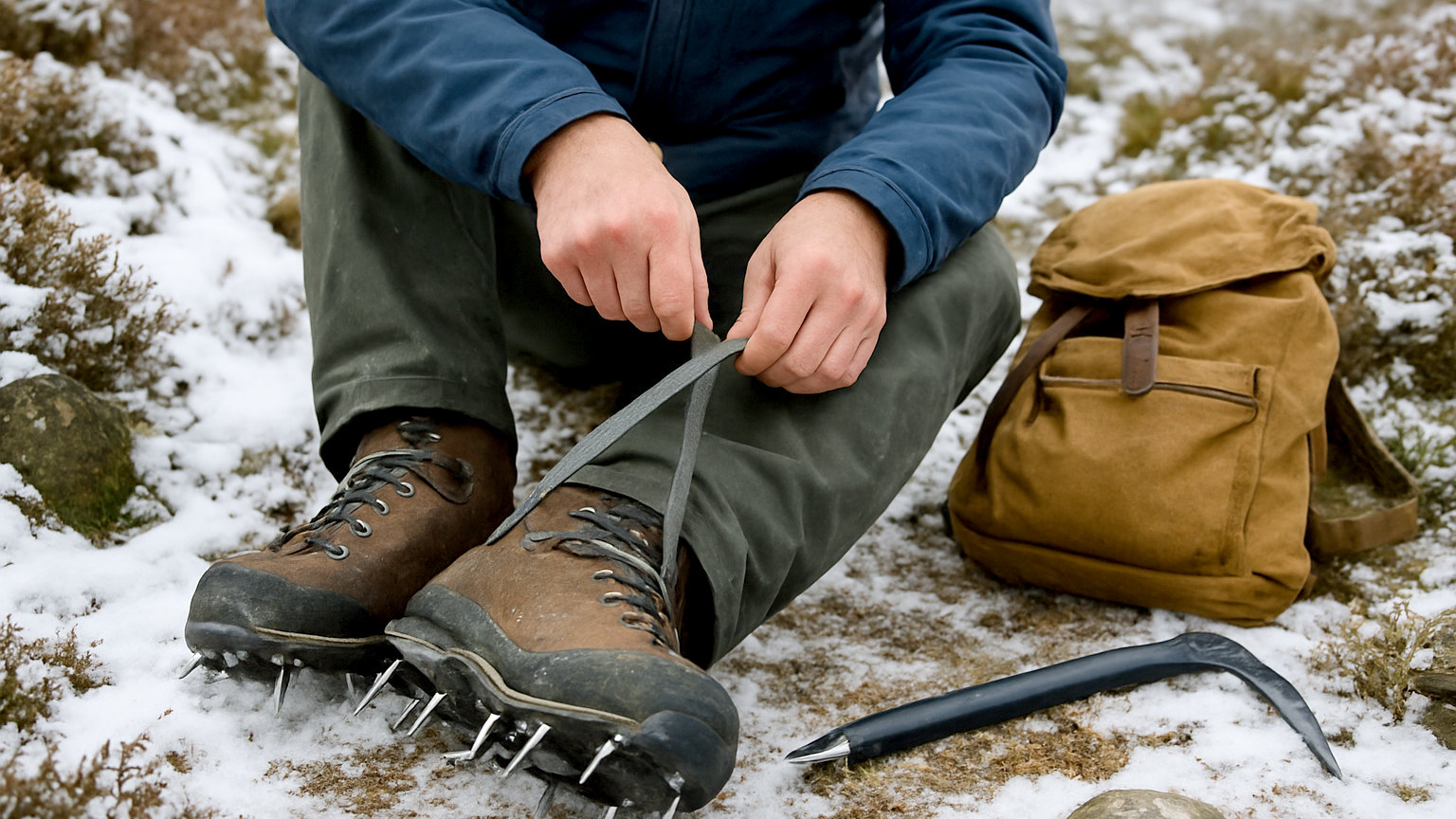
An axe and crampons are the defining equipment of British winter walking, and both are close to useless without instruction. Buying them is the easy part.
When do you need them?
When there is snow or ice on ground where a slip would carry you somewhere you do not want to go. That is the whole test. It is not about altitude or season, and a low hill with an icy path above a steep drop calls for them while a snowy plateau with a flat runout may not. Assess the consequence of sliding.
What does an ice axe do?
Three things. It provides a third point of contact and balance on snow slopes, used like a walking stick with the shaft pushed into the snow. It cuts steps and tests snow. And it allows self arrest, where you use the pick to stop a slide, which is the function everyone thinks of and the one requiring practice.
- Needed wherever a slip on snow or ice would matter
- Self arrest requires practice on a safe slope with a runout
- Carry the axe in your hand, not strapped to the pack
- Crampons must match the stiffness rating of your boots
- Crampon technique needs teaching, not improvising
- A winter skills course is the sensible way to learn
Why does self arrest need practice?
Because it happens in seconds, in whatever position you fell, and the correct response is not intuitive. You may be head first, on your back, or tumbling. Doing it effectively requires having practised on a safe slope with a clear runout until it is automatic, which is exactly what a winter skills course provides and what nobody manages by reading.
Where should you carry the axe?
In your hand, on the uphill side, whenever you are on ground where you might need it. An axe strapped to a rucksack cannot stop a slide that begins without warning, and people have died with an axe on their pack. The moment the ground could require it, it comes off the pack.
How do crampons match boots?
By stiffness rating. Boots are graded by how rigid the sole is, and crampons by what they will fit, using a matching system of ratings. A flexible walking boot will not hold a rigid crampon securely and the crampon will come off, which is dangerous. Take your boots to the shop and get the combination checked rather than buying separately.
What about crampon technique?
It has to be taught. Walking flat footed with all points engaged, angling the feet on traverses, front pointing on steep ground, and above all not catching a point on a gaiter or trouser leg, which trips people at the worst moment. Crampons make you considerably more secure and considerably more likely to fall over if used badly.
What about walking poles?
Useful on approach and no substitute for an axe. Poles help enormously with balance and with the walk in, and they cannot stop a slide. Many winter walkers carry both, using poles on flat ground and swapping to the axe as soon as the terrain calls for it. Stow the poles rather than trying to hold both.
Where should you learn?
On a winter skills course, with an instructor, on a slope chosen for safe practice. Two days covering axe use, self arrest, crampon technique, avalanche awareness and winter navigation transforms what you can safely do, and it is the single highest value training in British hillwalking. Practise the arrest again at the start of each season.
What length axe do you need?
Shorter than instinct suggests for most walkers, typically in the region of fifty to sixty centimetres for a general mountaineering axe. The old test of the axe reaching your ankle when held by the head produces something too long for modern use. Take advice when buying, since length depends on your height and on what you intend to do.
Carry them wherever a slip would matter, hold the axe rather than strapping it on, match crampons to boot rating, and learn both on a course.


